When Doors Alone Are the Right Answer
Replace only the doors and fronts when the boxes are sound and the layout is one you want to keep. Those two conditions do almost all the work in this decision, and they are easy to test yourself in about five minutes.
The structural test is the sink base. Open it, press the floor at its front edge, and look at the back corners. Softness, swelling, delamination or a visible tidemark means water has been at it, and a swollen composite panel does not recover. That cabinet is a replacement, and if one is gone the others under a run frequently are too.
The layout test is more personal. Walk through a normal evening in the kitchen and notice where you are annoyed. If the annoyance is visual, doors will fix it. If the annoyance is "there is nowhere to put the pans" or "I cannot reach the back of that corner", then new doors will leave you with exactly the same kitchen in a nicer colour, which is an expensive way to stay annoyed.
Overlay: the Measurement Nobody Explains
Overlay is how much of the cabinet frame each door covers, and it controls the size of every new door as well as the entire look of the finished kitchen. There are three types and they are not interchangeable without changing hardware.
| Overlay | What you see | Common in | Notes |
|---|---|---|---|
| Partial overlay | A wide band of painted face frame between doors | Most Huntington Beach kitchens built before the 1990s | Forgiving of boxes that are out of square |
| Full overlay | Doors almost touching, a narrow even reveal | Contemporary kitchens and most European systems | Needs a face frame wide and sound enough for the new hinge positions |
| Inset | Doors flush inside the frame, frame visible all round | Traditional and high-end work | Least forgiving; every opening must be square and stay square |
Changing from partial to full overlay is the single most effective way to modernise an older kitchen without touching the carcasses, and it is a very common request here. It means larger doors and new hinges because the geometry changes. It also means the face frame has to be able to carry the new hinge positions, which is usually fine and occasionally is not at one particular cabinet.
Hinge Boring and Why It Decides the Price
A European concealed hinge sits in a circular recess bored into the back of the door, and that recess has both a diameter and a distance from the door edge. If the new doors are bored to match your existing hinges and mounting plates, they drop straight on and the job is quick. If the boring pattern does not match, you need new hinges and usually new plates as well.
Neither outcome is a disaster, but they are different prices and it is better to establish which applies before ordering rather than on installation day. The same goes for the condition of the stiles the hinge plates screw into: hinge screws pull out of tired particleboard, and a stile that will not hold a fixing turns a door swap into a box repair.
Hardware worth naming in the quote
- Hinge brand and series, with six-way adjustment, rather than the words soft close on their own
- Whether new mounting plates are included or the existing ones are being reused
- Drawer runner type if the boxes are changing: full extension undermount rather than side-mount ball bearing
- Corrosion resistant plating where the property is close to the water in Sunset Beach or Huntington Harbour
- Whether handles and knobs are included, and whether existing screw holes will be reused or filled
Door Styles, Briefly
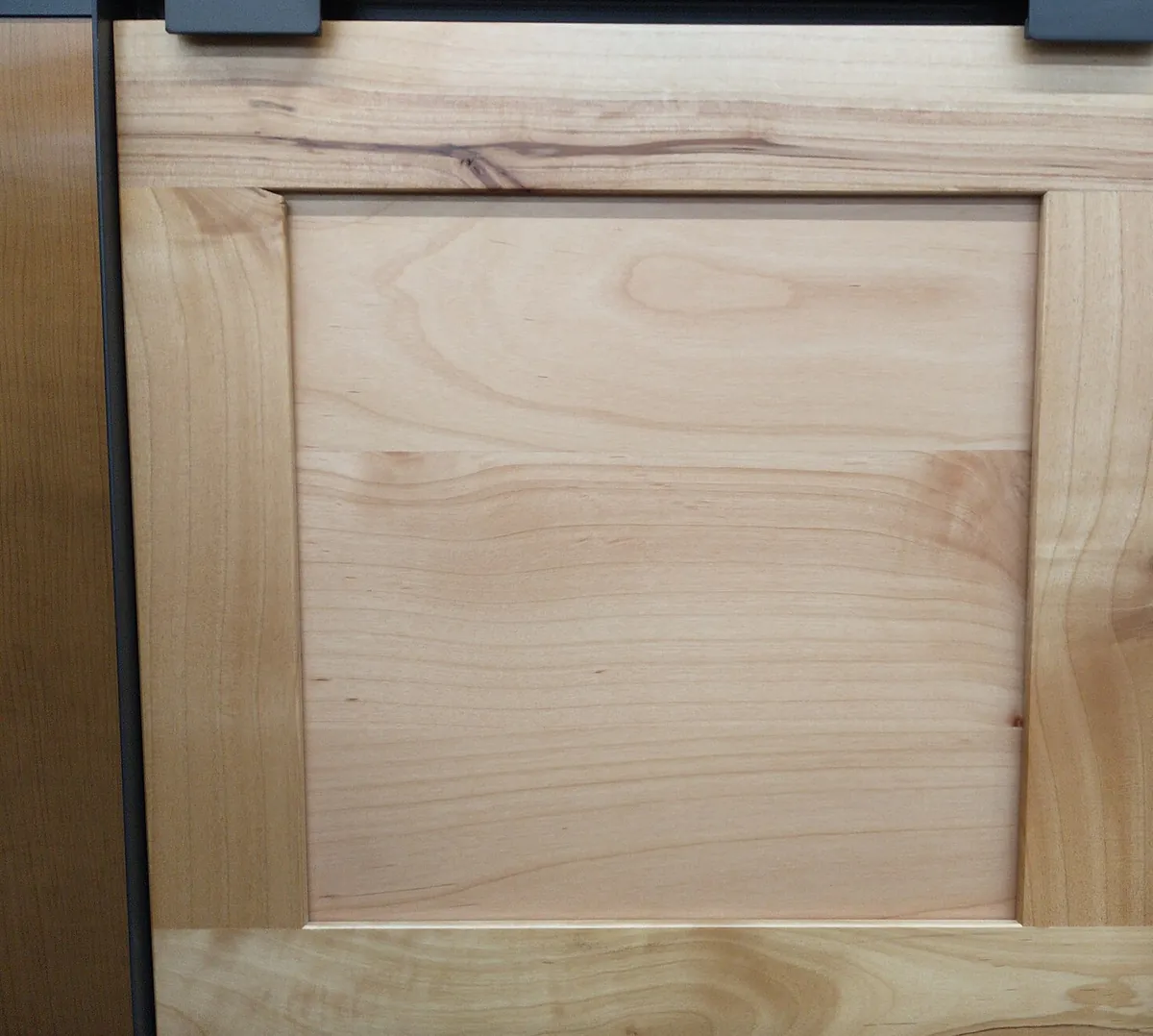
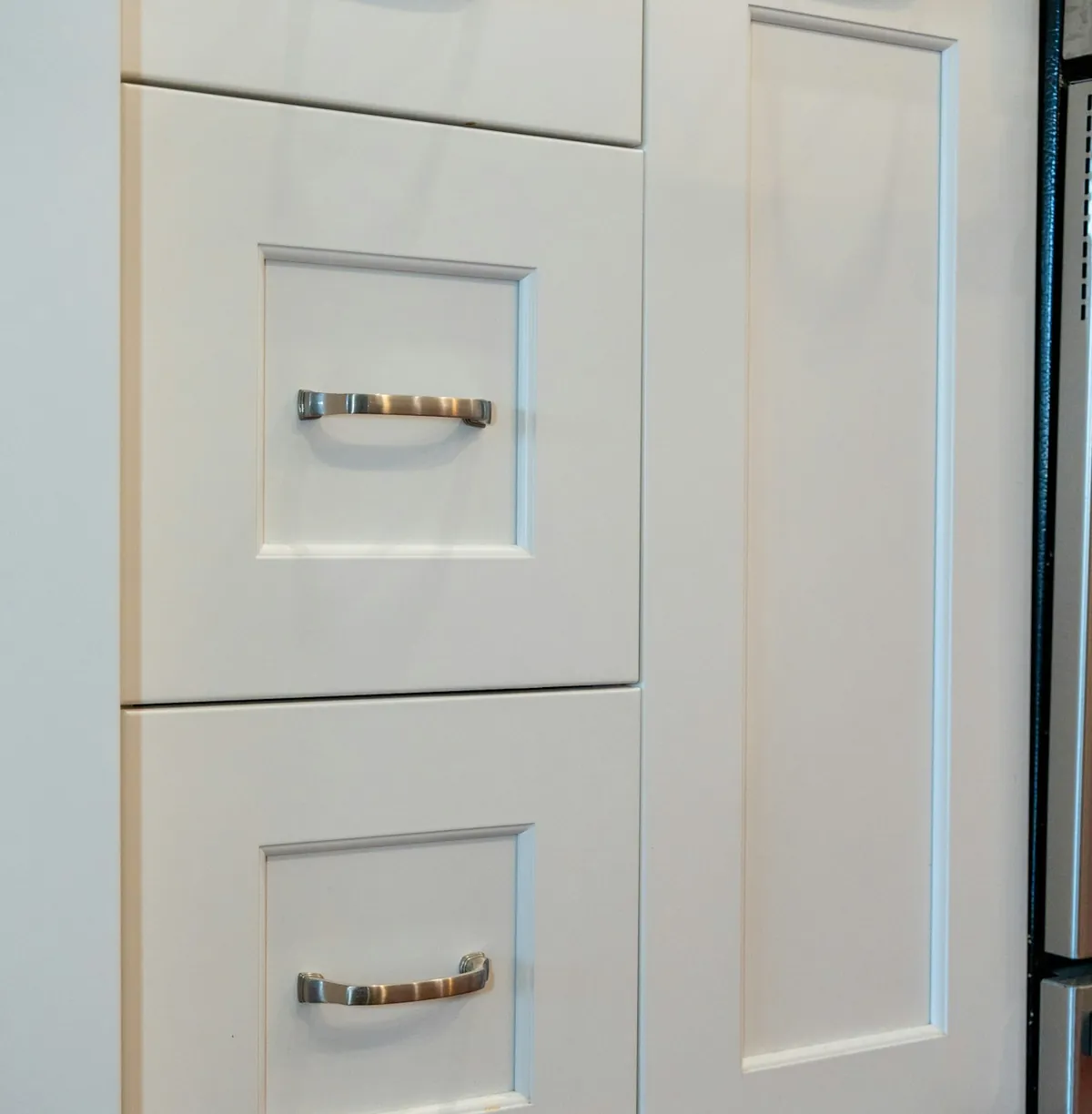
Shaker is the default in this market and deserves to be: a flat centre panel in a square frame is straightforward to build accurately, easy to clean, and stable because there is less shaped surface for a finish to crack over. Slab is cheaper and shows every imperfection in the substrate, which is why it is normally made in MDF or in a veneer rather than in solid wood.
Raised panel and other profiled doors cost more because there is more machining and more finishing surface, and they are the styles most likely to show a hairline crack at the panel shoulder if the wood moves. On the Orange County coast that risk is lower than almost anywhere in the country: the USDA Forest Products Laboratory puts the nearest listed station, Los Angeles, in a 2.3 point annual equilibrium moisture content band, against 8.4 points for Fresno.
The door styles guide goes through all six styles with what each one costs to build and how each behaves, and the coastal moisture guide runs the movement arithmetic.
Substrate and Finish
For a painted door, medium density fibreboard is the better substrate, not the compromise. It is flatter than solid wood, it has no grain to telegraph through the finish, and it machines a crisp, consistent profile. Painted MDF doors on solid boxes is a correct specification, not a cheap one.
For a stained or clear-finished door, solid wood or a good veneer is the only real option, because the grain is the point. Species choice then drives both appearance and price, and the wood species guide compares the common ones on how much each actually moves.
Where the finish is applied decides which South Coast AQMD rule applies. Doors finished in a shop fall under Rule 1136, which caps clear and pigmented topcoats at 275 grams of volatile organic compounds per litre. Doors finished in your house fall under Rule 1113, which caps wood coatings, varnish, sanding sealers and lacquer at 275 each and interior stains at 250. Shop finishing is generally the better result for doors, because they can be sprayed flat, both faces, in a controlled space.
How This Compares to Refacing, Refinishing and Painting
Four services keep your boxes and change what you see, and they get quoted against each other constantly. Doors and fronts is the narrowest of the four: it replaces the doors, the drawer fronts and the hardware, and leaves the visible face frame or box edge exactly as it is.
| Service | Replaces | Leaves alone | Published local range |
|---|---|---|---|
| Doors and drawer fronts | Doors, fronts, hardware | Boxes and the visible face frame | Quoted per door and front |
| Refacing | Doors, fronts, hardware, plus a skin over the face | Boxes only | $1,576 to $2,482, 12 cabinets, laminate |
| Refinishing | The finish on the existing doors and boxes | Everything else, grain stays visible | $1,079 to $6,002, about $4 to $10 per sq ft |
| Painting | The finish, with an opaque coating | Everything else, grain hidden | $1,060 to $5,899, labour $70 to $120 per hour |
Published Huntington Beach cost pages, read at source 30 September 2026. The choice between doors-only and refacing usually comes down to the condition and colour of the visible face frame.
The practical dividing line between doors-only and refacing is the face frame. If the visible frame is in good condition and a colour you can live with, doors alone will do. If the frame is worn, stained or the wrong colour, you need the skin that refacing adds, otherwise the new doors will sit in an old frame and the contrast will make both look worse.