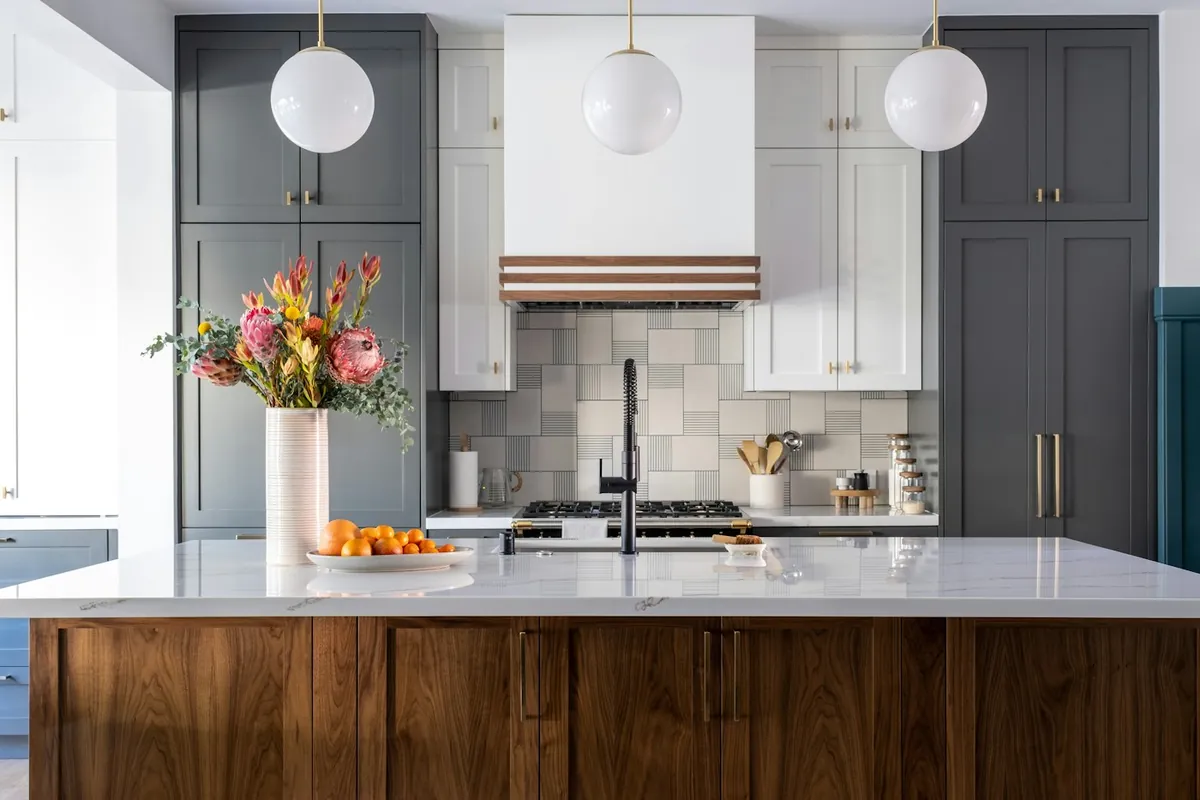
Fourteen Cabinet Services, and When Each One Is Right
Every service below has its own page because a service worth doing is a service worth explaining. What follows is the short version of each, in the order a project usually runs: the whole-job services first, then the room-specific ones, then the face-level work that keeps existing boxes, then installation on its own.
The one decision that governs all of it is whether your carcasses stay. Everything from custom cabinetry down to wet bars assumes new boxes. Doors, refacing, refinishing and painting all assume the boxes stay. Installation assumes somebody else supplied them. Get that decision right and the rest of the list narrows to two or three candidates.
Custom Cabinets in Huntington Beach, CA
Cabinetry drawn to a dimension you supply rather than chosen from a width list.
This is the whole-job service and the one everything else is a subset of. The room is measured on site, an elevation is drawn with every width, height and depth on it, a specification names material and hardware by location, and one price covers the defined scope.
It is worth the premium in Huntington Beach specifically because the tract housing that makes up most of the city's 78,003 housing units was framed fast. Walls lean, ceilings drift, and a fixed width list answers that with filler strips you paid cabinet money for.
Published figure: $500 to $1,500 per linear foot, published Los Angeles area range.
Custom Cabinetsin Huntington Beach →Kitchen Cabinets in Huntington Beach, CA
Full kitchen runs, from a 1960s galley to a rebuilt open plan.
The most common job in this city, and the one where layout matters more than finish. Most original Huntington Beach kitchens were planned around appliance dimensions that no longer exist, which is why so many refacing enquiries turn into rebuilds once somebody measures the run.
A kitchen is priced per linear foot of cabinet run. Measure yours before reading any average: this city has plenty of 12 foot galleys and plenty of 35 foot open plans, and the two are not the same project.
Published figure: Measured per linear foot, with the tier bands in the cost guide.
Kitchen Cabinetsin Huntington Beach →Kitchen Islands in Huntington Beach, CA
Islands and peninsulas planned around clearance, seating and services.
An island is the one cabinet where getting the surrounding space wrong is unfixable. Aisle width, seating overhang, the position of any drain or circuit and the direction every door and drawer opens all have to be settled before anything is cut.
If the island takes a sink or a cooktop it stops being finish work and picks up the trades that need a permit, which changes the shape of the whole project.
Kitchen Islandsin Huntington Beach →Bathroom Vanities in Huntington Beach, CA
Vanities sized to the real wall, with the plumbing notch where your plumbing is.
A vanity is the easiest genuinely custom cabinet to justify, because bathroom walls are short and a two inch shortfall is a quarter of the available storage. It is also the cabinet where a stock unit most often forces a compromise: drawers that stop dead at the trap, or a box that misses the wall by an inch and a half.
Bathrooms are also the room where box material earns its keep, for the same plumbing reason as a kitchen sink base.
Bathroom Vanitiesin Huntington Beach →Built-Ins and Media Walls in Huntington Beach, CA
Bookcases, media walls, window seats and fireplace flanks, scribed into the room.
Built-ins are the service that most changes how a room reads, because a scribed cabinet becomes part of the architecture while a bought unit stays furniture. In single-storey houses with eight foot ceilings, a full-height run is also a real storage gain.
The technical work is almost all in the scribing and the ventilation. Media walls in particular need airflow planned around the equipment rather than around the door layout.
Built-Ins and Media Wallsin Huntington Beach →Closets and Pantries in Huntington Beach, CA
Walk-in and reach-in systems and pantry fit-outs planned around what you own.
Closet work is an inventory problem before it is a cabinet problem. Hanging length, shoe count, folded stack height and long-hang requirement decide the layout, and standard shelf spacing usually wastes a third of the volume.
The NAHB life expectancy study puts closet shelves at a lifetime, which makes this one of the cheapest permanent improvements in a house.
Closets and Pantriesin Huntington Beach →Garage Cabinets in Huntington Beach, CA
Storage that gets the bins off the floor, in materials that suit the room.
The garage is the one room in a Huntington Beach house that is genuinely exposed to outside air, because an uninsulated roll-up door is not a weather seal. That changes the material answer: this is where melamine, laminate and plywood earn their place and where raw MDF does not.
The NAHB study gives garage and laundry cabinets 100 years or more, the longest life expectancy of any cabinet category it lists.
Garage Cabinetsin Huntington Beach →Laundry and Mudroom Cabinets in Huntington Beach, CA
A folding surface, a utility sink base and somewhere for everything that comes off the beach.
Laundry rooms in this building stock are usually narrow and often a pass-through, which makes the depth decision the important one. A 24 inch run in a 30 inch corridor is a different room from an 18 inch run.
In a beach city the mudroom function matters more than it does inland. Sand, wetsuits, boards and towels all need somewhere that is not the hallway floor.
Laundry and Mudroom Cabinetsin Huntington Beach →Wet Bar Cabinets in Huntington Beach, CA
Bars and beverage runs planned around the appliance and the drain you actually have.
A wet bar is defined by its plumbing. A run with a sink is a wet bar and needs a drain, a supply and usually a permit for the plumbing move. A run without one is a dry bar and stays inside the finish work exemption.
Undercounter refrigeration, ice and wine storage each have their own clearance and ventilation requirements, and each one needs a dedicated circuit planned before the cabinet is drawn.
Wet Bar Cabinetsin Huntington Beach →Doors and Drawer Fronts in Huntington Beach, CA
New fronts and hardware on boxes you are keeping, matched and hung properly.
The narrowest service on this list and often the right one. If the boxes are square, dry and laid out the way you want them, replacing only the doors, drawer fronts and hardware changes everything you look at and nothing you paid for.
The constraints are overlay type, hinge boring and the condition of the stiles the hinges screw into. Those three decide whether the job is straightforward or not.
Doors and Drawer Frontsin Huntington Beach →Cabinet Refacing in Huntington Beach, CA
New doors, fronts and face skins over sound existing boxes.
Refacing keeps the carcasses and replaces everything visible, including a veneer or laminate skin over the face frame or box edge. It is the best value job on this list when the boxes pass the test, and a waste of money when they do not.
The published Huntington Beach estimate is specific enough to be useful: a standard 12 cabinet kitchen in a 10 by 12 foot room, priced at roughly 26.2 hours of labour plus materials.
Published figure: $1,576 to $2,482 laminate, 12 cabinets; $131 to $207 per cabinet.
Cabinet Refacingin Huntington Beach →Cabinet Refinishing in Huntington Beach, CA
Strip or scuff the existing finish and put a new one on the same wood.
Refinishing is the right answer when the wood is good and the finish is not: worn through at the handle positions, yellowed on the sun-facing wall, blotchy around the sink. It keeps the grain visible, which paint does not.
It is a preparation job more than a coating job. Most refinishing failures are adhesion failures, and adhesion is decided before the first coat goes on.
Published figure: $1,079 to $6,002, or about $4 to $10 per square foot.
Cabinet Refinishingin Huntington Beach →Cabinet Painting in Huntington Beach, CA
Opaque finishes sprayed to the limits that apply inside the South Coast air district.
Painting covers the grain rather than showing it, which is the point when the wood underneath is mismatched, repaired or simply not attractive. On a sound set of boxes it is the cheapest way to change a kitchen completely.
In Huntington Beach the coating choice is constrained by South Coast AQMD Rule 1113, which caps wood coatings, varnish, sanding sealers and lacquer at 275 grams per litre and interior stains at 250.
Published figure: $1,060 to $5,899, labour at $70 to $120 per hour.
Cabinet Paintingin Huntington Beach →Cabinet Installation in Huntington Beach, CA
Installation only, for cabinets you have already bought.
A completely normal standalone job. You buy the boxes from wherever you like and somebody competent levels them, plumbs them, scribes them to the real walls, fixes them into framing and adjusts the doors so the reveals stay even.
National installer labour runs $50 to $70 per linear foot, or roughly $100 per cabinet box. It is also where a stock kitchen either succeeds or visibly fails, because the filler work is all done at this stage.
Published figure: $50 to $70 per linear foot of labour, national figure.
Cabinet Installationin Huntington Beach →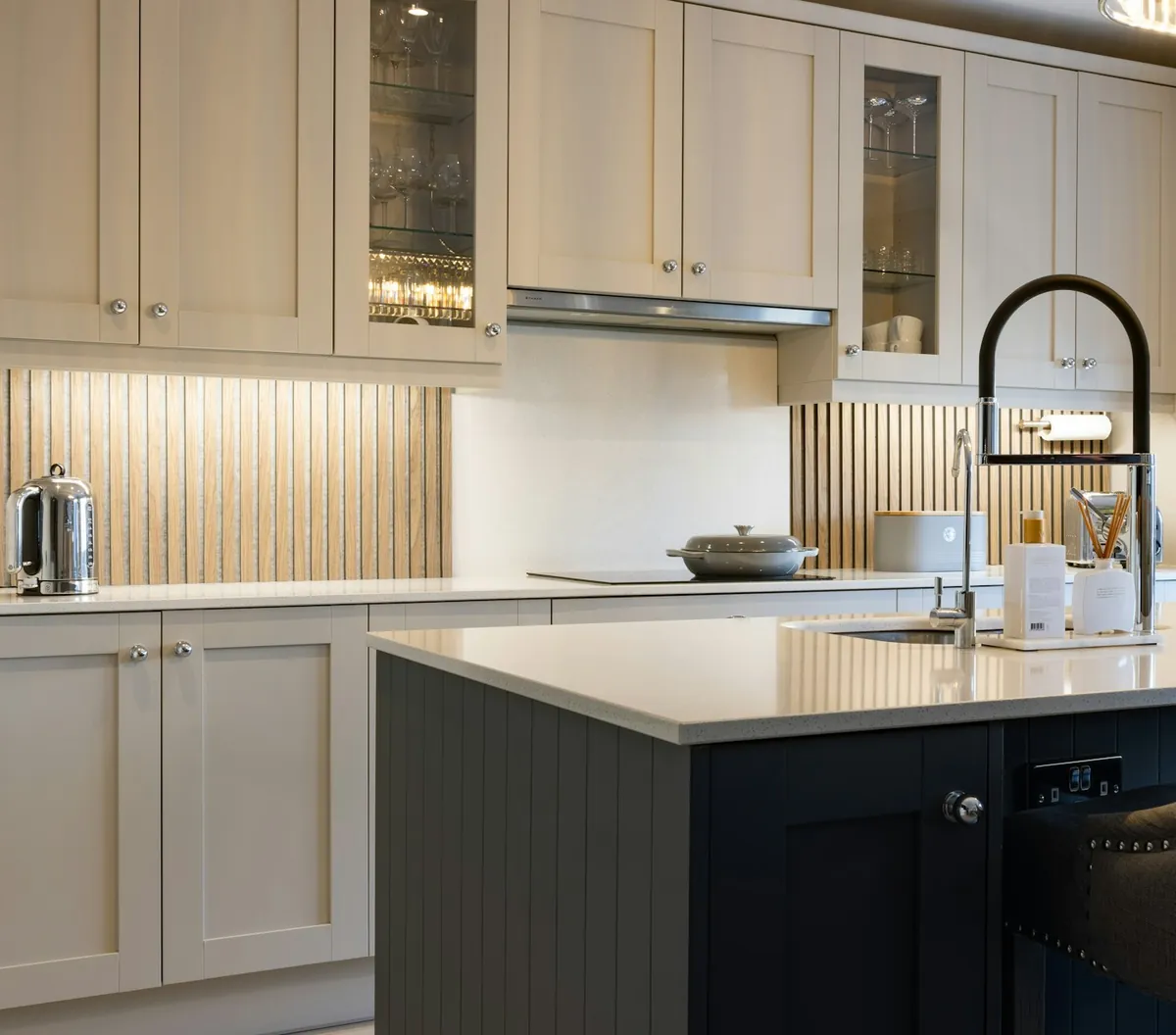
Choosing Between the Face-Level Services
Four services on this list keep your existing boxes and change only what you see, and they get quoted against each other constantly even though they are different jobs producing different results. The table below is the short version; each service page goes into what the work actually involves.
| Service | What it replaces | What it keeps | Published local range |
|---|---|---|---|
| Doors and drawer fronts | Doors, fronts, hardware | Boxes and the visible face frame | Quoted per door and front |
| Refacing | Doors, fronts, hardware, plus a skin over the face | Boxes only | $1,576 to $2,482, 12 cabinets, laminate |
| Refinishing | The finish on the existing wood | Boxes, doors, fronts, grain | $1,079 to $6,002, about $4 to $10 per sq ft |
| Painting | The finish, with an opaque coating | Boxes, doors, fronts, hides grain | $1,060 to $5,899, labour $70 to $120 per hour |
Refacing, refinishing and painting figures come from published Huntington Beach cost pages read at source on 30 September 2026. The refacing estimate assumes 12 cabinets in a 10 by 12 foot kitchen.
The three-question test
- Are all the boxes structurally sound, including the sink base floor? If no, none of the four apply and you are replacing.
- Is the layout right, including drawer positions and corner access? If no, surface work will leave the problem exactly where it was.
- Do you want to keep seeing the wood grain? If yes, refinish. If no, paint, reface or replace the fronts.
The Two Constraints That Apply to Every Service Here
Formaldehyde labelling on every composite panel
Every composite wood panel used in cabinets sold in California has to meet the formaldehyde emission standards in TSCA Title VI, which match California's own CARB Air Toxic Control Measure Phase 2 limits. Since 22 March 2019, covered products have had to be labelled as TSCA Title VI compliant by an EPA-recognised third-party certifier. That applies to a $400 flat-pack box exactly as it applies to a shop-built one, and it is worth asking to see on anything imported.
Coating limits inside the South Coast air district
Huntington Beach sits inside the South Coast Air Quality Management District, and both its finishing rules cap the same number: 275 grams of volatile organic compounds per litre for the clear and pigmented coats that go on cabinets. Rule 1136 covers shop finishing and names cabinets for the kitchen, bath and vanity in its own definition of wood products. Rule 1113 covers coatings applied on site and caps wood coatings, varnish, sanding sealers and lacquer at 275 each, with interior stains at 250.
That constraint applies whether the service is a full custom kitchen or a Saturday repaint, and it is why professional cabinet finishing here runs on waterborne systems. The finishing rules guide sets out both tables.
Guides Behind These Services
Thirteen guides sit behind this list, each written from a source you can open. The ones most people need first are the cost guide, the custom versus semi-custom versus stock comparison, and the permits and licensing page.
The Order These Services Should Be Decided In
Layout first, then cabinets, then doors and hardware, then finish. Skipping that order is the most reliable way to pay for the same decision twice, and it happens on a large share of kitchen projects because the fun decisions are at the end of the list and the consequential ones are at the start.
The classic sequence failure looks like this. Somebody chooses a door style and a colour, gets a quote against them, and only then discovers that the sink needs moving or that a 36 inch range will not fit the opening the 30 inch one left behind. The layout change resets the cabinet schedule, the cabinet schedule resets the door count, and the quote is rebuilt from scratch.
| Decide | What it locks in | Cost of changing it later |
|---|---|---|
| Layout, and whether services move | Permit position, trades involved, the whole budget shape | Highest. It resets everything downstream |
| Cabinet schedule and widths | Run length, tier, drawer versus door split | High. The quote is rebuilt |
| Box material by location | Durability, particularly at the sink base | High once boxes are built |
| Door style and overlay | Door count, hinge type, the whole look | Moderate before manufacture, high after |
| Hardware series | Feel, durability, coastal corrosion resistance | Moderate. Retrofittable but fiddly |
| Finish and colour | Appearance and washability | Lowest of these, and the easiest to defer |
| Interior fittings | Day-to-day usability | Lowest. Most fit an existing carcass later |
Services That Usually Travel Together
Few cabinet projects are a single service, and some combinations save real money because the mobilisation is shared. Others are worth deliberately separating so that one delay does not hold up the other.
- Kitchen and island: always one project, because the island contributes run length and shares the finish schedule
- Kitchen and pantry: usually one project, since the tall run is part of the same elevation
- Vanities and a kitchen: separate rooms, but one visit and one finish batch, which is worth combining
- Garage and laundry: the same material answer applies to both, so specifying them together is efficient
- Refacing and interior fittings: an excellent pairing, because fittings address reach while refacing addresses appearance
- Built-ins and a media wall: one piece of casework, planned around ventilation from the start
Every Published Cost Figure for These Services, in One Table
Three of these services have genuinely Huntington Beach specific published cost figures, and the rest are priced against Los Angeles area or national benchmarks because nothing closer exists. Keeping the geography of each figure attached to it is the whole discipline here, because a national average quoted as a local price is how homeowners end up with a number that does not match a single quote they receive.
| Service | Published figure | Geography of the figure |
|---|---|---|
| Cabinet refacing | $1,576 to $2,482 for 12 cabinets, $131 to $207 per cabinet | Huntington Beach specific |
| Cabinet painting | $1,060 to $5,899, labour around $70 to $120 per hour | Huntington Beach specific |
| Cabinet refinishing | $1,079 to $6,002, about $4 to $10 per square foot | Huntington Beach specific |
| Custom cabinetry | $500 to $1,500 per linear foot | Los Angeles area published guide |
| Installation labour | $50 to $70 per linear foot, about $100 per cabinet box | National |
| Whole installation, typical | $482 to $2,167, most people around $1,044 | National |
| Custom cabinet project, typical | $1,447 to $5,294, most homeowners around $2,817 | National |
| Semi-custom cabinetry, installed | $150 to $900 and up per linear foot | National |
| Stock cabinetry, installed | $75 to $400 and up per linear foot | National |
| Custom cabinetry, installed | $500 to $1,400 and up per linear foot | National |
| Cabinet removal | Around $300 | National |
| Crown moulding | About $70 per 8 foot section | National |
| Finished ends | $100 to $200 each | National |
Huntington Beach figures from three published city cost pages for refacing, painting and refinishing, read at source 30 September 2026. Los Angeles per-linear-foot range from a published Los Angeles cabinet maker's cost guide. National figures from a published cost source last updated 8 July 2026. The three tiered per-linear-foot figures are installed cost per LINEAR FOOT, not per cabinet.
Two readings of that table are worth stating because they change decisions. First, the three box-keeping surface services all start in the same $1,000 to $1,600 region locally, which means price is not how you choose between them. What separates refacing, refinishing and painting is what happens to the existing doors: refacing replaces them, refinishing renews the finish on them and keeps the grain visible, and painting hides the grain under an opaque film. Choose on that, then check the price.
Second, the gap between keeping the boxes and replacing them is an order of magnitude, not a percentage. Refacing 12 cabinets locally is $1,576 to $2,482. A 25 linear foot custom kitchen at the Los Angeles published band is $12,500 to $37,500. That is the single most useful number on this page for anyone deciding how far to take a project, and it is why the first question on every enquiry here is about the condition of the carcasses rather than about a style.
A published Los Angeles guide also breaks the per-linear-foot market into tiers with an expected service life attached to each, which is a more useful framing than a single average. It gives budget cabinetry at $75 to $150 per linear foot with a 5 to 10 year lifespan, semi-custom at $150 to $650 with 15 to 25 years, premium at $300 to $800 with 20 to 30 or more years, and luxury at $500 to $1,500 and up with 30 to 50 or more years. The same guide puts project totals at $7,500 to $22,500 for a small 15 linear foot kitchen, $12,500 to $37,500 at 25 feet, $17,500 to $52,500 at 35 feet, and above $75,000 for luxury work over 50 feet, and describes Los Angeles pricing as about 25 percent higher than a national figure it gives as $400 to $1,200 per linear foot. Those are one Los Angeles maker's published figures rather than a survey, and they are labelled as such throughout this site.
The Coastal Climate Question, Answered Once for All Fourteen Services
Coastal Southern California is one of the most dimensionally stable places in the country to own wooden cabinetry, which is the opposite of what almost every cabinet advertisement in a beach city implies. That matters here because the claim gets attached to all fourteen of these services as a reason to spend more, and for most of them it is not true.
The published data comes from the USDA Forest Service Forest Products Laboratory Wood Handbook, which tabulates equilibrium moisture content for outside conditions at United States stations, based on average relative humidity and temperature data over 30 or more years from the National Climatic Data Center, averaging morning and afternoon values. The nearest listed station to Huntington Beach is Los Angeles, in the same coastal basin marine-layer regime.
| Station | Annual range | Band |
|---|---|---|
| California, Los Angeles | 9.4% to 11.7% | 2.3 points |
| Alabama, Mobile | 13.1% to 14.3% | 1.2 points |
| Florida, Miami | 12.2% to 14.4% | 2.2 points |
| Illinois, Chicago | 12.3% to 15.1% | 2.8 points |
| Arizona, Phoenix | 4.4% to 9.0% | 4.6 points |
| Nevada, Las Vegas | 3.7% to 8.3% | 4.6 points |
| California, Fresno | 15.8% (Jan) down to 7.4% (Jul) | 8.4 points |
Source: USDA Forest Service, Forest Products Laboratory, Wood Handbook FPL-GTR-282, Chapter 13, Table 13-1, equilibrium moisture content for outside conditions through 2010.
Two things in that table are worth sitting with. Coastal Los Angeles has a narrower annual band than Chicago, Phoenix, Las Vegas and Fresno, and its wettest months are the summer months rather than the winter ones, which is unusual. And Fresno, three and a half hours inland in the same state, swings nearly four times as far. Wood in this basin barely moves by national standards.
The Handbook lets this be quantified rather than asserted. It publishes a dimensional change equation, valid between 6 and 14 percent moisture content, in which the change equals the starting dimension multiplied by a species coefficient multiplied by the change in moisture content. Running that for a 24 inch wide flat-sawn panel across the measured 2.3 point Los Angeles band gives 0.137 inches in black cherry, 0.151 in black walnut, 0.195 in sugar maple, 0.208 in white oak and 0.238 in American beech. The same sugar maple panel across Fresno's 8.4 point band moves 0.712 inches.
So what does the coast actually change?
Hardware, and only hardware. Salt-laden air attacks plated steel, which means hinges, drawer runners and pulls have a shorter life near the water than inland. That is a specification decision, not a reason to avoid wood, and it is worth taking seriously at the Sunset Beach and Huntington Harbour end of the city where properties sit closest to the water.
| Service | Does the coast change the decision? | Why |
|---|---|---|
| New cabinetry and kitchens | Hardware only | Wood movement is low here; plating life is the real variable |
| Bathroom vanities | Hardware, and the box material | A wet room plus coastal air is the one place both matter |
| Laundry and mudroom | Hardware, and ventilation | Beach gear arrives wet, so airflow beats sealed doors |
| Refacing and door replacement | Hardware only | New hinges on every front are part of the job anyway |
| Refinishing and painting | No | Film performance is a preparation and product question, not a climate one |
| Installation only | No, beyond normal acclimatisation | Reveals set here stay set, because seasonal travel is small |
| Garage cabinets | Slab moisture more than salt air | The floor is the moisture source, not the atmosphere |
Assessment based on the published Wood Handbook figures above. Hardware plating life near the ocean is a materials-selection judgement, not a published figure.
The Handbook adds one caveat that applies to every service on this page. Its recommended interior values are based on measurements in well-ventilated buildings without unusual moisture sources and without air conditioning, and in air-conditioned buildings moisture conditions depend largely on the proper sizing of the air-conditioning equipment. A leak under a sink, a bathroom with no extraction or a dryer venting into the room are the unusual moisture sources that genuinely damage cabinetry in this city. The ocean is not one of them. The wood movement guide works through the full tables and the arithmetic.
Everything That Governs Cabinet Work in Huntington Beach, On One Page
Eight separate bodies of rule touch cabinetry in this city, and no competitor page in this market lists more than one of them. They are collected here because knowing which rule applies to which service is the difference between reading a quote and guessing at it.
| Rule | What it sets | Services affected |
|---|---|---|
| California Residential Code R105.2 | Lists cabinets and similar finish work as exempt from permit | All of them, until services move |
| EPA Renovation, Repair and Painting Rule | Firm certification and trained renovators for paid work disturbing paint in pre-1978 homes | Refacing, refinishing, painting, installation, any strip-out |
| CALGreen section 4.504.5 | Numerical formaldehyde ceilings on composite wood panels | Every service that supplies a panel |
| TSCA Title VI and CARB ATCM | Third-party certified compliance labelling on composite wood since 22 March 2019 | Every service that supplies a panel |
| South Coast AQMD Rule 1136 | 275 g/L on shop-applied wood coatings; names kitchen, bath and vanity cabinets | New cabinetry, doors and fronts, shop refinishing |
| South Coast AQMD Rule 1113 | 275 g/L on wood coatings, varnish, sealers and lacquer applied on site, 250 on interior stain | On-site painting, refinishing, touch-up |
| CSLB classification C-6 | Cabinet, Millwork and Finish Carpentry licence scope | Whoever performs any of it |
| Business and Professions Code 7048, 7159, 7159.5 | Licence exemption limit, written contract threshold, deposit cap | Every contract over five hundred dollars |
Every rule in this table was read at its own source on 30 September 2026. Individual guides on this site quote the operative provisions.
The one nobody mentions: lead paint in a pre-1978 house
Four of the services on this page disturb painted surfaces, and in a pre-1978 Huntington Beach house that makes them federally regulated. The EPA states that in 1978 the federal government banned the sale of lead-based paint for use in homes, childcare facilities and preschools, and that approximately three-quarters of homes built in the United States before 1978 still contain some lead-based paint.
The Renovation, Repair and Painting Rule requires anyone paid to perform work that disturbs painted surfaces in those homes to be certified, with employees trained in lead-safe work practices, and the agency is explicit that this includes all firms, even sole proprietorships. It names general contractors and special trade contractors including painters, plumbers, carpenters and electricians, and its list of covered activities includes remodeling and repair or maintenance, carpentry, painting preparation, electrical work, plumbing, and window replacement.
There is a minor-work exemption for activities that disturb six square feet or less of paint per room inside, or 20 square feet or less outside, but it carries a carve-out that removes it from most real cabinet jobs: the EPA states that demolition of painted surfaces is always covered regardless of square footage. Taking an old painted kitchen off the walls is demolition of painted surfaces.
The rule's default also runs the opposite way to how people assume. Paint testing is not required, but unless you hold documentation that the paint is not lead-based, the requirements of the rule apply. California is not one of the states authorised to run its own programme, so the EPA administers it here directly, and the National Lead Information Center takes questions on 1-800-424-5323.
Certification: the One Independent Check Across All Fourteen Services
Whichever of these services you buy, if a new cabinet or a new door is being supplied, there is exactly one third-party performance standard you can ask about by name. The Kitchen Cabinet Manufacturers Association runs the ANSI/KCMA A161.1 Quality Certification, described by the association as covering rigorous tests of structural strength, drawer and door integrity, and finish durability.
KCMA publishes two numbers that make the seal informative rather than decorative. Certified cabinets have passed 14 rigorous tests, including a 600-pound load test, to simulate a lifetime of use. And between 40 and 50 percent of cabinets fail their first certification attempt. The association also states that certified cabinets are available at every price point, from builder-grade units to high-end custom designs, so asking about it is not an invitation to be upsold, and that it acts as a mediator to facilitate a resolution with the manufacturer where a homeowner has an issue with a certified cabinet.
Two other seals exist and one of them matters for particular jobs on this list. The Severe Use Certification was, in KCMA's account, originally developed by the United States Department of Housing and Urban Development, and provides confidence that kitchen cabinets can withstand the exceptionally high levels of wear that apartment building kitchens often encounter. For a rental unit or a hard-used family laundry room, that is the more relevant benchmark. The Environmental Stewardship Program certifies manufacturers adhering to sustainability practices.
What Each Service Buys You, in Years
The published life expectancy figures make the comparison between these services much clearer than any price list does, because they show which components are the long-lived part of a kitchen and which are not.
| Component | Expected life |
|---|---|
| Closet shelves | A lifetime |
| Natural stone countertops | A lifetime |
| Garage and laundry cabinets | 100 or more years |
| Kitchen cabinets | Up to 50 years |
| Medicine cabinets | 20 or more years |
| Cultured marble countertops | About 20 years |
Source: NAHB and Bank of America Home Equity, Study of Life Expectancy of Home Components, February 2007, from a comprehensive telephone survey of manufacturers, trade associations and researchers conducted in summer 2006.
The study attaches caveats that most citations drop, and they change how the numbers should be read. Many of the people interviewed emphasised that the life expectancy of housing components is greatly affected by the quality of maintenance, and noted that changing consumer preferences can result in products being replaced long before, or after, the end of their practical life expectancy. The study also states that life expectancies depend on the quality of installation, the level of maintenance, weather and climate conditions, and the intensity of use.
Used as a ranking rather than a guarantee, those figures explain the logic of the whole service list. The carcass is the durable part, which is why four of these services exist to keep it. The face and the hardware are the parts that date and wear, which is why refacing and door replacement are good value when the carcass is sound. And a countertop is a shorter-lived component than the cabinet under it, which is why replacing a top is a normal event in the life of a kitchen rather than a sign that something failed.
Where These Services Are Available
All fourteen run across Huntington Beach and the Orange County cities around it. Each area page covers what is different about working there, which in a city like Sunset Beach is a hardware question and in a city like Westminster is a housing stock question.