Start With Overlay, Not With the Profile
Overlay is how much of the cabinet frame each door covers, and it changes the appearance of a kitchen more than the door profile does. Two kitchens with identical shaker doors will look like different decades if one is partial overlay and the other is full.
| Overlay | What you see | Where it is common | Tolerance of an out-of-square box |
|---|---|---|---|
| Partial overlay | A wide band of frame visible between doors | Most Huntington Beach kitchens built before the 1990s | High. Errors hide in the wide reveal |
| Full overlay | Doors almost touching, a narrow even reveal | Contemporary work and most European systems | Moderate. A narrow reveal shows inconsistency |
| Inset | Doors flush inside the frame, frame visible all round | Traditional and high-end cabinetry | Low. Every opening must be square and stay square |
Changing from partial overlay to full overlay is the single most effective way to modernise an older kitchen without touching the carcasses, and it is one of the most common requests in this city. It means larger doors and new hinges, because the geometry changes, and it means the face frame has to be wide enough and sound enough to carry the new hinge positions. Occasionally one particular cabinet in a run will not take the change, which is worth establishing before ordering rather than after.
The Six Styles
1. Slab
One flat panel, no joinery, no profile. The cheapest style to make and the easiest to clean, because it wipes in a single pass with nowhere for cooking residue to collect. Its weakness is that it shows everything: any imperfection in the substrate, any unevenness in the finish, any telegraphing grain. That is why good slab doors are made in MDF or in a carefully chosen veneer rather than in solid wood, and why the finish quality matters more on a slab than on any other style.
2. Shaker
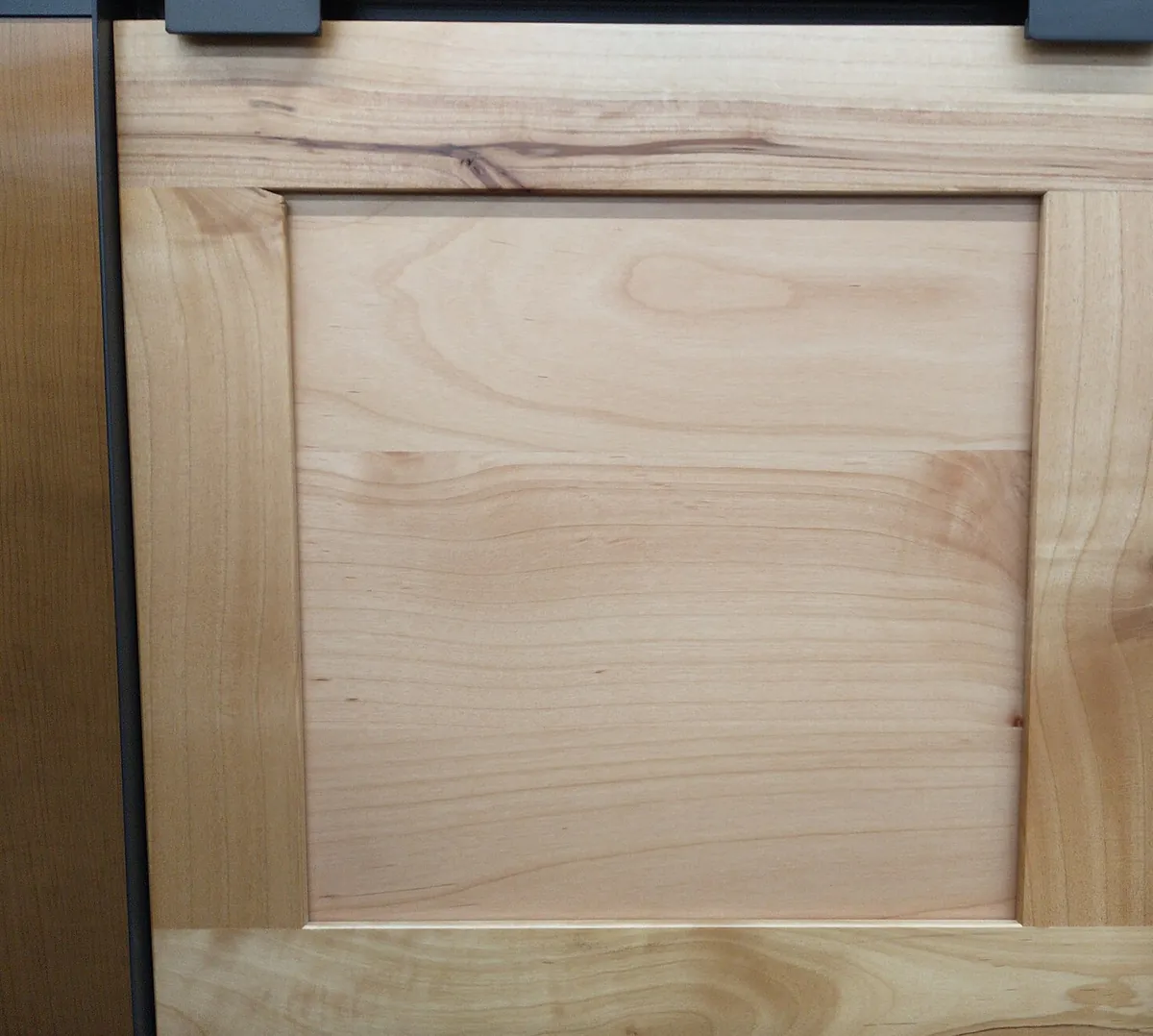
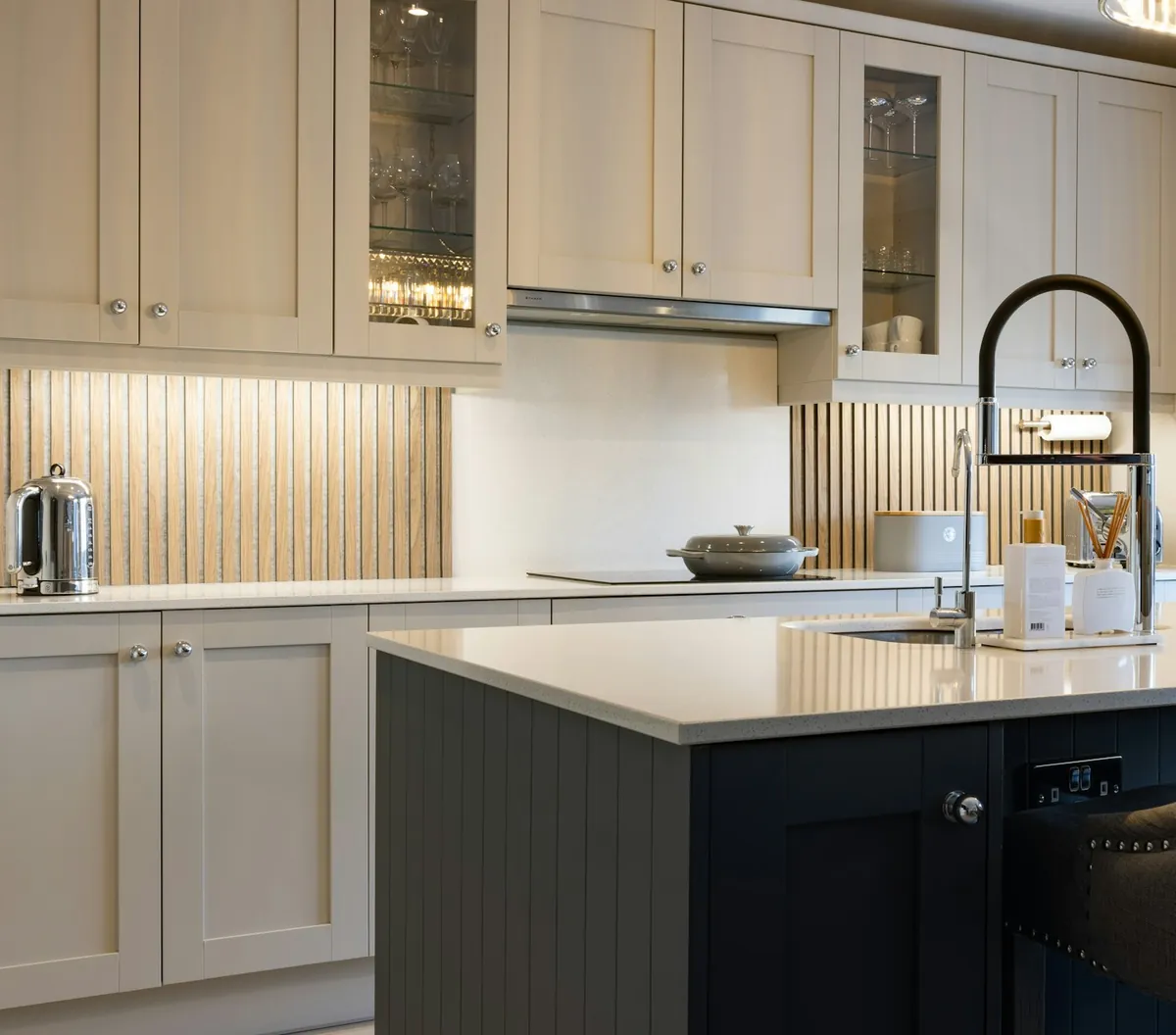
A flat centre panel held in a square frame of four rails and stiles. It is the default in this market and deserves to be: straightforward to build accurately, easy to clean with one internal corner per side, and comparatively stable because there is less shaped surface for a finish to crack over if the panel moves. It also carries no strong period signal, which is why it has survived several changes of fashion.
3. Recessed panel
A shaker with a profile added to the inside edge of the frame, so the panel sits in a moulded rather than a square opening. More machining, more finishing surface, a slightly more traditional read. It is the natural step up from shaker for somebody who wants a little more detail without going to a raised panel.
4. Raised panel
A centre panel machined with a bevelled or shaped edge so it stands proud of the frame. The most traditional of the common styles and the most expensive of them to make, because there is more machining and considerably more surface to finish. It is also the style most likely to show a hairline crack at the panel shoulder if the panel moves inside its frame, which is a real consideration inland and a small one on this coast.
5. Mullion, or glass-fronted
A frame carrying glass, usually divided by bars. It is a display door rather than a storage door, and specifying it has a consequence people forget: the inside of that cabinet now needs finishing to the same standard as the outside, because it is visible. If the cabinet is to be lit, the wiring has to be planned into the carcass rather than added afterwards.
6. Louvre
Angled slats in a frame. Rarely used in kitchens and genuinely useful in specific positions: a laundry cupboard housing something that generates heat or moisture, or a ventilated section in a mudroom run for wet beach kit. It is the hardest style on this list to clean and the only one chosen primarily for airflow.
| Style | Relative build cost | Cleanability | Shaped surface |
|---|---|---|---|
| Slab | Lowest | Best, one flat plane | None |
| Shaker | Low to moderate | Very good, one internal corner per side | Minimal |
| Recessed panel | Moderate | Good | A profile on the inner frame edge |
| Raised panel | Highest of the common styles | Fair, the profile collects residue | Substantial |
| Mullion or glass | High, and the interior must be finished | Glass is easy, the bars are not | Moderate |
| Louvre | High for the size | Poorest on this list | Every slat |
Relative build cost reflects machining time and finishing surface area rather than a published price. Actual quotes depend on species, finish system and quantity.
How Door Style Behaves on the Orange County Coast
A framed door fails, when it fails, at the shoulder where the panel meets the frame. The panel expands and contracts across its width with changes in moisture content while the frame holds it, and if there is a rigid finish bridging that joint, the finish cracks and leaves a fine bare line.
On this coast, that risk is unusually low. The USDA Forest Products Laboratory Wood Handbook records the nearest listed station, Los Angeles, at 9.4 percent equilibrium moisture content in January and 11.7 in June, a band of 2.3 points across a whole year. Fresno swings across 8.4 points; Chicago across 2.8 from a much higher base. Wood moves with the change rather than the level, and a 2.3 point change is a small one.
| Species | Tangential coefficient | Movement of a 16 in panel over 2.3 points |
|---|---|---|
| Cherry, black | 0.00248 | 0.091 in |
| Alder, red | 0.00256 | 0.094 in |
| Maple, sugar | 0.00353 | 0.130 in |
| White oak, white | 0.00376 | 0.138 in |
| Beech, American | 0.00431 | 0.159 in |
Our arithmetic from the Wood Handbook's Equation 13-3 and Table 13-5 coefficients, over the 9.4 to 11.7 percent band recorded for Los Angeles in Table 13-1. A panel in a conditioned house sees less than the full outdoor swing.
The practical conclusion is that raised panel doors, which are the style most sensitive to this, are a safer specification here than they would be in the Central Valley. That is a genuine local advantage rather than a marketing line, and the coastal moisture guide goes through the moisture data and the movement arithmetic.
Style and Material Interact
Some combinations are correct and some are a fight. The most important pairing to understand is style with substrate.
| If the door is | The right substrate is usually | Because |
|---|---|---|
| Slab, painted | MDF | No grain to telegraph, flatter than solid wood |
| Slab, clear finished | Veneered panel | Solid wood this wide would move and cup |
| Shaker, painted | MDF frame and panel, or poplar frame with MDF panel | Crisp profile, stable, no grain showing through |
| Shaker, stained | Solid hardwood frame, veneered or solid panel | The grain is the point |
| Raised panel, stained | Solid hardwood | The profile needs real depth of material |
| Mullion | Solid hardwood frame | Narrow bars carry load and need strength |
The pairing people most often get wrong is a painted door in an open-grained species such as red oak without filling the grain first. Paint follows grain rather than filling it, so the result is a white oak kitchen: the colour changes and the texture stays. Some people want exactly that. Those who want the smooth sprayed look of a modern painted kitchen need grain filling specified as a line item. The box materials guide covers substrates in more detail.
Finishing a Door in Huntington Beach
Where the finish goes on decides which rule applies. Doors finished in a shop fall under South Coast AQMD Rule 1136, which caps clear and pigmented topcoats, primers, sealers and undercoats at 275 grams of volatile organic compounds per litre and names cabinets for the kitchen, bath and vanity in its own definition of wood products. Doors finished in your house fall under Rule 1113, which caps wood coatings, varnish, sanding sealers and lacquer at 275 each and interior stains at 250.
For doors specifically, shop finishing is almost always the better result. A door sprayed flat on a bench, both faces, in a controlled space with proper extraction produces an even film that a door hung vertically in a kitchen cannot match. The finishing rules guide sets out both tables.
Choosing, in Order
- Settle overlay first, because it changes the look more than the profile does
- Decide painted or stained, which eliminates most substrate questions immediately
- Pick the profile knowing what each one costs to build and to clean
- Check the widest panel in the design against the movement figures above
- Confirm where the finish will be applied, since that decides which rule and which quality of result
- If any of the cabinets are existing, confirm the hinge boring before ordering anything
If the boxes are staying and only the doors are changing, the doors and drawer fronts page covers the constraints that apply to a retrofit, including overlay changes and hinge boring. If the whole kitchen is being rebuilt, the custom cabinets page covers the wider process.
The Details That Decide How a Door Looks Up Close
Two doors in the same style and the same colour can look meaningfully different, and the differences are almost always in details nobody mentions when a style is chosen.
Rail and stile width
The width of the frame members around a shaker or panelled door changes its whole character. A narrow frame reads contemporary and leaves more centre panel visible; a wide frame reads traditional and makes a small door look heavier. It is a free choice on custom work and a fixed one on most catalogue doors, which is one of the quieter advantages of having doors made rather than bought.
The inner edge profile
Where the frame meets the panel, the inner edge can be square, chamfered or moulded. Square is the true shaker detail and the easiest to clean. Any profile there adds machining time, adds finishing surface, and adds somewhere for cooking residue to sit.
The outer edge
The outside edge of the door can be square, eased, or given a small profile. On a full overlay kitchen where doors nearly touch, this edge is visible on every door in the room and does more to set the tone than the centre panel does.
Reveal consistency
The gap between adjacent doors, and between a door and the cabinet above it, is not a manufacturing outcome. It is an installation outcome, produced by a proper adjustment pass with six-way adjustable hinges. A beautifully made door hung without that pass looks worse than a modest door hung with it, which is why the installation page spends time on the subject.
Mixing Styles Within One Kitchen
Two door styles in one room reads as a mistake; one style in two colours reads as a design decision. That is the practical rule, and it is why a contrasting island is the most requested combination in this market while a contrasting door profile is almost never asked for twice.
The exception that does work is a display door in a run of solid doors. A pair of glass-fronted mullion uppers in an otherwise shaker kitchen is a deliberate punctuation rather than an inconsistency, provided the frame width and the outer edge detail match the doors either side of them. What it brings with it is a finishing requirement: the inside of a glass-fronted cabinet is visible, so it gets finished to the same standard as the outside.