One Rule Does Most of the Work
Plywood at the sink base. Everything else is preference, budget and finish considerations, and reasonable people specify differently. That one position is not a preference, and the reason is simple enough to state in a sentence: the sink base is the only cabinet in a kitchen guaranteed to meet liquid water, and only one of the common box materials survives that.
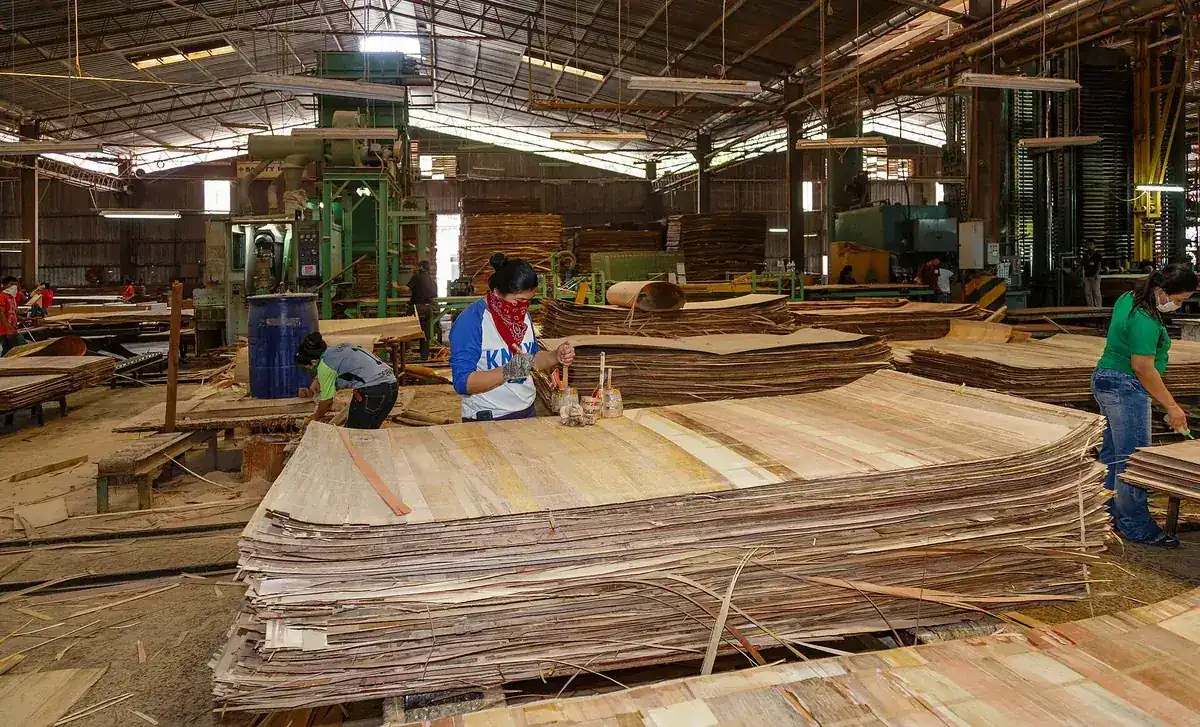
It is worth being precise about the failure mechanism, because it is different from the one people imagine. Particleboard and medium density fibreboard are wood fibre bonded with resin under pressure. Soak them and the fibres swell, the bond between them fails, and the panel expands irreversibly. Drying it out does not bring it back; the swelling is permanent and the panel has lost most of its structural integrity. Plywood is thin veneers laid at alternating grain directions and glued; it swells far less, and it recovers.
The Four Materials, Compared Honestly
| Material | What it is | Strengths | Weaknesses |
|---|---|---|---|
| Plywood | Thin veneers glued at alternating grain directions | Survives soaking, holds a screw, lighter than composite | Edges can contain voids; face veneer is thin and easily sanded through |
| Particleboard | Wood particles bonded with resin under pressure | Flat, dimensionally stable, inexpensive, good with confirmat screws | Swells permanently when wet, sags over long spans, heavy |
| MDF | Fine wood fibre bonded with resin, denser than particleboard | Very flat, machines a crisp profile, the best paint substrate there is | Swells permanently when wet, heavy, needs the right fixings |
| Solid hardwood | Sawn timber | Repairable, strong, can be refinished many times | Moves with humidity, most expensive, rarely used for whole carcasses |
Plywood
The most forgiving cabinet material and the right default for anything that might get wet. Its cross-banded construction gives it dimensional stability in two directions and genuine screw-holding ability, which matters at hinge positions and at any fixing into the back panel. The things to ask about are the core quality, since cheap plywood can contain voids that show at a cut edge, and the veneer thickness, since a thin face veneer limits how much the surface can ever be sanded.
Particleboard
Unfairly maligned. Good particleboard is flat, stable, inexpensive and entirely adequate for dry carcasses, and a great deal of very good cabinetry is built from it. It holds a confirmat-style screw well and an ordinary tapered wood screw badly, which is where most of its bad reputation comes from: a tapered screw acts as a wedge and splits the fibre, so fixings pull out and people blame the board. It also sags over long unsupported spans, which is a shelf design problem rather than a material defect.
MDF
The correct choice for a painted door, and it should be specified as an upgrade rather than accepted as a compromise. It is flatter than solid wood, has no grain to telegraph through a finish, and machines a clean consistent profile, which is exactly what a sprayed painted door needs. Its weaknesses are weight, a fondness for the right fixing rather than any fixing, and the same permanent swelling when wet that particleboard has.
Solid hardwood
Rarely used for whole carcasses, universally used for face frames, doors, drawer boxes and exposed ends. It is the only material on this list that can be repaired and refinished repeatedly, and it is the only one that moves measurably with humidity, which on this coast is a very small effect. The wood species guide compares the common cabinet timbers on exactly how much each one moves.
Specifying by Location, Which Is the Only Useful Way
A quote that says "plywood construction" without saying where is not a specification. Cabinets in one kitchen face very different conditions, and the sensible answer varies cabinet by cabinet.
| Position | Conditions | Specify |
|---|---|---|
| Kitchen sink base | Guaranteed to meet liquid water eventually | Plywood, without exception |
| Dishwasher return and adjacent cabinets | Steam and occasional leaks | Plywood |
| Bathroom vanity | Standing water and heavy humidity cycling | Plywood |
| Laundry run with a utility sink | Two plumbed appliances plus a sink | Plywood at the sink base, sealed edges throughout |
| Dry base and wall cabinets | Normal kitchen conditions | Good particleboard or MDF is entirely adequate |
| Painted doors and panels | Needs flatness and no telegraphing grain | MDF, as an upgrade rather than a compromise |
| Garage carcasses | Outside air through an uninsulated door, wet floor | Sealed-face melamine or laminate, lifted clear of the slab |
| Drawer boxes | Repeated racking loads | Solid wood or birch plywood with a mechanical corner joint |
The garage row is worth a pointer, because the conditions there are genuinely different from the rest of the house. The garage cabinets page covers why an uninsulated roll-up door changes the material answer.
Formaldehyde: What the Label on Your Panels Means
Every composite wood panel used in cabinets sold in California has to meet the formaldehyde emission standards in TSCA Title VI. Those federal limits match California's own CARB Air Toxic Control Measure Phase 2 standards, which have applied in this state since 2009, so California effectively set the national standard and the rest of the country followed.
Since 22 March 2019, covered products have had to be labelled as TSCA Title VI compliant by an EPA-recognised third-party certifier. The covered categories are hardwood plywood, medium density fibreboard and particleboard, plus finished goods containing them, which means cabinets themselves are covered rather than just the raw sheets.
The primary sources are worth having: the EPA page on formaldehyde emission standards for composite wood products and the California Air Resources Board composite wood products program.
Why Coastal Humidity Is Not the Argument Here
It is worth separating the real material risk from the one that gets used in sales conversations. The risk to a composite panel is liquid water. The risk people are told about is humidity, and on this coast humidity is remarkably benign.
The USDA Forest Products Laboratory Wood Handbook publishes month-by-month equilibrium moisture content for US locations. The nearest listed station to Huntington Beach, Los Angeles, reads 9.4, 10.2, 10.5, 10.4, 11.0, 11.7, 11.6, 11.2, 10.8, 10.6, 9.8 and 9.9 percent across the twelve months. That is a 2.3 point band across a whole year, against 8.4 points for Fresno and 2.8 for Chicago from a considerably higher base.
| Location | Low | High | Band |
|---|---|---|---|
| Los Angeles, CA | 9.4% | 11.7% | 2.3 points |
| Fresno, CA | 7.4% | 15.8% | 8.4 points |
| Chicago, IL | 12.3% | 15.1% | 2.8 points |
| Las Vegas, Nevada | 3.7% | 8.3% | 4.6 points |
| Miami, FL | 12.2% | 14.4% | 2.2 points |
Source: USDA Forest Service, Wood Handbook FPL-GTR-282, Chapter 13, Table 13-1. EMC values derived from 30 or more years of NOAA relative humidity and temperature data.
A composite panel does not swell meaningfully across a 2.3 point humidity band. It swells when somebody's waste connection drips for three weeks. The coastal moisture guide works through what these numbers do and do not mean for cabinetry.
What to Ask a Cabinet Supplier
- Which cabinets have plywood boxes, named by position rather than in general
- What the sink base floor is made of specifically, and how its edges are sealed
- What the drawer boxes are made of, and how the corners are joined
- Whether the composite panels carry TSCA Title VI compliance labelling
- What fixings are used into composite panels, since a tapered wood screw is the wrong answer
- Shelf thickness and maximum unsupported span, because sag is a span problem
- Whether the backs are captured in a groove or simply pinned on, since the back is what keeps a carcass square
Every one of those has a specific answer that a competent supplier can give immediately. A supplier who answers all seven in general terms is describing a hope rather than a specification, and the hiring guide covers what else to ask before signing anything.
Drawer Boxes, Which Are a Separate Decision
Specify drawer boxes separately from carcasses, because they do a different job and fail for different reasons. A carcass sits still and carries a static load. A drawer box is racked every time it is opened, loaded unevenly, and stopped hard at both ends of its travel.
That favours a material and a joint that resist racking: solid wood or a good birch plywood with a mechanical corner joint, rather than a butt joint screwed into the end grain of a composite panel. Drawer boxes are also the component that most often fails first in an otherwise sound kitchen, which makes them worth the upgrade even in a budget-constrained specification.
| Construction | How it behaves | Where it suits |
|---|---|---|
| Solid wood, mechanical corner joint | Best resistance to racking, repairable | Anywhere, and essential in a pot drawer |
| Birch plywood, mechanical corner joint | Very good, lighter, stable | A sensible default throughout a kitchen |
| Melamine-faced panel, dowelled or cammed | Adequate for light loads, wipe clean | Bathroom, laundry and light kitchen drawers |
| Composite panel, butt jointed and screwed | The joint is the weak point | Light-duty positions only |
| Metal-sided systems | Very strong, integral runner, fixed heights | Where the system's proportions suit the design |
Backs, Shelves and the Parts Nobody Asks About
The back panel keeps the cabinet square
A carcass back is not just a dust cover. A back captured in a groove on all four sides braces the box against racking and keeps it square for its whole life. A thin back simply pinned onto the rear edges does far less of that job, and it is the reason some older cabinets go out of square while others of the same age do not. Ask which you are getting.
Shelf sag is a span problem
Every shelf sags eventually if the span, the thickness, the material and the load are wrong together, and the failure is permanent because a sagged panel does not straighten. The four remedies are shorter spans, thicker material, a stiffening front edge, or a vertical divider breaking the run. Any of the four works; the mistake is relying on none of them and hoping.
Edges decide how long a composite panel lasts
A melamine or laminate panel is sealed on its faces and completely raw on its cut edges, and the edges are where moisture gets in. Properly applied edge banding on every exposed edge, including the bottom edge of a door and the underside of a shelf, is the difference between a cabinet that lasts decades and one that swells at the corners within a few years. This matters most in bathrooms, laundries and garages.