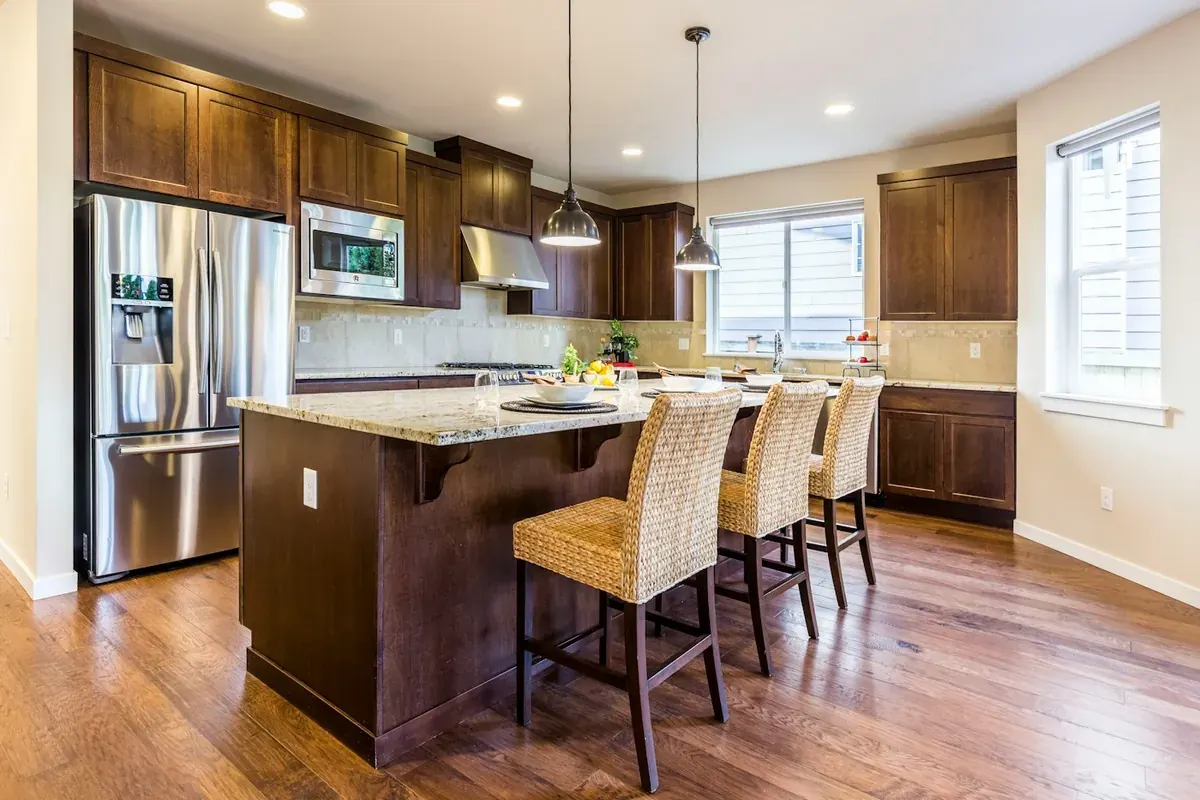
What Refacing Costs in Huntington Beach
Published estimates for this city put laminate cabinet refacing at $1,576 to $2,482 for a standard 12 cabinet kitchen. That is one of the few genuinely Huntington Beach specific cabinet figures that exists anywhere, and unlike most published averages it comes with its workings attached.
| Line | Low | High |
|---|---|---|
| Labour, 26.2 hours | $978 | $1,729 |
| Job materials and supplies, 12 cabinets | $545 | $683 |
| Equipment allowance | $53 | $71 |
| Total | $1,576 | $2,482 |
| Average per cabinet | $131 | $207 |
Source: a published Huntington Beach, CA cabinet refacing cost page, read at source on 30 September 2026. The estimate assumes a standard kitchen of 12 cabinets in a 10 by 12 foot configuration.
Real wood veneer refacing is a different product at a different price. The same source estimates wood veneer at around $2,000 to $6,000 for a standard project, with larger jobs reaching $7,000 to $10,000. The gap between laminate and veneer is material cost and handling: veneer has to be laid, bonded and finished, and it can be stained to match new solid wood doors in a way laminate cannot.
The Box Test: Does Your Kitchen Qualify
Sound, square and dry. Those three words decide whether refacing is the best value job in your house or an expensive way to postpone a real problem, and you can test all three yourself in about five minutes.
1. The sink base
Open it, press the floor at the front edge, and look at the back corners for a tidemark. Softness, swelling or delamination means the panel has taken water, and a swollen composite panel does not recover when it dries. Bonding a new face onto that carcass buys you a beautiful kitchen with a failing cabinet underneath the sink, which is the one cabinet that will keep getting wet.
2. The stiles and the screws
Hinges screw into the stiles of the face frame or into the box edge. If those screws have pulled, been re-drilled off-centre, or turn without biting, the frame will not hold new hinges either. Tired particleboard stiles can sometimes be repaired, and sometimes they are telling you the boxes have done their work.
3. Square and level
Refacing does not reset the geometry. If a cabinet has racked out of square, new doors will hang out of square in it, and the reveals will be uneven no matter how carefully they are adjusted. Close every door and look along the run at eye level: a consistent reveal means the boxes are still true.
- Sink base floor firm at the front edge, no tidemark at the back corners
- Hinge screws holding without being over-sized or re-drilled
- Shelves flat rather than visibly bowed under load
- Reveals even along the run when every door is shut
- Carcass backs still attached and square, not pulled away at a corner
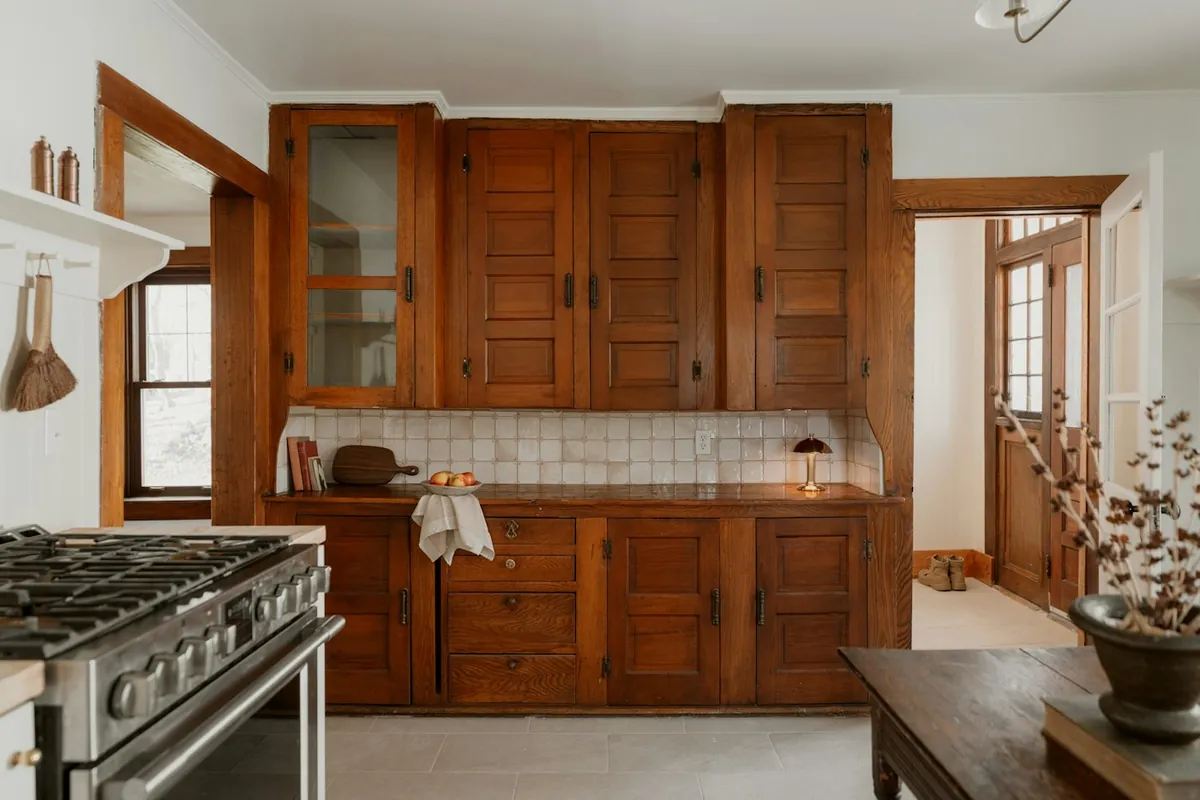
The Five Things Refacing Cannot Do
Refacing changes the face. It does not change the cabinet, and almost every disappointed refacing customer was disappointed because they hoped for something on this list.
| What people hope for | What refacing does | What actually fixes it |
|---|---|---|
| More usable storage | Nothing. Volume is unchanged | New cabinetry, or interior fittings in the existing boxes |
| Drawers instead of doors | Nothing. The carcass is unchanged | New base cabinets, or a drawer conversion where the box allows |
| A wider cabinet to close a gap | Nothing. Widths are fixed | New cabinetry drawn to the wall |
| A fixed corner problem | Nothing. The blind corner stays blind | A corner mechanism, or a redesigned corner |
| A repaired sink base | Nothing. The floor stays swollen | Replacing that carcass, at minimum |
There is one partial exception worth knowing about. Interior fittings such as pull-out shelves, waste units and drawer inserts can often be added to existing boxes at the same time as refacing, which addresses reach without addressing volume. That is a genuinely good combination, and it is worth asking about.
Laminate, Thermofoil or Real Wood Veneer
The face material is the main price lever in refacing, and each of the three has a different failure mode worth understanding before choosing.
Rigid thermofoil and laminate
A printed or solid-colour film or sheet bonded to the face. Consistent, wipe-clean, inexpensive and completely immune to the wood movement questions that affect solid timber. The failure mode is delamination at an edge or at a heat source, so the detailing around a dishwasher or an oven matters. This is the specification the published $1,576 to $2,482 figure describes.
Real wood veneer
A thin layer of actual timber bonded to the face, then finished. It can be stained to match new solid wood doors, which laminate cannot, and it reads as wood because it is wood. It costs more, estimated at $2,000 to $6,000 for a standard project locally, and it needs a finish applied over it, which brings in the South Coast AQMD coating limits.
| Material | Published local estimate | Strength | Failure mode |
|---|---|---|---|
| Laminate or thermofoil | $1,576 to $2,482, 12 cabinets | Cheap, consistent, wipe clean | Delamination at edges and heat sources |
| Real wood veneer | $2,000 to $6,000 standard, $7,000 to $10,000 larger | Matches solid wood doors, refinishable | Sanded through if refinished carelessly |
Both figures from a published Huntington Beach cabinet refacing cost page, read at source 30 September 2026.
Finishing, and Which Air District Rule Applies
If the refacing involves applying a finish in your house, which real wood veneer normally does, the coating is governed by South Coast AQMD Rule 1113 rather than by the shop rule. Rule 1113 caps wood coatings, varnish, sanding sealers and lacquer at 275 grams of volatile organic compounds per litre each, and interior stains at 250. Those four wood categories also carry no small container exemption, unlike most categories in the same table.
Doors and drawer fronts made for the job are normally finished in a shop instead, which falls under Rule 1136. That rule caps clear and pigmented topcoats, primers, sealers and undercoats at 275 grams per litre, and its definition of wood products explicitly names cabinets for the kitchen, bath and vanity. A laminate reface sidesteps both, because nothing is being coated at all. The finishing rules guide sets out both tables.
Refacing Against the Alternatives
Four services keep your boxes. Refacing sits in the middle of them: more thorough than new doors alone, less invasive than refinishing the whole kitchen in place, and completely different from replacement.
| Service | What changes | Published local range |
|---|---|---|
| Doors and drawer fronts | Doors, fronts, hardware only | Quoted per door and front |
| Refacing | Doors, fronts, hardware and a face skin | $1,576 to $2,482, 12 cabinets, laminate |
| Refinishing | The finish on existing wood, grain kept | $1,079 to $6,002, about $4 to $10 per sq ft |
| Painting | An opaque finish, grain hidden | $1,060 to $5,899, labour $70 to $120 per hour |
All three local figures from published Huntington Beach cost pages, read at source 30 September 2026.
The refacing cost guide works through the decision in detail with the costs of both paths, and the three-way comparison covers the difference between the surface treatments.
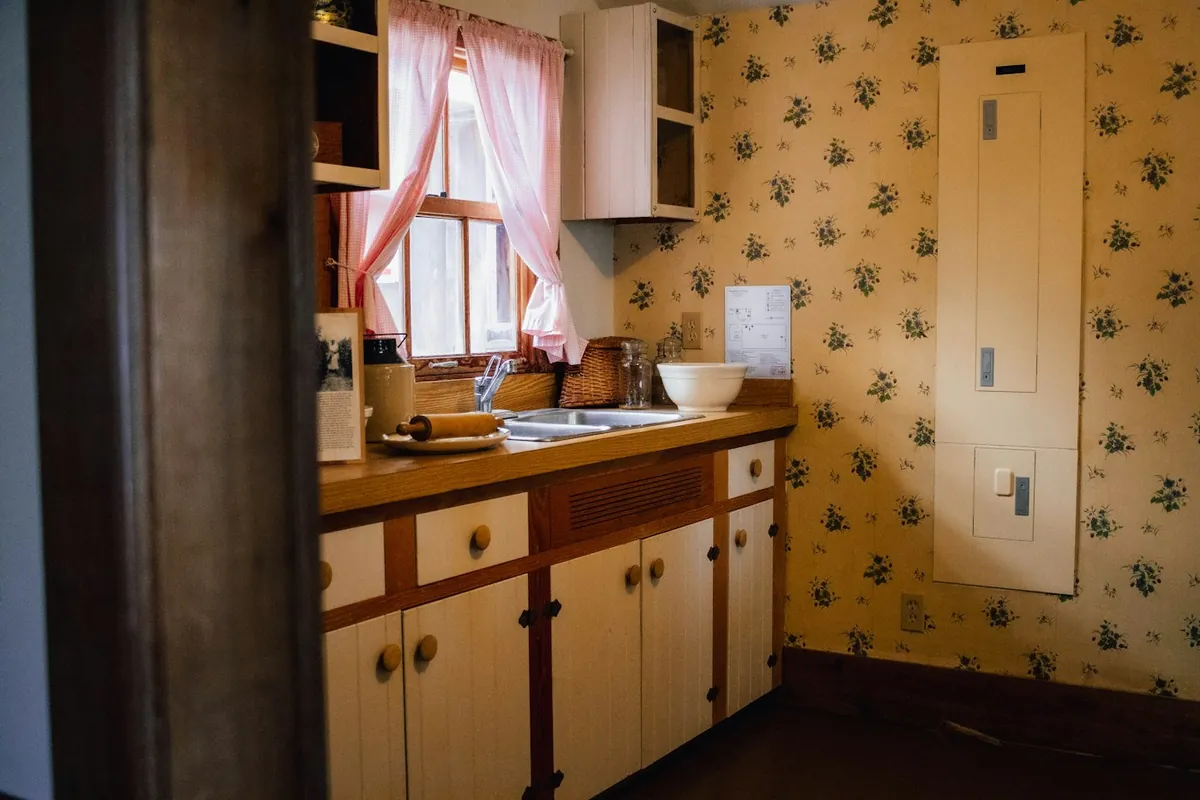
Lead Paint, and Why a Pre-1978 Kitchen Changes the Job
If your Huntington Beach house was built before 1978 and any painted surface is going to be disturbed, federal law decides who is allowed to do the work, and refacing disturbs painted surfaces by design. This is the single most consequential thing on this page that no competing cabinet page in this market mentions, so it is worth setting out precisely.
The Environmental Protection Agency states the background plainly: in 1978 the federal government banned the sale of lead-based paint for use in homes, childcare facilities and preschools, and approximately three-quarters of the homes in the United States built before 1978 still contain some lead-based paint. The agency's position is that children can live safely in those homes as long as paint and surfaces are in good condition and kept clean. The hazard appears when painted surfaces are disturbed, and old worn lead-based paint on surfaces subject to constant friction can produce chips and dust that become dangerous when inhaled or ingested.
That is what the Renovation, Repair and Painting Rule exists to control. In the EPA's words, the rule requires that anyone paid to perform work that disturbs painted surfaces in homes, childcare facilities and preschools built before 1978 be certified, and that their employees be trained, either as a certified renovator or on the job by one, in lead-safe work practices. The scope of who that covers is deliberately wide: it includes all firms, even sole proprietorships, and the EPA names general contractors and special trade contractors including painters, plumbers, carpenters and electricians. A carpenter refacing cabinets in a 1966 Huntington Beach kitchen is squarely inside that list.
The six square foot line, and the two activities it never covers
There is a minor-work exemption, and its boundaries are exact. The EPA excludes minor repair and maintenance activities that disturb six square feet or less of paint per room inside, or 20 square feet or less on the exterior of a home or building. The parenthetical that follows matters more than the threshold: window replacement and demolition of painted surfaces are always covered regardless of square footage, and activities designated as prohibited are prohibited regardless of square footage.
Apply that to refacing. Stripping the old doors and fronts off a 12 cabinet kitchen and preparing the visible face frame is not a six square foot job. A face frame is a narrow component, so it is easy to underestimate, but a 12 cabinet run has 12 carcasses worth of stiles, rails and exposed ends, and the preparation is abrasive by nature. Refacing a kitchen in a pre-1978 house should be assumed to be covered work, not assumed to be exempt.
| Situation | Covered by the rule? |
|---|---|
| Paid work disturbing paint, home built before 1978 | Yes. Firm certification and trained renovators required |
| Housing built in 1978 or later | No |
| Minor work disturbing six sq ft or less of paint per room, inside | No, unless it is window replacement or demolition of painted surfaces |
| Demolition of painted surfaces, any size | Yes, always, regardless of square footage |
| Window replacement, any size | Yes, always, regardless of square footage |
| Components declared lead-free by a certified inspector or risk assessor | No |
| Homeowner doing the work in their own pre-1978 home | Generally no. Yes if the home is rented out in whole or part, runs a childcare centre, or is being renovated for resale at a profit |
| Zero-bedroom dwellings and housing for the elderly or disabled | No, unless children under six live there or are expected to |
Source: EPA, Lead Renovation, Repair and Painting Program, and the Program's Contractors page, both read at source 30 September 2026.
Testing, and who is allowed to do which test
Testing is optional and its absence is not neutral. The EPA states that paint testing is not required by the rule, but that unless you have documentation the paint is not lead-based, the requirements of the rule apply. In other words, no test means the rule applies by default. If you or the contractor do decide to test, the agency is specific about who may use which method, and the three methods do not carry the same authority.
| Method | Who can do the testing |
|---|---|
| EPA-recognised test kits | Certified renovators |
| X-ray fluorescence instruments | Certified lead-based paint inspectors or risk assessors |
| Paint chip sampling | Certified renovator, inspector or risk assessor |
Source: EPA, Renovation, Repair and Painting Program: Contractors, read at source 30 September 2026. The page also notes that where testing is done, it must cover all surfaces to be affected by the work.
One California-specific point that is easy to get wrong. The EPA authorises certain states to run their own RRP programmes, and the published list is Alabama, Delaware, Georgia, Iowa, Kansas, Massachusetts, Mississippi, North Carolina, Oklahoma, Oregon, Rhode Island, Utah, Vermont and Wisconsin, plus one Minnesota tribal programme. California is not on that list, so the programme here is administered by the EPA directly rather than by a state agency. The EPA also runs the National Lead Information Center on 1-800-424-5323 for questions and for reporting suspected violations.
What KCMA Certification Tells You About the New Doors
The doors and drawer fronts are the part of a reface you actually buy, and there is exactly one third-party performance benchmark in this industry worth asking about. The Kitchen Cabinet Manufacturers Association runs the ANSI/KCMA A161.1 Quality Certification, which the association describes as covering rigorous tests of structural strength, drawer and door integrity, and finish durability.
Two published numbers make the certification meaningful rather than decorative. KCMA states that certified cabinets have passed 14 rigorous tests, including a 600-pound load test, intended to simulate a lifetime of use. And it states that between 40 and 50 percent of cabinets fail their first certification attempt. A test that half the entrants fail is a test that discriminates, which is the only reason a certification mark carries information.
Two further points are worth knowing before you assume certification implies a price bracket. KCMA states that certified cabinets are available at every price point, from builder-grade units to high-end custom designs, so certification is not a luxury signal. And the association runs two other seals: the Environmental Stewardship Program, which certifies manufacturers adhering to sustainability practices, and a Severe Use Certification originally developed by the United States Department of Housing and Urban Development for the exceptionally high wear that apartment kitchens see.

Formaldehyde: What the New Doors and Skins Have to Meet
Almost everything in a refacing job is a composite wood panel. The door cores, the drawer fronts and the face skin substrate are hardwood plywood, particleboard or medium density fibreboard, and California sets numerical formaldehyde emission ceilings on all three for products used inside a building.
The California Green Building Standards Code requires that hardwood plywood, particleboard and medium density fibreboard composite wood products used on the interior or exterior of a building meet the formaldehyde requirements of the Air Resources Board's Air Toxics Control Measure for Composite Wood, at Title 17 of the California Code of Regulations, section 93120 and following. The code prints the resulting limits as a table, and those values are derived from the Air Resources Board figures as tested in accordance with ASTM E1333.
| Product | Current limit |
|---|---|
| Hardwood plywood, veneer core | 0.05 |
| Hardwood plywood, composite core | 0.05 |
| Particleboard | 0.09 |
| Medium density fibreboard | 0.11 |
| Thin medium density fibreboard, maximum 5/16 inch thick | 0.13 |
Source: California Green Building Standards Code, formaldehyde limits table at section 4.504.5 for residential mandatory measures, with the identical table printed at 5.504.4.5, read at source 30 September 2026. Values as tested per ASTM E1333.
The code also lists what counts as proof, which is the practical part for a homeowner. Any of the following satisfies an enforcing agency: product certifications and specifications, chain of custody certifications, product labelled and invoiced as meeting the Composite Wood Products regulation, or, for exterior grade products, marking to the PS-1 or PS-2 standards of the Engineered Wood Association, the Australian AS/NZS 2269 standard or European 636 3S. Separately, federal law under the Toxic Substances Control Act Title VI has required covered composite wood products to be labelled as compliant by an EPA-recognised third-party certifier since 22 March 2019.
What that means on a refacing quote is concrete. Ask for the doors and fronts to be invoiced as meeting the Composite Wood Products regulation. It costs nothing to ask, it is a normal request that any legitimate supplier can satisfy, and it converts an invisible property of the product into a line you can read.
Three Worked Refacing Budgets
The published Huntington Beach estimate describes one kitchen size, so here is the arithmetic extended to two others using the same published per-cabinet figure of $131 to $207. Every number below is either quoted from a published source or is that source multiplied out, and the multiplication is shown so you can check it.
| Kitchen | Arithmetic | Low | High |
|---|---|---|---|
| 12 cabinets, the published basis | Source figure, 10 by 12 ft kitchen | $1,576 | $2,482 |
| 18 cabinets | 18 x $131 and 18 x $207 | $2,358 | $3,726 |
| 24 cabinets | 24 x $131 and 24 x $207 | $3,144 | $4,968 |
Per-cabinet range from the published Huntington Beach cabinet refacing cost page, read at source 30 September 2026. The 18 and 24 cabinet rows are that range multiplied out, not separately published figures.
Two additions worth budgeting for, both from a published national cost source rather than a local one. If old cabinetry has to be taken out rather than refaced, removal is put at around $300. If any new box is added to the run while the kitchen is open, installation of a cabinet box is put at about $100 per box, finished ends at $100 to $200 each, and crown moulding at about $70 per eight foot section. Those are national figures and they are labelled as such, because no Huntington Beach equivalent is published.
Living With a Refaced Kitchen in Coastal Orange County
A refaced kitchen in Huntington Beach has an easier environmental life than almost anywhere in the country, and the data behind that is federal rather than promotional. The USDA Forest Service Forest Products Laboratory publishes monthly equilibrium moisture content figures for United States locations in its Wood Handbook, and the nearest listed station to Huntington Beach is Los Angeles, in the same coastal basin marine-layer regime.
The Los Angeles row runs 9.4, 10.2, 10.5, 10.4, 11.0, 11.7, 11.6, 11.2, 10.8, 10.6, 9.8 and 9.9 percent from January to December. That is a band of 2.3 percentage points across a whole year, and unusually the wettest months are the summer months rather than the winter ones. For comparison, the same table gives Fresno 15.8 down to 7.4, a band of 8.4 points, and Chicago 12.3 up to 15.1. The practical consequence for a refaced kitchen is that solid wood doors move very little here, so reveals set correctly in March are still correct in September.
Salt air is a different question from wood movement, and it is a hardware question rather than a cabinet question. Hinges, pulls and drawer runners are the components exposed to it, which is an argument for specifying good hardware on a reface rather than an argument against refacing. The wood movement guide works through the published figures and the arithmetic in full.
- Wipe spills at the toe kick and around the dishwasher, where laminate edges fail first
- Avoid abrasive cleaners on thermofoil and laminate faces, which cannot be sanded back
- Re-adjust hinges once, about two months after the job, when everything has settled
- Treat the sink base as the early warning system for the whole run, and look at it twice a year
- Keep one spare door and front from the batch if the supplier will sell one, because colour batches do not repeat
On how long any of it lasts, the most careful published answer comes from the NAHB and Bank of America Study of Life Expectancy of Home Components, published February 2007 from a telephone survey of manufacturers, trade associations and researchers conducted in summer 2006. It reports that kitchen cabinets are expected to last up to 50 years, medicine cabinets 20 or more years, garage and laundry cabinets 100 or more years, and closet shelves for a lifetime. The study attaches its own caveats, which are the honest part: many of the people interviewed emphasised that life expectancy is greatly affected by the quality of maintenance, and noted that changing consumer preferences can result in products being replaced long before, or after, the end of their practical life expectancy.