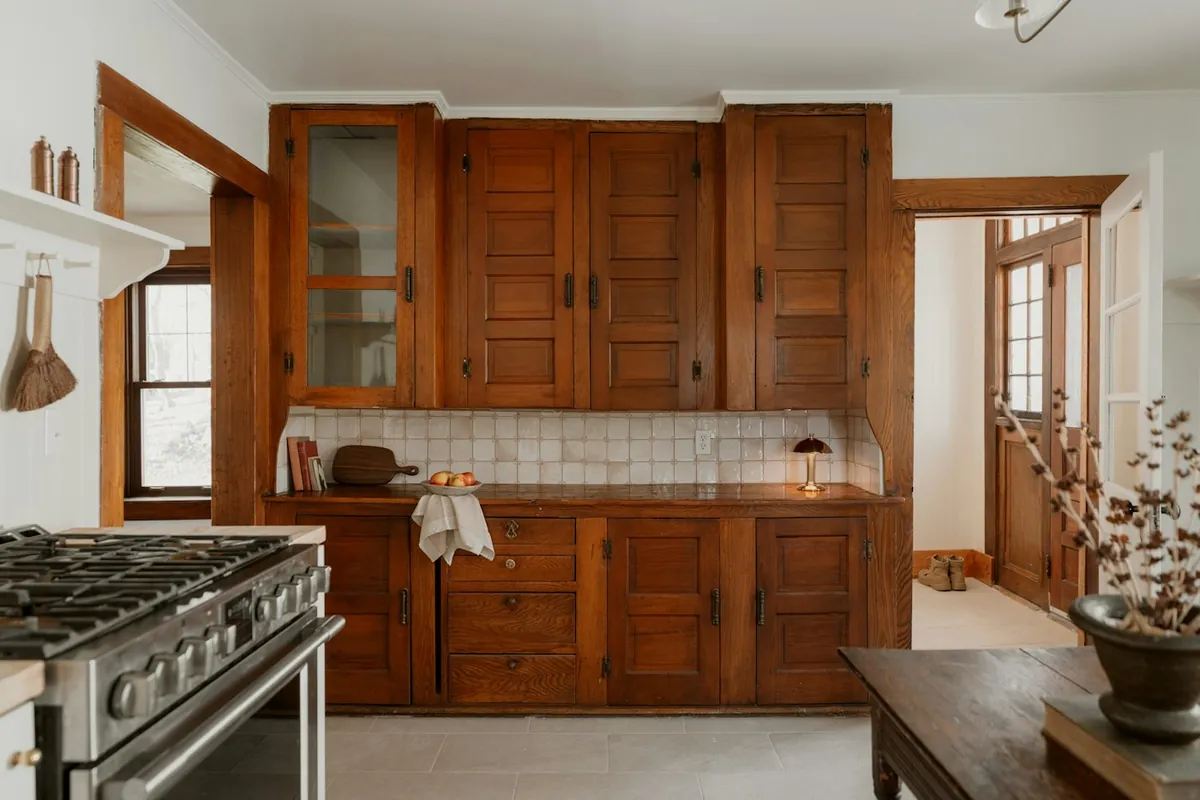
The Published Huntington Beach Estimate, Line by Line
Laminate refacing of a standard 12 cabinet kitchen in Huntington Beach is estimated at $1,576 to $2,482. That figure is unusually useful because the source publishes what is inside it rather than only the total.
| Line | Low | High | Share of the total |
|---|---|---|---|
| Labour, 26.2 hours | $978 | $1,729 | Roughly 62 to 70 percent |
| Job materials and supplies, 12 cabinets | $545 | $683 | Roughly 27 to 35 percent |
| Equipment allowance | $53 | $71 | Roughly 3 percent |
| Total | $1,576 | $2,482 | |
| Average per cabinet | $131 | $207 |
Source: a published Huntington Beach, CA cabinet refacing cost page, read at source on 30 September 2026. Share-of-total percentages are our arithmetic from the published lines.
The most useful thing that breakdown tells you is that refacing is a labour job. Between roughly 62 and 70 percent of the total is somebody's time, which explains why the price scales with cabinet count and why a kitchen with awkward access or a deeply moulded face frame lands at the top of the range rather than the bottom.
It also explains why refacing does not get dramatically cheaper if you supply your own materials. The materials line is $545 to $683 out of a total that can reach $2,482, so even eliminating it entirely would move the number far less than most people expect.
Laminate Against Real Wood Veneer
The two products do different jobs and are priced accordingly. Laminate and rigid thermofoil are films or sheets bonded to the visible face; real wood veneer is a thin layer of actual timber, bonded and then finished.
| Material | Published estimate | What it gives you | Main failure mode |
|---|---|---|---|
| Laminate or thermofoil | $1,576 to $2,482 for 12 cabinets | Solid colour or printed finish, wipe clean, consistent | Delamination at an edge or near a heat source |
| Real wood veneer, standard project | Around $2,000 to $6,000 | Visible grain that can be stained to match new solid doors | Sanding through if refinished carelessly later |
| Real wood veneer, larger kitchens | $7,000 to $10,000 | The same, at scale | The same |
Both figures from the same published Huntington Beach cabinet refacing cost page, read at source 30 September 2026.
The deciding question is usually whether you want to see wood. If the new doors are painted, laminate on the face frame will match them perfectly and cost less. If the new doors are stained hardwood, only a veneer face will read correctly beside them, because a printed woodgrain next to real grain is visible from across the room.
The hidden cost in veneer: finishing
Wood veneer has to be finished after it is laid, and if that happens in your house it falls under South Coast AQMD Rule 1113, which caps wood coatings, varnish, sanding sealers and lacquer at 275 grams of volatile organic compounds per litre each, and interior stains at 250. Those four wood categories carry no small container exemption, unlike most categories in the same table. That is not an extra cost as such, but it does constrain the product and therefore the schedule. The finishing rules guide sets out both applicable rules.
Six Conditions That Disqualify a Kitchen
Refacing keeps the boxes, so every one of its limits is a limit of the boxes. If any of the following is true of your kitchen, the published $1,576 to $2,482 is money spent on a problem that will still be there afterwards.
| Condition | Why refacing cannot help | What does |
|---|---|---|
| The sink base floor is soft or swollen | Refacing does not touch the carcass | Replacing that cabinet at minimum |
| Hinge screws no longer hold in the stiles | New doors need fixings the frame cannot give | Stile repair, or new cabinetry |
| A cabinet has racked out of square | New doors will hang out of square in it | New cabinetry, or resetting that box |
| You need drawers where there are doors | The carcass is unchanged | New base cabinets, or a drawer conversion if the box allows |
| Filler strips are doing three or more inches per wall | The widths stay exactly as they are | Cabinetry drawn to the measured wall |
| You are moving a sink, range or wall | The whole layout resets anyway | New cabinetry, planned around the new layout |
The five-minute test
- Open the sink base, press the floor at its front edge, and look at the back corners for a tidemark
- Try a hinge screw on two or three doors and see whether it bites
- Close every door and sight along the run at eye level: consistent reveals mean the boxes are still true
- Look for bowed shelves under load
- Measure the total filler strip along each wall and write the number down
Pass all five and refacing is probably the best value job available to you. Fail the first and it is the wrong service no matter how attractive the price is. The refacing service page covers the process itself.
What the Same Money Buys Elsewhere
Refacing sits among four services that keep your boxes and one that does not. Comparing them on published local figures is the fastest way to see whether refacing is actually the bargain it looks like for your situation.
| Service | What changes | Published local range |
|---|---|---|
| Cabinet painting | An opaque finish over existing doors and boxes | $1,060 to $5,899, labour $70 to $120 per hour |
| Cabinet refinishing | A new clear or tinted finish, grain kept | $1,079 to $6,002, about $4 to $10 per sq ft |
| Laminate refacing | New doors, fronts, hardware and a face skin | $1,576 to $2,482 for 12 cabinets |
| Wood veneer refacing | The same, in real timber | Around $2,000 to $6,000 standard |
| New doors and fronts only | Doors, fronts and hardware, face frame untouched | Quoted per door and front |
All Huntington Beach figures from published cost pages read at source on 30 September 2026.
Two observations fall out of that table. First, the four surface services overlap heavily in price, which means the choice between them should be made on the result rather than the budget. Second, refacing is the only one of the four that changes the door style, because it is the only one that replaces the doors. If you dislike your door profile, the other three cannot help you at any price.
Refacing Against Replacement
Replacement costs several times more and buys something categorically different. Using the published Los Angeles custom band of $500 to $1,500 per linear foot on a 20 linear foot kitchen, replacement is roughly $10,000 to $30,000 against $1,576 to $2,482 for laminate refacing of a 12 cabinet kitchen.
What the difference buys is every dimension. New boxes can be any width, any height and any internal configuration; they can close the gaps that filler strips currently cover; they can turn doors into drawers; and they can be arranged in a different layout entirely. If none of those matters to you, replacement is a very expensive way to get a new door style.
The custom cabinet cost guide sets out the replacement side of that comparison, including how to measure your own run length, and the three-way surface comparison works through the other services in this table.
Permits and the Deposit Rule
Refacing needs no permit. The California Residential Code lists "Painting, papering, tiling, carpeting, cabinets, counter tops and similar finish work" as exempt, and refacing touches nothing structural and no services.
What does apply is the statutory deposit cap. California Business and Professions Code section 7159.5(a)(3) limits a downpayment to $1,000 or 10 percent of the contract amount, whichever is less, which on a $2,000 refacing job means $200. Section 7159 also requires a written contract on home improvement work above $500, which every refacing job is. Both are worth knowing before signing anything, and the full texts are at Business and Professions Code section 7159.5 and section 7159.
What Is and Is Not Inside a Refacing Quote
Refacing quotes vary less than cabinetry quotes do, because the scope is fairly standard. What varies is the edges of it, and those are worth confirming before comparing two numbers.
| Item | Usually included | Worth confirming |
|---|---|---|
| New doors and drawer fronts | Yes | Whether they are sized to each opening individually |
| A skin over the visible face frame or box edge | Yes, this is what makes it refacing | Laminate, thermofoil or real wood veneer |
| New hinges | Usually | Brand and series, and whether mounting plates are included |
| New handles and knobs | Sometimes | And whether existing screw holes are reused or filled |
| Removal and disposal of the old doors | Usually | Ask, because it is easy to leave out |
| Cabinet interiors | No | They stay exactly as they are, which matters with dark new doors |
| Countertops, sinks, appliances | No | Separate trades entirely |
| Interior fittings such as pull-outs | No | But an excellent thing to add at the same time |
That last row is the most useful addition anybody makes to a refacing job. Roll-out shelves, a waste pull-out and drawer inserts fit into existing carcasses and address reach, which is the one complaint refacing alone cannot touch. Combining them is the closest thing to getting both benefits at a refacing price.
The Interiors Problem, and What to Do About It
Refacing changes the outside of the cabinet and leaves the inside alone. In a kitchen going from mid-tone oak to a very dark or very pale new front, that contrast is visible every time a door opens, and it is the single most common source of mild disappointment with an otherwise good refacing job.
There are three reasonable answers. Accept it, which most people do and which is genuinely fine in a kitchen where doors are usually shut. Have the interiors addressed separately, which is extra labour in an awkward space and pushes the cost up. Or choose a new front colour that does not fight the existing interiors, which costs nothing at all and is the option most worth considering at the specification stage rather than afterwards.
It is worth opening a few cabinets and looking properly before choosing a colour. What is in there is usually a pale melamine, and a very dark exterior against it is a strong contrast that reads as unfinished to some people and as normal to others.