The Claim, and What the Data Says
Coastal Southern California is one of the gentlest environments for wood in the United States. That is not a sales line, it is what the federal moisture tables show, and it is worth stating plainly because the opposite claim gets used constantly to justify prices and product choices in beach cities.
The USDA Forest Products Laboratory publishes the Wood Handbook, and its Chapter 13 carries Table 13-1, "Equilibrium moisture content for outside conditions in several U.S. locations." The table's own note says the values are "based on the average relative humidity and temperature data (30 or more years) available from the National Climatic Data Center of the National Oceanic and Atmospheric Administration," with relative humidity taken as the average of morning and afternoon values.
The nearest listed station to Huntington Beach is Los Angeles, which sits in the same coastal marine layer regime as coastal Orange County.
| Location | Jan | Apr | Jul | Oct | Annual band |
|---|---|---|---|---|---|
| CA Los Angeles | 9.4 | 10.4 | 11.6 | 10.6 | 9.4 to 11.7, 2.3 points |
| CA Fresno | 15.8 | 10.3 | 7.4 | 9.8 | 7.4 to 15.8, 8.4 points |
| NV Las Vegas | 8.3 | 5.3 | 4.4 | 5.7 | 3.7 to 8.3, 4.6 points |
| AZ Phoenix | 8.9 | 6.0 | 6.2 | 6.9 | 4.4 to 9.0, 4.6 points |
| IL Chicago | 14.3 | 12.4 | 12.7 | 13.2 | 12.3 to 15.1, 2.8 points |
| FL Miami | 13.5 | 12.2 | 13.4 | 13.8 | 12.2 to 14.4, 2.2 points |
| AL Mobile | 13.8 | 13.3 | 14.3 | 13.1 | 13.1 to 14.3, 1.2 points |
Source: USDA Forest Service, Wood Handbook FPL-GTR-282, Chapter 13, Table 13-1. Annual bands are computed by us from the full twelve-month rows.
Two things stand out. First, the Los Angeles band of 2.3 points is narrow, comparable to Miami and better than Chicago. Second, and unusually, the wettest months here are the summer months. June reads 11.7 and July 11.6, while January reads 9.4. Most of the country runs the other way round.
What 2.3 Points Does to an Actual Panel
The Wood Handbook provides the arithmetic in Equation 13-3: change in dimension equals the starting dimension multiplied by the species dimensional change coefficient multiplied by the change in moisture content. It is valid between 6 and 14 percent moisture content and is based on the dimension at 10 percent.
The Handbook's own worked example makes the method concrete. A flat-grained white fir board 9.15 inches wide at 8 percent moisture content, taken to 11 percent, changes by 9.15 x 0.00245 x 3, which is 0.067 inches.
Applying the same method to a 24 inch flat-sawn cabinet panel across the measured Los Angeles band of 2.3 points gives the following. The coefficients come from Table 13-5; the multiplication is ours.
| Species | Tangential coefficient | Coastal LA, 2.3 points | Fresno, 8.4 points |
|---|---|---|---|
| Cherry, black | 0.00248 | 0.137 in | 0.500 in |
| Alder, red | 0.00256 | 0.141 in | 0.516 in |
| Walnut, black | 0.00274 | 0.151 in | 0.552 in |
| Maple, red | 0.00289 | 0.160 in | 0.583 in |
| Red oak, northern red | 0.00304 | 0.168 in | 0.613 in |
| Maple, sugar | 0.00353 | 0.195 in | 0.712 in |
| White oak, white | 0.00376 | 0.208 in | 0.758 in |
| Hickory, true | 0.00411 | 0.227 in | 0.829 in |
| Beech, American | 0.00431 | 0.238 in | 0.869 in |
Our arithmetic from Wood Handbook Equation 13-3 and the Table 13-5 coefficients, applied across the bands recorded in Table 13-1 for Los Angeles and Fresno. A panel inside a conditioned house sees less than the full outdoor swing in either location.
The comparison is the point. A sugar maple panel that moves roughly three sixteenths of an inch on this coast moves nearly three quarters of an inch in the Central Valley. Design allowances that are essential two hundred miles inland are comfortable margins here.
Quarter-sawn material halves it again
Radial movement is roughly half tangential movement in most species. Sugar maple is 0.00353 tangentially and 0.00165 radially, so a quarter-sawn panel moves about 47 percent as much as a flat-sawn one. Across a 24 inch quarter-sawn sugar maple panel on this coast that is 24 x 0.00165 x 2.3, or 0.091 inches. At that point the movement is essentially a non-issue, which is why quarter-sawn material here is worth paying for on appearance rather than on stability.

The Published Installation Zones, and What We Will Not Claim
Table 13-2 of the same chapter publishes recommended moisture content values for wood products at time of installation, in three regional zones.
| Use | Most areas of the US | Dry south-western area | Damp, warm coastal area |
|---|---|---|---|
| Interior: woodwork, flooring, furniture, wood trim | 8% avg, 6 to 10% individual | 6% avg, 4 to 9% | 11% avg, 8 to 13% |
| Exterior: siding, wood trim, sheathing, laminated timbers | 12% avg, 9 to 14% | 9% avg, 7 to 12% | 12% avg, 9 to 14% |
Source: Wood Handbook FPL-GTR-282, Chapter 13, Table 13-2. The table's own footnote states that the major areas are indicated in Figure 13-1.
The Shop Target, Which Matters More Than the Zone
The Wood Handbook is direct about what cabinet stock should arrive at: "Hardwood and softwood lumber for furniture, cabinetry, and millwork usually has a final moisture content of 6% to 8% and can be specified to be free of drying stresses." Elsewhere it states that hardwood lumber for furniture, flooring, cabinets and millwork is usually dried to 6 to 8 percent, and softwood for the same appearance uses to 7 to 9 percent.
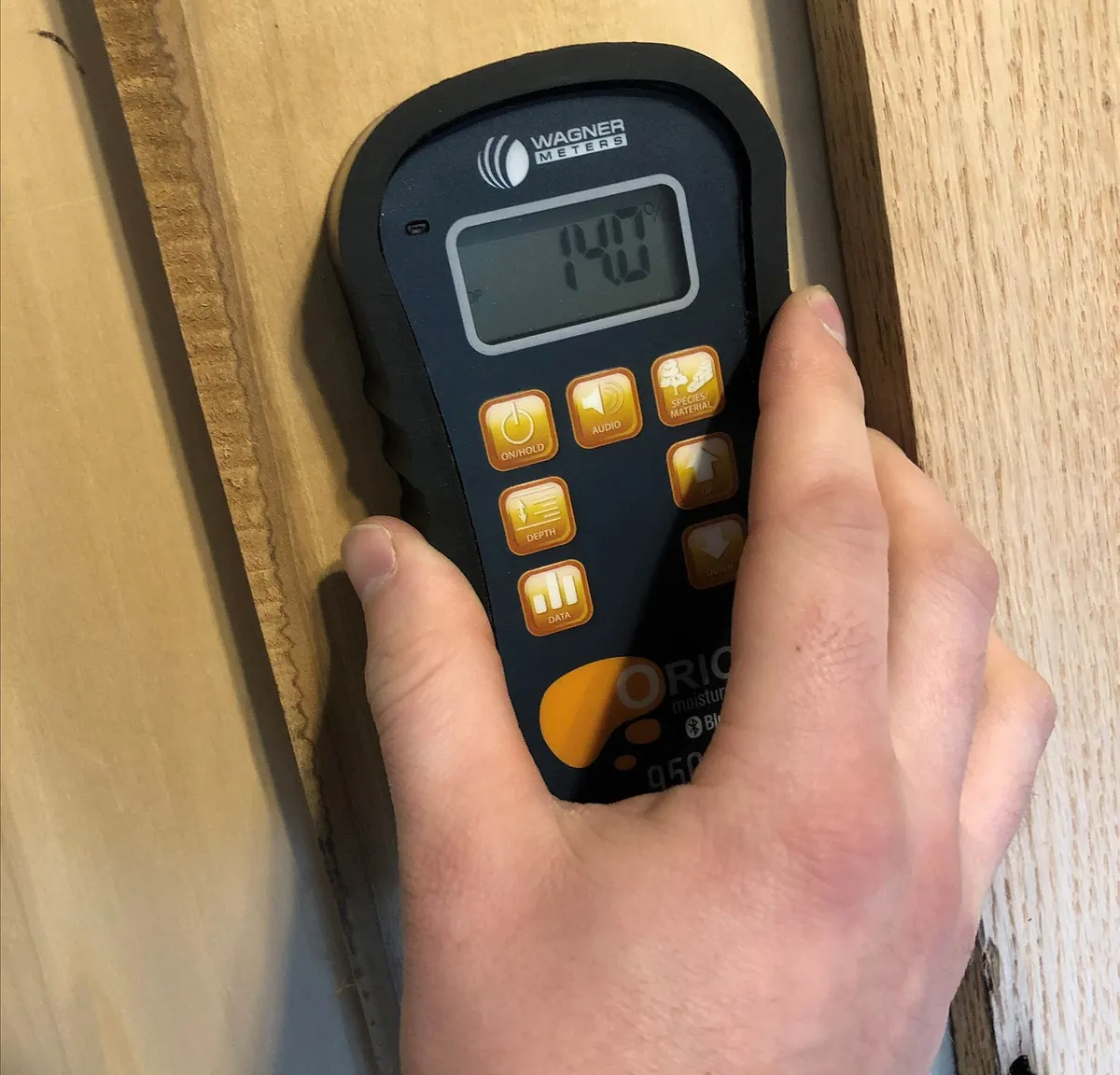
The principle underneath is one line: "Match the moisture content of lumber as closely as is practical to the equilibrium moisture content (EMC) conditions in service." That matters more than any species choice, because a door built from wood at 12 percent and installed into a house holding it at 8 will shrink four points after installation regardless of what it is made of, and four points is nearly twice the entire annual swing on this coast.
The Handbook also notes the air conditioning caveat: its recommended interior values "are based on measurements in well-ventilated buildings without unusual moisture sources and without air conditioning," and in air-conditioned buildings moisture conditions depend largely on the proper sizing of the equipment. A conditioned Huntington Beach house will sit drier and steadier than the outdoor numbers.
What Salt Air Actually Does
Corrosion. That is the whole of it, and it is a real problem worth specifying against, particularly within a few blocks of the water in Sunset Beach, Huntington Harbour and along the Seal Beach and Newport Beach frontages.
| Concern | Real? | What to do about it |
|---|---|---|
| Hinge and runner corrosion | Yes | Name a corrosion-resistant hardware series in the quote |
| Screws bleeding rust through a painted stile | Yes | Stainless or properly coated fixings throughout |
| Exposed handle and pull corrosion | Yes | Choose a finish rated for coastal exposure |
| Wood swelling from sea air | No | Nothing. The annual band here is 2.3 points |
| Panels cupping from humidity | No | Design allowance as normal; the swing does not justify more |
| Needing an exotic species for coastal use | No | Choose on appearance and budget |
A quote that uses sea air to justify a premium on the cabinetry is selling anxiety. A quote that names hardware plating as a coastal specification item is doing the job properly. The Sunset Beach page covers the most exposed part of this service area, and the Newport Beach page covers the harbour frontage.
Designing For It, Briefly
- Let framed door panels float in their grooves rather than being glued captive
- Size wide solid panels with an allowance rather than a tight fit
- Specify shop stock at 6 to 8 percent moisture content and ask for it in writing
- Let material acclimatise on site before doors are finally fitted and adjusted
- Remember doors fitted in January are at their narrowest, since the local peak is June
- Spend the coastal attention on hardware plating, not on timber selection
Those six items cover it. Everything else about cabinet durability in this city is about liquid water rather than ambient humidity, which is why the box materials guide spends its time on the sink base, and why the wood species guide can afford to rank species by appearance as much as by movement. The Wood Handbook chapter itself is published at the USDA Forest Service research library.
Why the Indoor Number Is Even Gentler
Everything on this page so far describes outdoor conditions, and cabinets live indoors. The Wood Handbook is careful about this distinction, and the effect runs in your favour.
Its recommended interior values, the chapter says, "are based on measurements in well-ventilated buildings without unusual moisture sources and without air conditioning." It adds that "in air-conditioned buildings, moisture conditions depend largely on the proper sizing of the air-conditioning equipment," and warns separately that wood installed in basements or over a crawl space may run wetter than the published range, as may wood in insulated walls, roofs and attics.
For a Huntington Beach kitchen the practical reading is straightforward. A conditioned house damps the outdoor swing further, so the 2.3 point band recorded outdoors is an upper bound on what a cabinet panel actually experiences rather than a description of it. The movement figures in the table above are therefore conservative, which is the right direction for a design allowance to err in.
What Wood Movement Failures Actually Look Like
It is worth knowing the symptoms, partly so you can recognise them and partly so you can recognise when something else is being blamed on them.
A bare line at a panel shoulder
The classic framed-door symptom. A centre panel shrinks slightly within its frame and a rigid finish bridging the joint cracks, leaving a fine unfinished line where the panel has pulled back. It is cosmetic rather than structural, and it is prevented by letting the panel float rather than gluing it captive.
An opened mitre
A mitred corner, whether on a door or on applied moulding, opens at the outside of the joint as the members move. Mitres are the least forgiving joint in cabinetry for exactly this reason, which is why traditional door construction uses a mortise and tenon or a cope and stick instead.
A cupped panel or a sticking door
Both are moisture symptoms and both are far more common inland than here. A door that sticks only in one season is telling you about moisture; a door that has always stuck is telling you about hinge adjustment, and those two have completely different fixes.
The useful diagnostic question is whether the problem is seasonal. If it comes and goes with the calendar, it is moisture. If it is constant, it is geometry, and geometry is an installation and adjustment question rather than a climate one.