The Ninety-Second Check That Matters Most
Ask for the CSLB licence number and check it yourself. That is the single highest-value action available to a homeowner on a cabinet project, it takes about ninety seconds, and a surprising proportion of people never do it.
The classification to look for is C-6, Cabinet, Millwork and Finish Carpentry, which the Contractors State License Board defines as covering a contractor who "makes cabinets, cases, sashes, doors, trims, nonbearing partitions and other items of 'finish carpentry' by cutting, surfacing, joining, gluing and fabricating wood or other products to provide a functional surface." A B General Building licence also covers this work and is what you want where the job goes wider than cabinets.
| Field | Why it matters |
|---|---|
| Classification | C-6 or B is what you want for cabinet work |
| Status | Active, or not. An expired licence is not a technicality |
| Business name | It should match the name on the quote and the contract |
| Bond | A contractor's bond is required and its status is shown |
| Workers' compensation | Shown as carried or exempt, which matters if anybody is injured on your property |
| Disciplinary history | Public, and worth reading if present |
Fields shown by the CSLB Check a License lookup. A contractor who cannot supply a number, or supplies one whose business name does not match the quote, has answered the question.
Three Numbers the Law Gives You
California's Business and Professions Code contains three provisions that protect homeowners on jobs of this size. Knowing them changes the shape of a negotiation.
| Number | Statute | What it says |
|---|---|---|
| $1,000 | BPC 7048 | Below this aggregate contract price, and only where no permit is required and the work is casual or minor, the licensing chapter does not apply |
| $500 | BPC 7159 | Above this, a home improvement contract must be in writing, with the Three-Day and Five-Day Right to Cancel notices |
| $1,000 or 10 percent | BPC 7159.5(a)(3) | The maximum downpayment is the lesser of the two. Subsection (a)(5) bars payment ahead of work performed or material delivered |
Full texts at california.public.law. Section 7048's subdivision (b) also voids the exemption where work is part of a larger operation or a job is split into sub-$1,000 contracts to evade the chapter.
The deposit cap is the one that comes up most often in practice. On a $20,000 kitchen it means $1,000, not $10,000, and a shop that explains it needs more to order materials is describing its own cash flow rather than your obligation. The full texts are at section 7159.5, section 7159 and section 7048.
The cancellation exception nobody mentions
Section 7159 specifies that the cancellation notice is not required where the contract is "Negotiated at the contractor's place of business." A contract signed in a showroom therefore carries no three-day window, and one signed at your own kitchen table does. If that protection matters to you, that is a reason to sign at home.
What a Real Quote Contains
Four things. A quote missing any of them is a hope with a number attached, and it cannot be compared with another quote in any meaningful way.
| Component | What it looks like | What its absence means |
|---|---|---|
| A dimensioned elevation | Every cabinet drawn with width, height and depth written on it | Nobody has yet decided what is being built |
| Material named by location | Plywood at the sink base, box material for the rest, door substrate | "Plywood construction" without a location is not a specification |
| Named hardware | Hinge and runner brand and series, with extension type and load rating | "Soft close" is a feature available at every price and durability |
| One price for a defined scope | A single figure attached to the drawing and the specification | A number attached to a conversation cannot be held to |
There is a fifth item worth asking for that is not strictly part of the quote: the finish system, named. Inside the South Coast Air Quality Management District, which covers all of Orange County, coatings on cabinets are capped at 275 grams of volatile organic compounds per litre. A finisher working here should be able to name the product and show it complies without hesitating. The finishing rules guide sets out the limits.
Eight Questions Worth Asking
Each has a specific answer. A shop that answers all eight immediately is a shop that has thought about your job; a shop that answers in generalities is describing an intention.
- Where will these cabinets be made, and by whom? Both manufacturing and reselling are legitimate. Presenting one as the other is not.
- Which cabinets have plywood boxes, by position? The sink base is the one that matters, and the answer should be immediate.
- What moisture content is the stock at? The Wood Handbook puts the normal target for cabinetry at 6 to 8 percent.
- What hinge and runner series, and what extension and load rating? Naming a brand and series is the answer; saying soft close is not.
- What finish system, applied where, and does it meet the 275 gram per litre limit? A shop inside this district knows this number.
- How is the scribe allowance handled at each wall? This is the question that reveals whether somebody has actually measured your room.
- Who pulls any permit, and for what scope? Cabinets are exempt; plumbing, gas and electrical are not.
- What is the deposit, and how does it relate to the statutory cap of $1,000 or 10 percent, whichever is less?
The one that reveals the most
The scribe allowance question. Orange County's older housing stock, and particularly Huntington Beach's tract housing, has walls that are not plumb and ceilings that drift across a room. Somebody who has genuinely surveyed your kitchen will have an opinion about which walls lean and how the cabinets will absorb it. Somebody working from a floor plan will not, because a floor plan shows the house that was meant to be built.
Comparing Quotes Properly
Do not collect three prices. Collect three responses to one specification, which you write.
The reason is arithmetic. Two quotes for "a kitchen" can differ by a factor of three purely on the ratio of drawer bases to door bases, on whether the boxes are plywood or particleboard, on whether crown and finished end panels are included, and on whether removal and disposal of the existing kitchen is in scope. Published national figures put finished end panels at $100 to $200 each, crown at about $70 per eight foot section and removal at about $300, so the add-ons alone can account for a four-figure difference.
| Define | Example |
|---|---|
| Run length | Measured, in linear feet, wall by wall |
| Base cabinet split | How many drawer bases and how many door bases |
| Box material by position | Plywood at the sink base and dishwasher return, named material elsewhere |
| Door style and finish | Shaker, painted, sprayed in a shop |
| Hardware standard | Full extension undermount runners, six-way adjustable concealed hinges |
| Inclusions | Crown, finished ends, toe kick, removal and disposal, hardware fitting |
Hand the same list to every shop. Any difference in the prices that come back is then a real difference rather than an artefact of different assumptions.
The cost guide sets out the published per-foot bands to check those prices against, and the tier comparison covers which tier your walls actually need.
Warning Signs, and One Non-Warning Sign
- A deposit above the statutory cap of $1,000 or 10 percent, whichever is less
- No licence number, or one that does not match the business name on the quote
- A quote with one number and no drawing, no material schedule and no named hardware
- Pressure to sign today, particularly in a showroom where no cancellation window applies
- An answer of "we use quality materials" to a direct question about box material at the sink base
- Cost figures quoted per cabinet that are really per linear foot figures, which suggests the numbers came from a search result rather than a source
Before hiring anybody, it is also worth reading the permits and licensing guide for the operative provisions of each statute, and the timeline guide for what to expect stage by stage.
What to Look At in Somebody's Previous Work
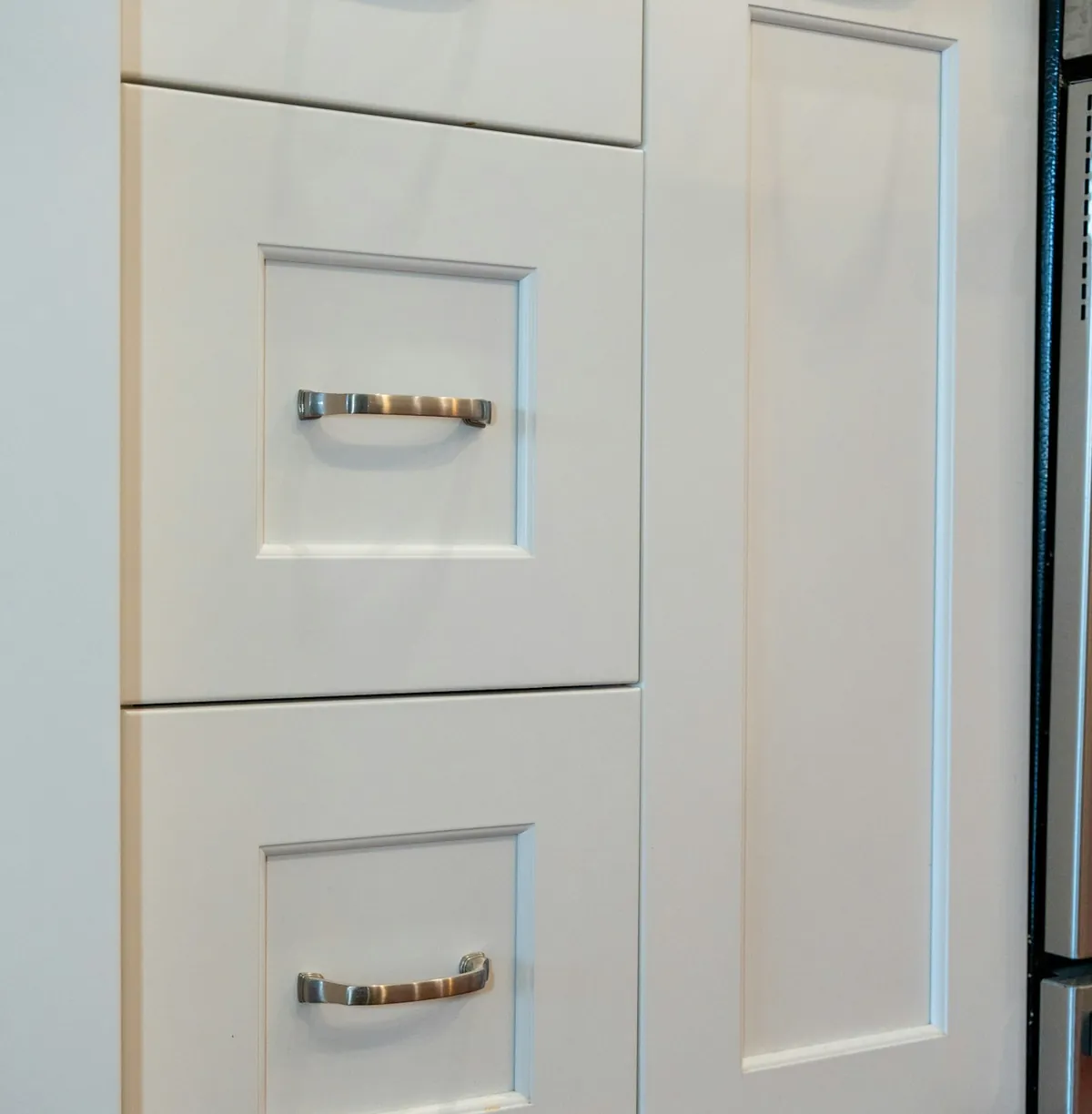
If you get the chance to see a finished kitchen, look at the things that are hard to fake rather than the things that photograph well. Four details tell you almost everything about the standard of work.
- Reveals. Close every door and sight along the run at eye level. Even gaps mean somebody did the adjustment pass; drifting gaps mean they did not.
- The filler strips. Look where a run meets a wall. A scribed filler follows the wall and disappears; a square filler in a leaning wall leaves a tapering gap you cannot unsee.
- The end panels. Every exposed cabinet end should be finished, and the joint between panel and carcass should be tight rather than caulked.
- Inside the sink base. Open it. Look at the material, the edge sealing and whether the plumbing penetrations are neatly cut.
The sink base is the most revealing of the four, because it is the cabinet nobody expects a client to inspect. A neatly made sink base in the right material is a reliable signal about everything you cannot see.
What the Contract Should Say Beyond the Price
Five things, none of which is unusual to ask for, and all of which prevent a specific argument later.
| Term | What it prevents |
|---|---|
| The approved drawing referenced by date or version | A dispute about which version of the layout was agreed |
| Material named by location, not in general | A sink base that turns out not to be plywood |
| Hardware brand and series named | Soft close of an unspecified quality |
| What happens to the existing cabinets | A surprise disposal charge, published nationally at about $300 |
| Payment stages tied to delivered value | A schedule that runs ahead of the work, which BPC 7159.5(a)(5) bars |
Applying This to Us
Every question on this page is one you should ask whoever quotes your job, including us, and every one of them has a specific answer. Ask where the cabinets will be made. Ask which boxes are plywood, by position. Ask what moisture content the stock is at. Ask which hinge and runner series. Ask what finish system and whether it meets the 275 gram per litre ceiling that applies in this district. Ask how the scribe allowance is handled at each wall.
A quote that comes back without a drawing, without materials named by location and without hardware named is a quote you cannot check, whoever it came from. That is the standard this page is arguing for, and it applies in both directions.