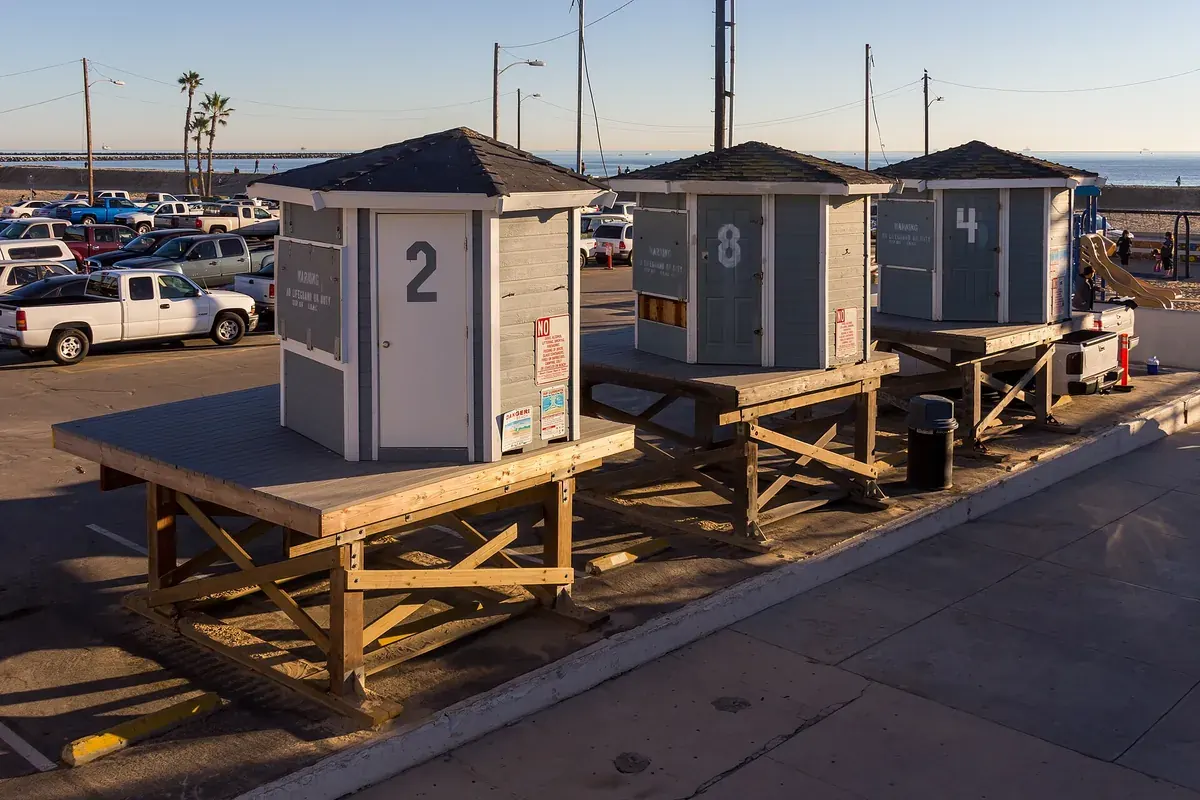
Seal Beach: Small City, Large Base
Seal Beach had 25,242 residents at the 2020 Census, up from 24,168 in 2010, and it sits in the westernmost corner of Orange County. It was originally known as Bay City and was incorporated into Orange County under its present name on 24 October 1915. A majority of the city's acreage is given over to the Naval Weapons Station Seal Beach, which is why a city with a substantial footprint has a comparatively small residential population.
Its neighbours map the western end of this service area neatly. Long Beach and San Pedro Bay lie just across the Los Angeles County line to the north-west. Huntington Harbour and Sunset Beach, both neighbourhoods of Huntington Beach, lie to the south-east. Westminster and West Garden Grove are to the east, and the unincorporated community of Rossmoor and the city of Los Alamitos are to the north.
For cabinet work, the useful consequence of all that is compactness. Seal Beach homes skew smaller than the county average, and small homes are where measuring properly pays the largest dividend.
Designing Cabinets for a Small Coastal Home
Four moves do most of the work in a compact kitchen, and all four are cabinetry decisions rather than appliance ones.
1. Go to the ceiling
Stopping wall cabinets a foot short of the ceiling creates a dust shelf and throws away the storage that is easiest to give up and hardest to reclaim. In a small kitchen that top band is the difference between having somewhere for the things used twice a year and having them in the garage.
2. Drawers instead of doors at base level
A base cabinet with a door and one shelf wastes the back third of its depth, and in a small kitchen you cannot afford to waste a third of anything. Drawers cost more per linear foot, and in a short run that premium is a smaller absolute number than people expect.
3. Reduce depth where depth is not needed
A narrow galley can often take a shallower run on one side, which buys back walking width in exchange for storage you were not reaching anyway. That is a decision only available if the cabinets are built to a dimension you choose.
4. Solve the corner deliberately
A blind corner in a small kitchen is a larger proportion of the total volume than it is in a big one, so leaving it dead is more costly here. A corner mechanism, a diagonal cabinet, or designing the corner out entirely are all valid, and which one is right depends on what sits either side of it.
| Move | What it costs | What it returns |
|---|---|---|
| Wall cabinets to the ceiling | A little more panel and one extra shelf | A whole band of seasonal storage |
| Drawers instead of doors at base level | More hardware and more joinery per foot | The back third of every base cabinet |
| Shallower run on one side of a galley | Some storage depth you were not reaching | Walking width, which is the scarce resource |
| A corner mechanism or a redesigned corner | Mechanism cost, or a layout change | Volume that was previously unreachable |
| Built-to-measure widths | The custom rate rather than the stock rate | Every inch currently going into filler strips |
Coastal Hardware, Which Matters Here More Than Most Places
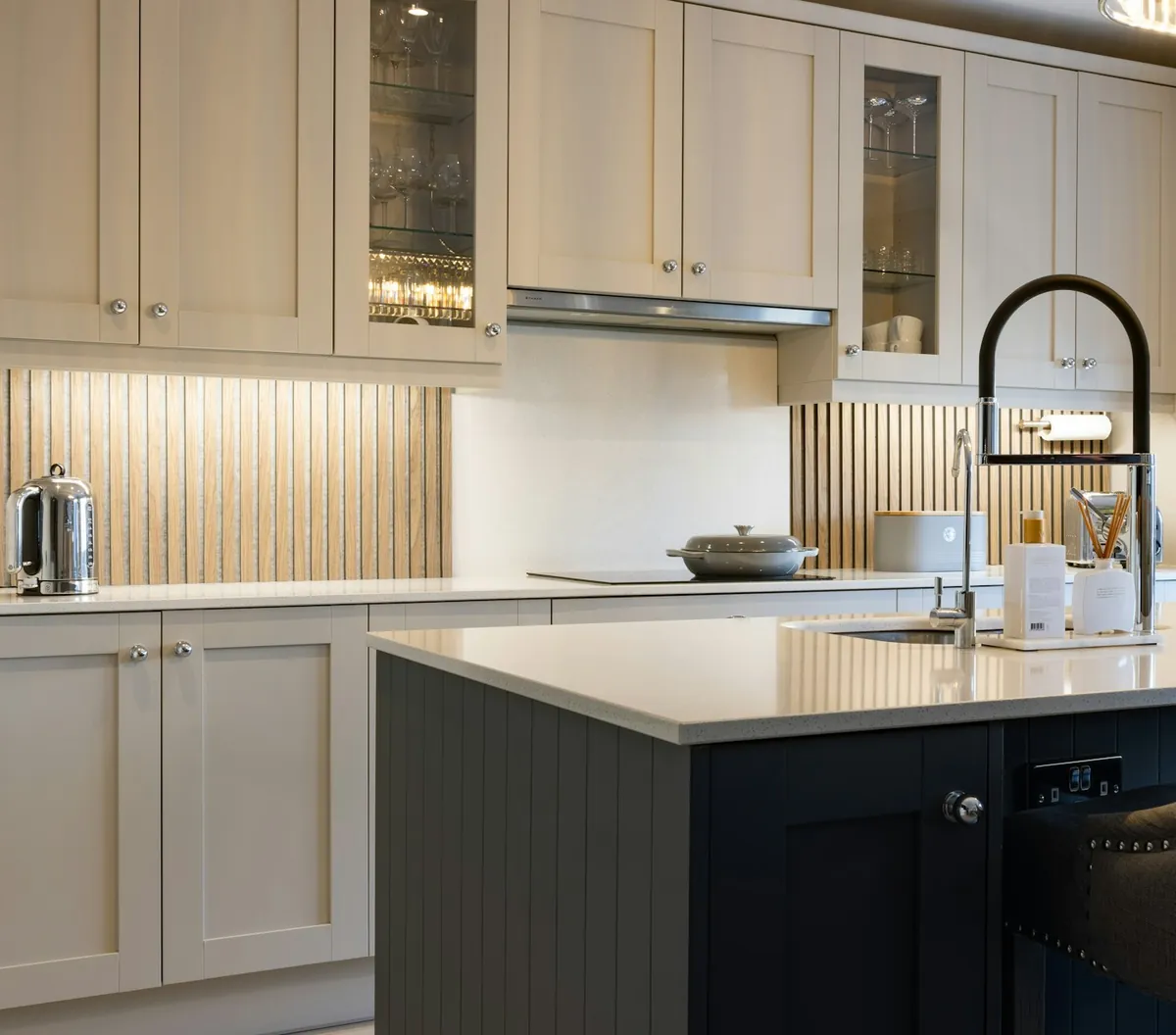
Seal Beach is on the water, and salt-laden air is genuinely aggressive towards plated steel. That makes hardware plating a real line item rather than a detail, and it is worth naming in the quote rather than assuming.
The failure mode is slow and unglamorous. A hinge develops surface pitting. A drawer runner under a heavy pot drawer gets notchy and then sticks. A cheap screw in a painted stile bleeds a rust stain through the finish eighteen months after the kitchen went in. None of these are dramatic, and all of them are avoidable by specifying properly at the start.
What does not need to change is the timber. The USDA Forest Products Laboratory Wood Handbook records the nearest listed station, Los Angeles, at 9.4 percent equilibrium moisture content in January and 11.7 in June, a band of 2.3 points across a whole year. Compare Fresno at 8.4 points or Chicago at 2.8 points from a much higher base. Wood moves with the change rather than the level, and this coast changes very little. The coastal moisture guide works through it.
Services in Seal Beach
Every service on this site runs here. The ones that come up most in a compact coastal city are kitchens, vanities and refacing, plus a steady amount of built-in work, because in a small home a scribed built-in is often the only way to add storage without losing floor area.
What It Costs in Seal Beach
Published rates are regional, and in a city of smaller homes the run length rather than the rate is what decides a total. A 12 foot kitchen at a custom rate is frequently a smaller number than a 25 foot kitchen at a semi-custom one, which is worth understanding before ruling a tier out on principle.
| Figure | Value | Scope |
|---|---|---|
| Custom cabinetry per linear foot | $500 to $1,500 | Published Los Angeles area range |
| Stock, installed per linear foot | $75 to $400 and up | National |
| Semi-custom, installed per linear foot | $150 to $900 and up | National |
| Custom, installed per linear foot | $500 to $1,400 and up | National |
| Laminate refacing, 12 cabinets | $1,576 to $2,482 | Published Huntington Beach estimate |
| Refacing, per cabinet | $131 to $207 | Published Huntington Beach estimate |
Read at source 30 September 2026. Refacing is priced per cabinet, which favours a small kitchen; new cabinetry is priced per linear foot, which also favours a small kitchen. Both are worth pricing properly before choosing.
Permits, Licensing and Coating Limits
The cabinet permit exemption is in the California Residential Code and is statewide. Plumbing, gas and electrical work are not exempt anywhere, and in Seal Beach they go through the city's own building department. Coastal properties can carry additional overlays that inland ones do not, so confirming scope with the city before starting is genuinely worth doing here.
Licensing is statewide: a California C-6 licence covers Cabinet, Millwork and Finish Carpentry, and the CSLB Check a License page confirms any number quickly. The deposit cap under Business and Professions Code section 7159.5 is $1,000 or 10 percent of the contract, whichever is less.
Seal Beach is inside the South Coast Air Quality Management District, whose own jurisdiction page describes a four-county jurisdiction covering Los Angeles, Orange, Riverside and San Bernardino counties. Two rules reach cabinetry: Rule 1136 for coatings applied in a shop, and Rule 1113 for coatings applied on site, which is what in-place refinishing, painting and touch-up all are. Since so much work in this city is in-place work on existing cabinetry, Rule 1113 is the one that bites here most often.
| Rule and where it applies | Category | Limit in g/L |
|---|---|---|
| Rule 1113, applied on site | Wood coatings | 275, no small container exemption |
| Rule 1113, applied on site | Varnish | 275, no small container exemption |
| Rule 1113, applied on site | Sanding sealers | 275, no small container exemption |
| Rule 1113, applied on site | Lacquer | 275, no small container exemption |
| Rule 1113, applied on site | Interior stains | 250 |
| Rule 1113, applied on site | Wood conditioners | 100 |
| Rule 1113, applied on site | Primers, sealers and undercoaters | 100 |
| Rule 1136, shop applied | Clear and pigmented primers, sealers, undercoats, topcoats | 275 |
| Rule 1136, shop applied | Fillers and other coatings | 275 |
| Rule 1136, shop applied | High-solids stains and japans | 350 |
| Rule 1136, shop applied | Low-solids stains, toners and washcoats | 120, per litre of material |
| Rule 1136, shop applied | Strippers | 350, plus a 2 mmHg vapour pressure limit at 20 C |
Sources: South Coast AQMD Rule 1113, Architectural Coatings, amended 5 February 2016, Table of Standards 1, and Rule 1136, Wood Products Coatings, adopted 16 September 1983 and amended 5 June 2026, Tables 1 and 2. Both read at source 30 September 2026.
Three practical consequences for Seal Beach work. The four wood categories under Rule 1113 carry no small container exemption while most other categories in the same table do, so a small tin or an aerosol brought to site is not exempted by being small. The 350 gram limit on strippers, together with a composite vapour pressure limit of 2 mmHg or less at 20 degrees Celsius, is directly relevant in a city where stripping back an old painted finish is a common request. And Rule 1136 states expressly that it does not apply to residential non-commercial operations, which is why a homeowner's own materials are not governed the same way as a professional's.
Read alongside the lead rules below, those two facts explain something that otherwise looks like fussiness. Stripping an old painted cabinet finish in a pre-1978 Seal Beach house is simultaneously governed by a federal certification requirement and a district limit on the stripper itself. That is not a reason to avoid the job, and it is a good reason to use somebody who knows both rules exist.
Seal Beach Has the Oldest Housing Stock on This List, and the Lead Rule Follows
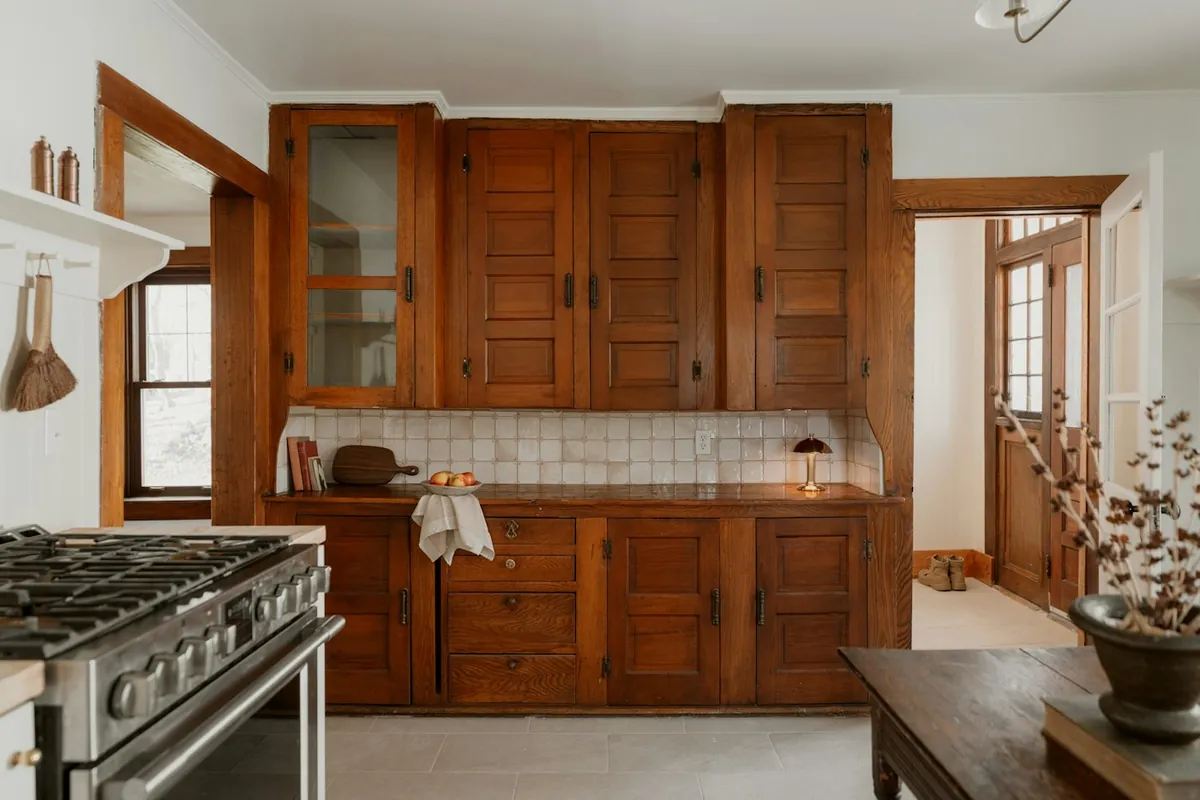
Seal Beach was incorporated into Orange County on 24 October 1915, and its population went from 24,168 in 2010 to 25,242 in 2020. A city that added about a thousand people in a decade is not a city building much new housing, which means the overwhelming majority of what is here predates the federal lead-paint cut-off of 1978. That makes the lead rules the single most consequential legal fact about cabinet work in this city.
There is a second reason the stock is fixed. A majority of Seal Beach's acreage is Naval Weapons Station Seal Beach, so the residential footprint is small and bounded. New supply has nowhere obvious to go, which is why the answer to almost any cabinet question here begins with the age and condition of what is already in the house.
The Environmental Protection Agency states the background. In 1978 the federal government banned the sale of lead-based paint for use in homes, childcare facilities and preschools, and approximately three-quarters of homes in the United States built before 1978 still contain some lead-based paint. Those homes are safe to live in while paint and surfaces are in good condition and kept clean; old or worn lead-based paint on surfaces subject to constant friction, such as doors, can produce chips and dust that become hazardous when inhaled or ingested. A cabinet door is a surface subject to constant friction.
The Renovation, Repair and Painting Rule therefore requires that anyone paid to perform work that disturbs painted surfaces in those homes be certified, with employees trained either as a certified renovator or on the job by one, in lead-safe work practices. The EPA states this includes all firms, even sole proprietorships, and names general contractors and special trade contractors including painters, plumbers, carpenters and electricians. Its published list of covered activities is remodeling and repair or maintenance, electrical work, plumbing, painting preparation, carpentry, and window replacement.
The exemption, and the two things it never covers
The rule does have a minor-work exemption, and it is worth knowing its exact boundary. The EPA excludes minor repair and maintenance activities that disturb six square feet or less of paint per room inside, or 20 square feet or less on the exterior of a home or building. Attached to it is a note that removes most real cabinet work from the exemption: window replacement and demolition of painted surfaces are always covered regardless of square footage, and activities designated as prohibited are prohibited regardless of square footage.
Six square feet sounds generous until you apply it to a small Seal Beach kitchen. Stripping the doors and fronts off a compact run and preparing the painted face frames is abrasive work across a lot of narrow components, and the surrounding wall almost always gets made good at the same time. Taking the old run off the wall is demolition of painted surfaces, and square footage does not rescue it.
| Situation | Covered? |
|---|---|
| Paid work disturbing paint in a pre-1978 house, which is most of the city | Yes, firm certification and trained renovators required |
| Removing an existing painted cabinet run | Yes, demolition of painted surfaces is always covered |
| Sanding painted face frames before refacing | Yes in practice, once six square feet per room is exceeded |
| Installing new cabinetry into a stripped opening with no paint disturbed | No, if genuinely no painted surface is disturbed |
| Housing built in 1978 or later | No |
| Homeowner doing the work in their own pre-1978 home | Generally no, unless the home is rented in whole or part, runs a childcare centre, or is being renovated for resale at a profit |
| A component declared lead-free by a certified inspector, risk assessor or renovator | No |
Source: EPA, Lead Renovation, Repair and Painting Program and its Contractors page, both read at source 30 September 2026.
Testing is optional and its absence is not neutral. Paint testing is not required by the rule, but unless you have documentation that the paint is not lead-based, the requirements of the rule apply. Where testing is done it must cover all surfaces to be affected by the work, and each method is restricted: EPA-recognised test kits to certified renovators, X-ray fluorescence instruments to certified lead-based paint inspectors or risk assessors, and paint chip sampling to a certified renovator, inspector or risk assessor. California is not among the states authorised to run their own programme, so the EPA administers it here directly, and its National Lead Information Center answers questions on 1-800-424-5323.
Cost in a City of Small Old Kitchens
Small kitchens keep totals down and push the decision towards keeping the boxes, which is the honest shape of the Seal Beach market. Here is the arithmetic, using published figures with the multiplication shown.
| Seal Beach kitchen | Typical run | Low | High |
|---|---|---|---|
| Compact single-wall in an older cottage | 12 linear feet | $6,000 | $18,000 |
| Small galley or L | 16 linear feet | $8,000 | $24,000 |
| Larger detached, reworked layout | 26 linear feet | $13,000 | $39,000 |
Per-linear-foot band from a published Los Angeles cabinet maker's cost guide, read at source 30 September 2026, used as the nearest printed benchmark to Orange County. Run lengths are typical for the housing type, not published figures. Countertops, appliances and any plumbing or electrical work are separate.
Now the box-keeping alternatives, using the nearest city-specific published figures, which are Huntington Beach ones. Laminate refacing of a 12 cabinet kitchen is published at $1,576 to $2,482, working out at $131 to $207 per cabinet, with a breakdown of 26.2 hours of labour at $978 to $1,729, job materials and supplies at $545 to $683 and an equipment allowance of $53 to $71. Refinishing is published at $1,079 to $6,002, or about $4 to $10 per square foot. Painting is published at $1,060 to $5,899, with labour around $70 to $120 per hour.
Put those two sets of numbers side by side and the Seal Beach logic is obvious. A 12 linear foot cottage kitchen replaced in custom cabinetry is $6,000 to $18,000. The same kitchen refaced is $1,576 to $2,482. Refacing is therefore somewhere between a quarter and a tenth of the cost, and in a small kitchen the layout is usually not what people are unhappy with anyway.
A published national source covers the smaller items either route may involve: installation of a cabinet box at about $100, a finished end at $100 to $200, crown moulding at about $70 per eight foot section, and removal of existing cabinetry at around $300. It also puts a typical whole installation at $482 to $2,167 with most people around $1,044, and extremes of $164 and $6,187. Those are national figures and are labelled as such.
Most Seal Beach Kitchens Are Past the Published Life Expectancy
Kitchen cabinets are expected to last up to 50 years, and a city that incorporated in 1915 has a lot of kitchens older than that. Applied honestly, that is the most useful framing available for cabinet decisions here.
| Component | Expected life |
|---|---|
| Closet shelves | A lifetime |
| Natural stone countertops | A lifetime |
| Garage and laundry cabinets | 100 or more years |
| Kitchen cabinets | Up to 50 years |
| Medicine cabinets | 20 or more years |
| Cultured marble countertops | About 20 years |
Source: NAHB and Bank of America Home Equity, Study of Life Expectancy of Home Components, February 2007, from a comprehensive telephone survey of manufacturers, trade associations and researchers conducted in summer 2006.
The study attaches caveats that matter more here than in a newer city. Many of the people interviewed emphasised that the life expectancy of housing components is greatly affected by the quality of maintenance, and noted that changing consumer preferences can result in products being replaced long before, or after, the end of their practical life expectancy. The study also states that life expectancies depend on the quality of installation, the level of maintenance, weather and climate conditions, and the intensity of use.
Read against Seal Beach's stock, this produces a genuinely useful rule of thumb rather than a sales line. A kitchen from the 1970s is roughly at the end of the published expectancy, which means the carcass condition has to be checked rather than assumed. A kitchen from the 1990s is halfway through, which is precisely when replacing the face rather than the cabinet is the better use of money. And a kitchen from the 1940s that is still sound has outlived the figure, which is worth knowing before anybody describes it as beyond saving.
Formaldehyde Limits on the New Material
Whatever route you take, new panels come into the house, and California sets numerical formaldehyde emission ceilings on them that differ by material.
The California Green Building Standards Code requires hardwood plywood, particleboard and medium density fibreboard composite wood products used on the interior or exterior of a building to meet the formaldehyde requirements specified in the Air Resources Board's Air Toxics Control Measure for Composite Wood, at Title 17 of the California Code of Regulations section 93120 and following. Products not exempted must meet the printed limits, tested per ASTM E1333.
| Product | Current limit |
|---|---|
| Hardwood plywood, veneer core | 0.05 |
| Hardwood plywood, composite core | 0.05 |
| Particleboard | 0.09 |
| Medium density fibreboard | 0.11 |
| Thin medium density fibreboard, maximum 5/16 inch | 0.13 |
Limits from the California Green Building Standards Code, residential mandatory measures section 4.504.5, with the identical table printed at 5.504.4.5, read at source 30 September 2026.
The code lists three acceptable forms of documentation, and each is something a homeowner can request by name: product certifications and specifications, chain of custody certifications, or product labelled and invoiced as meeting the Composite Wood Products regulation. Exterior grade material may instead be marked to the PS-1 or PS-2 standards of the Engineered Wood Association, the Australian AS/NZS 2269 standard or European 636 3S. Federal law under the Toxic Substances Control Act Title VI has separately required covered composite wood products to be labelled compliant by an EPA-recognised third-party certifier since 22 March 2019.
In a small kitchen this has slightly more weight than it does in a large one, for the straightforward reason that the same panel area sits in less air. That is an argument for asking rather than an argument for alarm, and the plywood specification recommended elsewhere on this site for sink bases happens to carry the lowest ceiling in the table.
The One Independent Check on What You Are Buying
Ask whether the cabinetry, or the replacement doors and fronts, carry ANSI/KCMA A161.1 certification. It is the only third-party performance standard in cabinetry a homeowner can verify.
The Kitchen Cabinet Manufacturers Association describes A161.1 as covering rigorous tests of structural strength, drawer and door integrity, and finish durability. It states that certified cabinets have passed 14 rigorous tests, including a 600-pound load test, to simulate a lifetime of use, and that between 40 and 50 percent of cabinets fail their first certification attempt. It also states that certified cabinets are available at every price point, from builder-grade units to high-end custom designs, and that it acts as a mediator to facilitate a resolution with the manufacturer where a homeowner has an issue with a certified cabinet.
Two further seals exist. The Environmental Stewardship Program certifies manufacturers adhering to sustainability practices. The Severe Use Certification was, in KCMA's account, originally developed by the United States Department of Housing and Urban Development for the exceptionally high wear that apartment building kitchens often encounter, which makes it the relevant benchmark for a let unit rather than an owner-occupied cottage.
Wood Movement at the Westernmost Corner of Orange County
Seal Beach sits at the westernmost corner of Orange County, across the Los Angeles County line from Long Beach and San Pedro Bay, and it is in the most dimensionally stable published moisture regime in the state. The numbers are federal rather than promotional, and they contradict the standard coastal sales pitch.
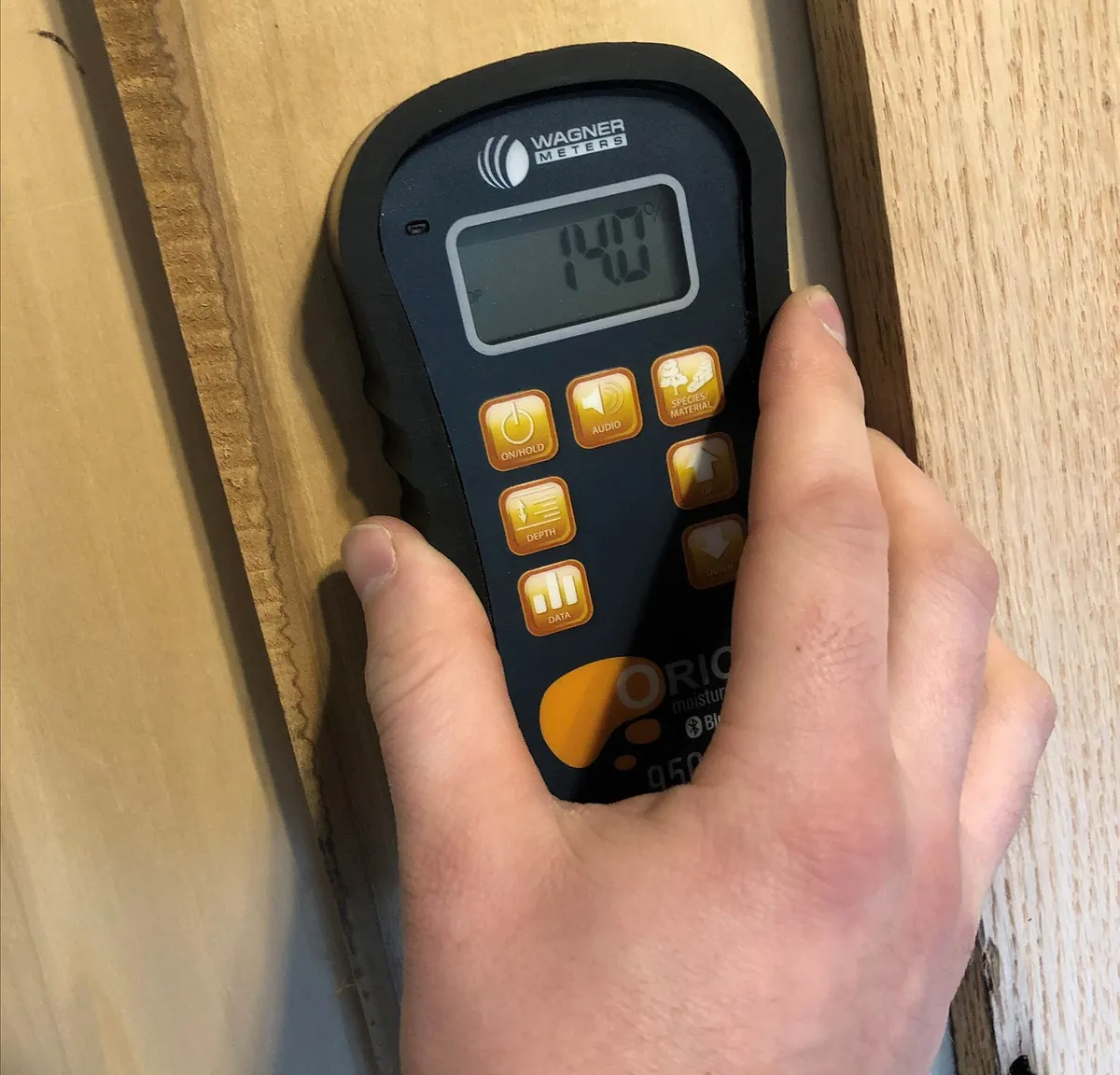
The USDA Forest Service Forest Products Laboratory Wood Handbook tabulates equilibrium moisture content for outside conditions at United States stations, based on average relative humidity and temperature data over 30 or more years from the National Climatic Data Center, averaging morning and afternoon values. The nearest listed station is Los Angeles, which is close by in both distance and climate, and it runs 9.4, 10.2, 10.5, 10.4, 11.0, 11.7, 11.6, 11.2, 10.8, 10.6, 9.8 and 9.9 percent across the twelve months. That is a band of 2.3 percentage points, and unusually the wettest months are the summer months.
The Handbook publishes a dimensional change equation, valid between 6 and 14 percent moisture content, in which the change equals the starting dimension multiplied by a species coefficient multiplied by the change in moisture content. Its own worked example is a flat-grained white fir board 9.15 inches wide at 8 percent moisture content, changing by 9.15 x 0.00245 x 3, or 0.067 inches, at 11 percent. Across a 24 inch flat-sawn panel and the measured local band:
| Species | Tangential coefficient | Movement |
|---|---|---|
| Old growth redwood | 0.00205 | 0.113 in |
| Western red cedar | 0.00234 | 0.129 in |
| Black cherry | 0.00248 | 0.137 in |
| Douglas fir, coast type | 0.00267 | 0.147 in |
| Black walnut | 0.00274 | 0.151 in |
| Sugar maple | 0.00353 | 0.195 in |
| White oak | 0.00376 | 0.208 in |
| American beech | 0.00431 | 0.238 in |
Coefficients from Wood Handbook Table 13-5. Movement computed with the Handbook's own equation: 24 x coefficient x 2.3. The same sugar maple panel across Fresno's published 7.4 to 15.8 percent band moves 0.712 in.
The Handbook also states the shop target that follows: hardwood and softwood lumber for furniture, cabinetry and millwork usually has a final moisture content of 6 to 8 percent and can be specified to be free of drying stresses. The governing principle it gives is to match the moisture content of lumber as closely as is practical to the equilibrium moisture content conditions in service, which is the reason a few days of acclimatisation in the house before fixing is worth the delay.
What the ocean genuinely changes in Seal Beach is hardware rather than wood. Salt-laden air attacks plated steel, so hinge, runner and pull plating is a real specification item here rather than a detail. That is a materials selection judgement rather than a published figure, and it is covered above. What it is not is a reason to avoid timber cabinetry in a coastal house.
The Contract, the Licence and the Deposit Cap
These protections are state-level, so they read the same in Seal Beach as anywhere in California, and in a city where much of the work is modest in value they are the rules most often skipped.
Business and Professions Code section 7048 exempts work from the licensing chapter only where the aggregate contract price for labour, materials and all other items is less than one thousand dollars, and only where the work does not require a building permit, describing that work as of casual, minor or inconsequential nature. Subdivision (b) voids the exemption where the work is part of a larger operation or where a job has been split to evade the chapter, and subdivision (c) removes it from anyone who advertises as if licensed. Even a small Seal Beach refacing job at the published $1,576 low end exceeds the threshold, so the exemption will not apply.
The classification to ask for is C-6, Cabinet, Millwork and Finish Carpentry. The Contractors State License Board describes a C-6 contractor as one who makes cabinets, cases, sashes, doors, trims, nonbearing partitions and other items of finish carpentry by cutting, surfacing, joining, gluing and fabricating wood or other products to provide a functional surface. Verification takes about ninety seconds on the CSLB Check a License page.
On money, section 7159 requires home improvement contracts over five hundred dollars to be in writing, which covers essentially every job here. Section 7159.5 caps the downpayment at one thousand dollars or 10 percent of the contract amount, whichever amount is less, and adds that except for a downpayment, the contractor shall neither request nor accept payment that exceeds the value of the work performed or material delivered. On a $2,400 refacing job, 10 percent is $240, and that is the lawful maximum because it is the lower of the two figures. On a $16,000 kitchen the cap is $1,000.
One provision surprises people. The three-day and five-day right to cancel notices required under section 7159 are not required where the contract is negotiated at the contractor's place of business, so a showroom signature carries no cooling-off window while the same contract signed at your kitchen table does.
- EPA lead-safe firm certification confirmed, because nearly all of this city predates 1978
- C-6 licence number in writing and checked on the CSLB Check a License page
- Written contract, since any home improvement contract over five hundred dollars must be
- Deposit no greater than one thousand dollars or 10 percent, whichever is less
- Sink base carcass tested for softness and tidemarks before refacing is agreed
- Cabinetry invoiced as meeting the Composite Wood Products regulation
- Hinge, runner and pull plating specified by brand and series, given the coastal position
Cabinetry for a Long-Tenure Household
The published reference for cabinetry somebody can reach from a seated position is the ADA Standards, and the figure to design from is the unobstructed forward reach range of 15 to 48 inches. In a city with very little turnover in its housing stock, that range is worth designing to well before anybody needs it.
Those standards govern public accommodations rather than private houses, so nothing here is a requirement on a Seal Beach home. They are the best-tested dimensions available, which makes them a better reference than a guess.
The United States Access Board draws the distinction that makes the range usable. Section 308.2 provides that the range for unobstructed reaches, 15 inches to 48 inches, applies only to those portions of elements that are operable, and that non-operable portions can be located outside the range. Operable parts are covered by section 205 and include light switches, electrical and communication receptacles, thermostats and other elements used by occupants, which in a kitchen means every pull, the tap and the switches. So a tall bottom drawer is fine provided its pull sits above 15 inches, which argues for fewer and deeper drawers rather than a stack of shallow ones.
Where a forward reach passes over a counter, section 309.2 requires clear floor space to extend up to, or where knee or toe space is provided, below the operable parts, and the knee and toe space must be at least as deep as the reach depth measured from the leading edge of the obstruction. Where clear floor space is obstructed on both sides for more than half the minimum required depth, a wider clearance of 36 inches minimum is required for manoeuvring and sway. That last clause is usually the binding constraint in the small galley kitchens common in this city, because a galley is obstructed on both sides by definition.
| Element | Published figure | Consequence in a small kitchen |
|---|---|---|
| Unobstructed forward reach range | 15 in to 48 in | Every pull, tap and switch inside the band |
| Non-operable portions | May fall outside the range | Fewer, deeper drawers beat a stack of shallow ones |
| Knee and toe space depth | At least as deep as the reach depth from the leading edge | A deeper counter needs a deeper open recess underneath |
| Clear floor space, obstructed both sides | 36 in minimum where obstruction exceeds half the required depth | Usually the binding constraint in a galley |
Source: United States Access Board, Guide to the ADA Accessibility Standards, Chapter 3: Operable Parts, read at source 30 September 2026, covering sections 205, 308.2 and 309.2. Public accommodation standards used here as a design reference for a private home, not as a requirement.
One thing worth saying plainly. In an existing small kitchen, converting doors to drawers is both the cheapest accessibility improvement available and the one that makes the biggest difference, because a drawer brings the contents out to the person instead of requiring the person to reach into the cabinet. It is also work that can often be done in existing carcasses, which keeps it inside the box-keeping economics set out above.
The Rest of This Stretch of Coast
Seal Beach is the north-western end of this service area, and everything to its south-east is covered: Sunset Beach, Huntington Beach including Huntington Harbour, Westminster, Fountain Valley, Costa Mesa and Newport Beach.