
Costa Mesa: a Bigger, Denser Neighbour
Costa Mesa had 111,918 residents at the 2020 Census, which makes it substantially larger than every other city on this site's service list except Huntington Beach itself. It incorporated in 1953, at which point it was a semi-rural farming community of 16,840 people, and almost everything about the city today is a product of what happened after that.
The economy is built on retail, commerce and light manufacturing, and the city contains part of the South Coast Plaza and John Wayne Airport edge city, described as one of the region's largest commercial clusters. That matters for a cabinet maker for a practical reason: a large commercial core surrounded by residential neighbourhoods produces a very mixed housing stock, from small post-war lots through 1960s and 1970s tract to newer attached and multi-family development.
That mix is the useful thing to understand about working here. Huntington Beach is fairly uniform, a city of single-storey tract houses on a grid. Costa Mesa is not, and the right cabinet answer changes considerably between a 1955 bungalow near the older neighbourhoods and a 2005 townhouse near the commercial core.
What the Housing Stock Means for Cabinets
Three broad categories, each with a different cabinet answer.
Post-war and early tract, roughly 1950s to 1960s
The stock closest to Huntington Beach's in character, and the one where built-to-fit cabinetry earns most. Framing from this era leans, ceiling heights drift across a room, and the original kitchens were drawn around appliance dimensions that no longer exist. Filler strips in these kitchens routinely do three or more inches of work along a single wall, which is a cabinet's worth of storage given away to trim.
Later tract and infill, 1970s to 1990s
Better framing, more consistent ceiling heights, and kitchens that were often already designed around a dishwasher. These are the houses where refacing most often turns out to be the right answer, because the boxes are square and the layout is workable and only the face has dated. Published Huntington Beach refacing estimates, which apply equally here, put laminate refacing of a 12 cabinet kitchen at $1,576 to $2,482.
Attached and multi-family
Condominiums and townhouses, which bring a different set of constraints: association rules, access and delivery logistics, working-hours restrictions and in some cases limits on what can be altered in a shared wall. The cabinetry is unaffected; the scheduling is not, and it is planned in at the start.
| Housing type | Typical cabinet issue | Usual answer |
|---|---|---|
| Post-war and early tract | Leaning walls, obsolete appliance openings, heavy filler use | Cabinetry drawn to the measured wall |
| Later tract and infill | Dated door style on sound square boxes | Refacing, or new doors and fronts |
| Attached and multi-family | Access, scheduling and association rules | Same cabinetry, planned around the building's rules |
| Larger detached, newer | Layout rather than construction | Islands, pantry runs, built-ins |
Every Service, Available in Costa Mesa
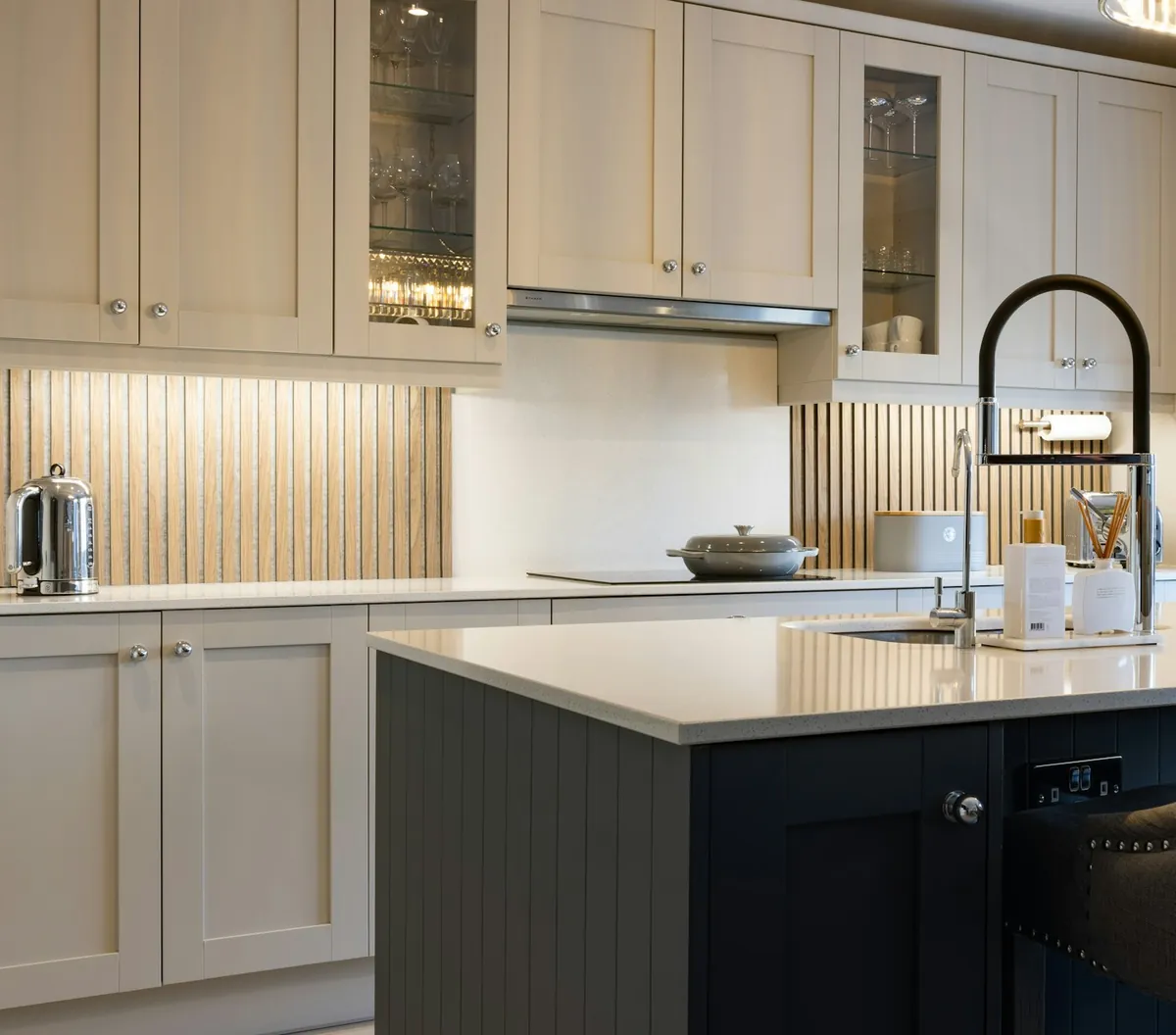
The full list runs here exactly as it runs in Huntington Beach: kitchens, islands, vanities, built-ins, closets and pantries, garage storage, laundry and mudroom runs, wet bars, replacement doors and fronts, refacing, refinishing, painting and installation-only work.
The two most requested in this city are full kitchens in the older stock and vanities everywhere, which is a common pattern in a city with a lot of two-bathroom houses and a lot of owners working through rooms one at a time. A vanity is also the easiest single custom cabinet to justify, because in a small room two inches lost to a filler strip is a large percentage of the drawer width.
Permits and Licensing for Costa Mesa
The permit rule is state-level, not city-level, which is the useful thing to know. The California Residential Code lists "Painting, papering, tiling, carpeting, cabinets, counter tops and similar finish work" as exempt from permit, and that applies in Costa Mesa exactly as it applies in Huntington Beach. What is city-level is who administers the permits you do need, and in Costa Mesa that is the city's own building department rather than Huntington Beach's.
The licensing rules are also state-level. Ask for a California C-6 licence, Cabinet, Millwork and Finish Carpentry, or a B General Building licence for wider work, and check the number on the CSLB Check a License page. The statutory deposit cap of $1,000 or 10 percent of the contract, whichever is less, applies here too, under Business and Professions Code section 7159.5. The permits and licensing guide quotes the operative provisions of each statute.
Finishing Rules Apply Here Too
Costa Mesa is inside the South Coast Air Quality Management District, whose four-county jurisdiction covers Los Angeles, Orange, Riverside and San Bernardino counties. That means the same coating limits apply as in Huntington Beach: Rule 1136 caps clear and pigmented topcoats, primers, sealers and undercoats at 275 grams of volatile organic compounds per litre for shop finishing, and Rule 1113 caps wood coatings, varnish, sanding sealers and lacquer at 275 each and interior stains at 250 for coatings applied on site.
It is worth knowing because it explains why quotes from inside the district look different from quotes brought in from elsewhere. Here are the operative numbers from both rules.
| Category | Limit |
|---|---|
| Clear primers, sealers and undercoats | 275 |
| Pigmented primers, sealers and undercoats | 275 |
| Clear topcoats | 275 |
| Pigmented topcoats | 275 |
| Fillers | 275 |
| Other coatings | 275 |
| High-solids stains | 350 |
| Japans | 350 |
| Low-solids stains, toners and washcoats | 120, as VOC per litre of material |
| Strippers | 350, with a composite vapour pressure limit of 2 mmHg or less at 20 C |
Source: South Coast AQMD Rule 1136, Wood Products Coatings, adopted 16 September 1983 and amended 5 June 2026, Tables 1 and 2, read at source 30 September 2026. Rule 1136's definition of wood products expressly includes cabinets for the kitchen, bath and vanity.
| Category | Limit | Small container exemption |
|---|---|---|
| Wood coatings | 275 | None listed |
| Varnish | 275 | None listed |
| Sanding sealers | 275 | None listed |
| Lacquer | 275 | None listed |
| Stains, interior | 250 | Yes |
| Wood conditioners | 100 | None listed |
| Primers, sealers and undercoaters | 100 | Yes |
| Nonflat coatings | 50 | Yes |
| Flats | 50 | Yes |
Source: South Coast AQMD Rule 1113, Architectural Coatings, amended 5 February 2016, Table of Standards 1, read at source 30 September 2026.
Three things follow that are worth carrying into a Costa Mesa quote comparison. The four wood categories in Rule 1113 carry no small container exemption while most other categories in the same table do, so an aerosol touch-up can is not exempted by being small. Rule 1136 offers an alternative compliance route, allowing a facility to use an approved air pollution control system that reduces VOC emissions by an equivalent or greater amount than the specified limits, which is why some larger shops finish differently from small ones. And Rule 1136 expressly does not apply to residential non-commercial operations, which is the honest explanation of why a homeowner's own weekend spray job is not governed the same way as a professional's. The finishing rules guide works through both rules in full.
The 1978 Line Runs Through the Middle of Costa Mesa's History
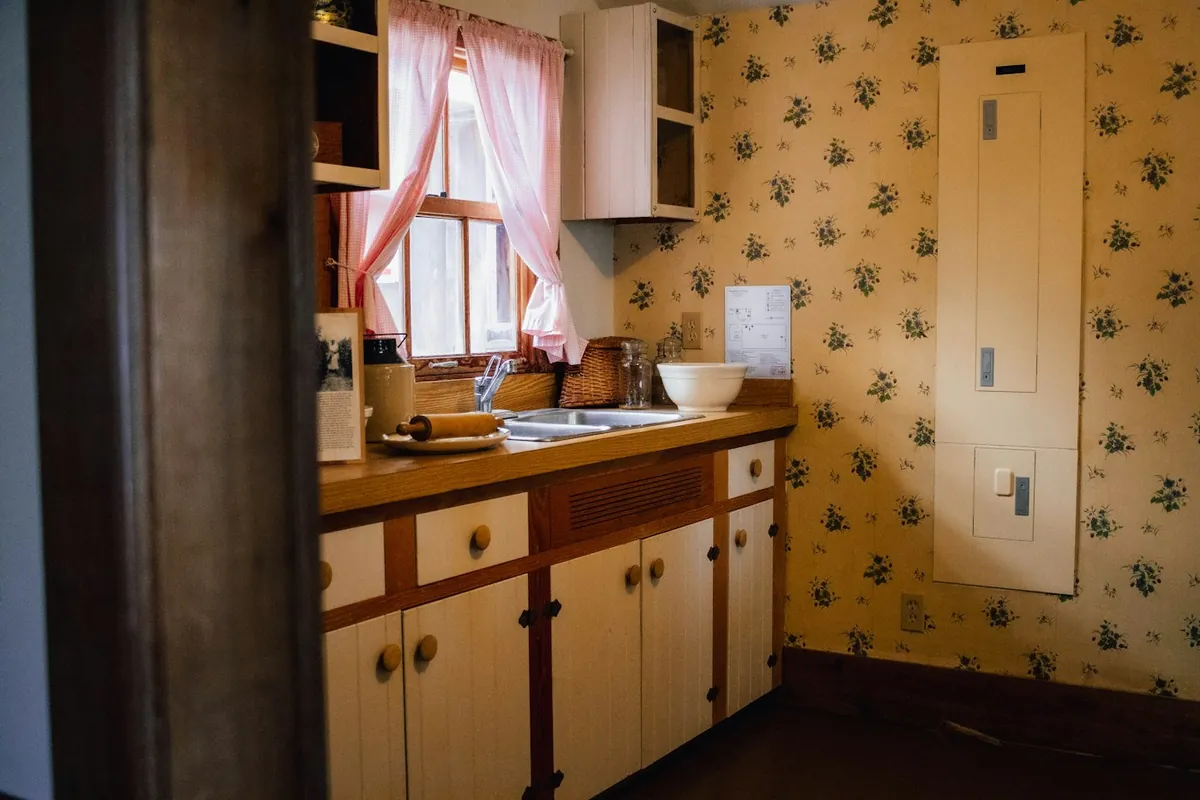
Costa Mesa incorporated in 1953 with 16,840 people and has 111,918 today, which means the federal lead-paint cut-off of 1978 falls directly through the city's main growth period. That single fact decides who is legally allowed to do a large share of the cabinet work in this city, and it is the most consequential thing on this page.
The Environmental Protection Agency sets out the background. In 1978 the federal government banned the sale of lead-based paint for use in homes, childcare facilities and preschools, and approximately three-quarters of the homes in the United States built before 1978 still contain some lead-based paint. The agency's position is that those homes are safe to live in while paint and surfaces are in good condition and kept clean, and that the hazard arises when painted surfaces are disturbed, because any renovation, repair or painting project in a pre-1978 home with lead-based paint can easily create dangerous lead dust.
Its Renovation, Repair and Painting Rule requires that anyone paid to perform work that disturbs painted surfaces in such homes be certified, and that their employees be trained, either as a certified renovator or on the job by one, in lead-safe work practices. The EPA states plainly that this includes all firms, even sole proprietorships, and names general contractors and special trade contractors including painters, plumbers, carpenters and electricians. Its published list of covered activities is remodeling and repair or maintenance, electrical work, plumbing, painting preparation, carpentry, and window replacement.
| Era | Relation to 1978 | Practical consequence |
|---|---|---|
| Pre-incorporation and 1950s | Well before | Assume the rule applies; certification and lead-safe practices expected |
| 1960s and 1970s tract | Mostly before | Assume the rule applies unless the build year is documented as 1978 or later |
| 1980s onward | After | Outside the rule entirely |
| Newer attached and multi-family near the commercial core | After | Outside the rule; association rules are the constraint instead |
Era framing from the city's own growth history: incorporated 1953 as a semi-rural farming community of 16,840, 111,918 residents at the 2020 Census. The 1978 boundary and all rule text are from the EPA's Renovation, Repair and Painting Program pages, read at source 30 September 2026.
There is a minor-work exemption and it is worth knowing exactly. The EPA excludes minor repair and maintenance activities that disturb six square feet or less of paint per room inside, or 20 square feet or less on the exterior. The note attached removes most cabinet jobs from it: window replacement and demolition of painted surfaces are always covered regardless of square footage. Taking an old painted kitchen off the walls of a 1958 Costa Mesa bungalow is demolition of painted surfaces.
The rule's default position runs the opposite way to how most people assume. Paint testing is not required, but unless you have documentation that the paint is not lead-based, the requirements of the rule apply. Where testing is done it must cover all surfaces affected by the work, and the agency restricts each method: EPA-recognised test kits to certified renovators, X-ray fluorescence instruments to certified lead-based paint inspectors or risk assessors, and paint chip sampling to a certified renovator, inspector or risk assessor. California is not one of the states authorised to operate its own programme, so the EPA administers it here directly, and the National Lead Information Center answers questions on 1-800-424-5323.
Costa Mesa Cost, Worked Through by Housing Type
The rates are the same across coastal Orange County; what changes between a 1955 bungalow and a 2005 townhouse is the run length, and that is what actually moves the total. Here is the arithmetic for three realistic Costa Mesa kitchens, using the published Los Angeles per-linear-foot band as the nearest printed benchmark to this county.
| Costa Mesa kitchen | Typical run | Low | High |
|---|---|---|---|
| Small post-war bungalow, single wall plus a short return | 15 linear feet | $7,500 | $22,500 |
| 1960s to 1970s tract, galley or L | 22 linear feet | $11,000 | $33,000 |
| Larger detached or townhouse with an island | 32 linear feet | $16,000 | $48,000 |
Per-linear-foot band from a published Los Angeles cabinet maker's cost guide, read at source 30 September 2026, used as the nearest published benchmark to Orange County. Countertops, appliances and any plumbing or electrical work are separate. Run lengths are typical for the housing type, not published figures.
The same published Los Angeles guide splits the market into tiers with an expected service life attached to each, which is a more useful frame than one average. It gives budget cabinetry at $75 to $150 per linear foot with a 5 to 10 year lifespan, semi-custom at $150 to $650 with 15 to 25 years, premium at $300 to $800 with 20 to 30 or more years, and luxury at $500 to $1,500 and up with 30 to 50 or more years. It also describes Los Angeles pricing as about 25 percent higher than the national figure it quotes of $400 to $1,200 per linear foot.
Against that, keeping the existing boxes is an order of magnitude cheaper rather than a percentage cheaper. Published Huntington Beach refacing estimates, which apply equally in Costa Mesa, put laminate refacing of a 12 cabinet kitchen at $1,576 to $2,482, or $131 to $207 per cabinet. Refinishing is published locally at $1,079 to $6,002, about $4 to $10 per square foot, and painting at $1,060 to $5,899 with labour around $70 to $120 per hour. If the carcasses in your 1970s tract kitchen are square and dry, that is where the value is.
Formaldehyde Limits on Every Panel Delivered
California sets numerical formaldehyde emission ceilings on the composite wood panels inside your cabinetry, and they differ by material, which makes the box specification an air-quality question as well as a durability one.
The California Green Building Standards Code requires that hardwood plywood, particleboard and medium density fibreboard composite wood products used on the interior or exterior of a building meet the formaldehyde requirements specified in the Air Resources Board's Air Toxics Control Measure for Composite Wood, at Title 17 of the California Code of Regulations section 93120 and following. Products not exempted must meet the limits the code prints, tested in accordance with ASTM E1333.
| Product | Current limit | Typical use in a cabinet |
|---|---|---|
| Hardwood plywood, veneer core | 0.05 | Sink bases, drawer boxes, premium carcasses |
| Hardwood plywood, composite core | 0.05 | Carcasses where cost outweighs screw holding |
| Particleboard | 0.09 | Melamine faced carcasses and shelving |
| Medium density fibreboard | 0.11 | Painted doors and fronts, the best paint substrate |
| Thin medium density fibreboard, maximum 5/16 inch | 0.13 | Carcass backs and drawer bottoms |
Limits from the California Green Building Standards Code, residential mandatory measures section 4.504.5, with the identical table printed at 5.504.4.5, read at source 30 September 2026. The use column is normal industry practice, not code text.
The code lists what an enforcing agency accepts as proof, and each item is something a Costa Mesa homeowner can ask for by name: product certifications and specifications, chain of custody certifications, or product labelled and invoiced as meeting the Composite Wood Products regulation. Exterior grade products may instead be marked to the PS-1 or PS-2 standards of the Engineered Wood Association, the Australian AS/NZS 2269 standard, or European 636 3S. Federal law under the Toxic Substances Control Act Title VI has separately required covered composite wood products to be labelled compliant by an EPA-recognised third-party certifier since 22 March 2019.
This check matters more in the attached and multi-family stock near the commercial core than anywhere else on this page, for a simple reason: those units are smaller and better sealed than a 1955 bungalow, so the same panel area sits in less air.
The One Certification Worth Asking About
Ask whether the cabinetry carries ANSI/KCMA A161.1 certification, because it is the only independent performance standard in cabinetry that a homeowner can check. Everything else in a quote is the supplier describing their own work.
The Kitchen Cabinet Manufacturers Association describes A161.1 as covering rigorous tests of structural strength, drawer and door integrity, and finish durability. It states that certified cabinets have passed 14 rigorous tests, including a 600-pound load test, to simulate a lifetime of use, and that between 40 and 50 percent of cabinets fail their first certification attempt. It also states that certified cabinets are available at every price point, from builder-grade units to high-end custom designs, and that it acts as a mediator to facilitate a resolution with the manufacturer where a homeowner has an issue with a certified cabinet.
Two further seals exist, and one of them is relevant to Costa Mesa specifically. KCMA's Severe Use Certification was, in its account, originally developed by the United States Department of Housing and Urban Development and provides confidence that kitchen cabinets can withstand the exceptionally high levels of wear that apartment building kitchens often encounter. In a city with a significant share of attached and rented housing, that is the more relevant benchmark for a unit that will turn over. The third seal, the Environmental Stewardship Program, certifies manufacturers adhering to sustainability practices.
How Long Cabinetry Lasts, and What That Means Here
Published life expectancy figures put the carcass as the long-lived part of a kitchen and the countertop as the short-lived one, which is the reverse of how most budgets are allocated.
| Component | Expected life |
|---|---|
| Closet shelves | A lifetime |
| Natural stone countertops | A lifetime |
| Garage and laundry cabinets | 100 or more years |
| Kitchen cabinets | Up to 50 years |
| Medicine cabinets | 20 or more years |
| Cultured marble countertops | About 20 years |
Source: NAHB and Bank of America Home Equity, Study of Life Expectancy of Home Components, February 2007, from a telephone survey of manufacturers, trade associations and researchers conducted in summer 2006.
The study attaches caveats that most citations drop. Many of the people interviewed emphasised that the life expectancy of housing components is greatly affected by the quality of maintenance, and noted that changing consumer preferences can result in products being replaced long before, or after, the end of their practical life expectancy. The study also states that life expectancies depend on the quality of installation, the level of maintenance, weather and climate conditions, and the intensity of use.
Read as a ranking rather than a guarantee, those numbers explain why so much cabinet work in Costa Mesa is box-keeping work. A kitchen from 1975 whose carcasses are sound is roughly halfway through a published 50 year expectancy, which is exactly the point at which replacing the face rather than the cabinet is the better use of money.
Wood Movement in Costa Mesa, With the Arithmetic
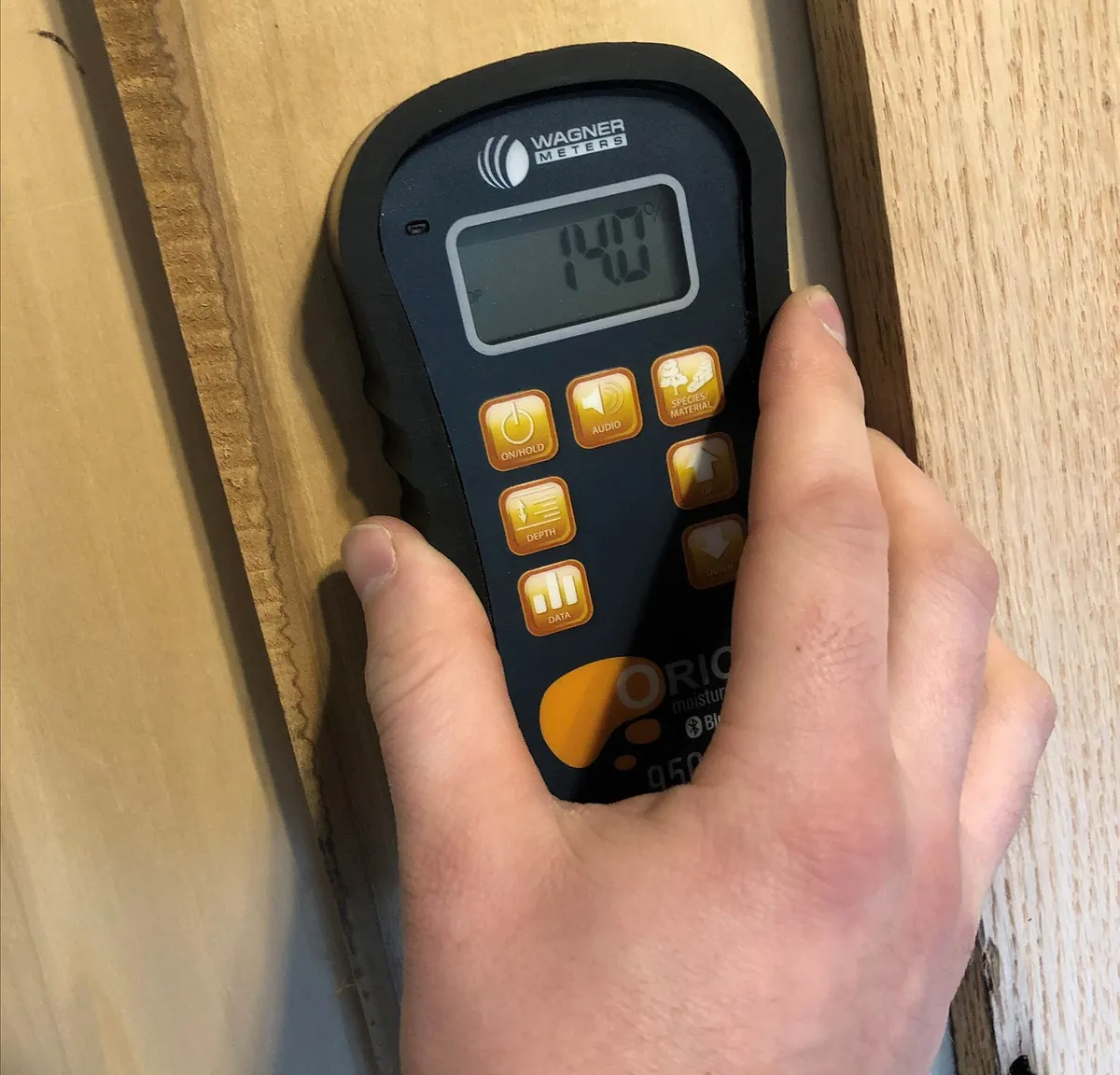
Costa Mesa sits one city inland from the ocean and in the same published moisture regime as the coast, which is unusually stable by national standards. The relevant figures are federal rather than promotional.
The USDA Forest Service Forest Products Laboratory Wood Handbook tabulates equilibrium moisture content for outside conditions at United States stations, based on average relative humidity and temperature data over 30 or more years from the National Climatic Data Center, averaging morning and afternoon values. The nearest listed station is Los Angeles, which runs 9.4, 10.2, 10.5, 10.4, 11.0, 11.7, 11.6, 11.2, 10.8, 10.6, 9.8 and 9.9 percent from January to December. That is a band of 2.3 percentage points, with the wettest months in summer.
The Handbook publishes a dimensional change equation, valid between 6 and 14 percent moisture content, in which the change equals the starting dimension multiplied by a species coefficient multiplied by the change in moisture content. Its own worked example is a flat-grained white fir board 9.15 inches wide at 8 percent moisture content changing by 9.15 x 0.00245 x 3, or 0.067 inches, at 11 percent. Applied to a cabinet-scale panel across the measured local band:
| Species | Tangential coefficient | Movement |
|---|---|---|
| Black cherry | 0.00248 | 0.137 in |
| Red alder | 0.00256 | 0.141 in |
| Black walnut | 0.00274 | 0.151 in |
| Northern red oak | 0.00304 | 0.168 in |
| Sugar maple | 0.00353 | 0.195 in |
| White oak | 0.00376 | 0.208 in |
| American beech | 0.00431 | 0.238 in |
Coefficients from Wood Handbook Table 13-5. Movement computed with the Handbook's own equation, 24 x coefficient x 2.3. The same sugar maple panel across Fresno's published 7.4 to 15.8 percent band moves 0.712 in.
The Handbook also states the shop target that follows from this, and it is the specification to ask for: hardwood and softwood lumber for furniture, cabinetry and millwork usually has a final moisture content of 6 to 8 percent and can be specified to be free of drying stresses. Its governing principle is to match the moisture content of lumber as closely as is practical to the equilibrium moisture content conditions in service. Since cabinetry arrives drier than the room here, it gains a little moisture and joints tighten, which is the favourable direction.
One caveat the Handbook attaches applies to Costa Mesa's newer attached housing in particular. Its recommended interior values are based on measurements in well-ventilated buildings without unusual moisture sources and without air conditioning, and in air-conditioned buildings moisture conditions depend largely on proper sizing of the air-conditioning equipment. A well-sealed air-conditioned townhouse is a slightly drier environment than the tabulated one.
The Contract, the Licence and the Deposit Cap
The statutory protections are state-level, so they read the same in Costa Mesa as anywhere in California, and they are the cheapest quality filter available to a homeowner.
On licensing, Business and Professions Code section 7048 exempts work from the licensing chapter only where the aggregate contract price for labour, materials and all other items is less than one thousand dollars, and only where the work does not require a building permit, describing that work as of casual, minor or inconsequential nature. Subdivision (b) voids the exemption where the work is part of a larger operation, or where a job has been split to evade the chapter, and subdivision (c) removes it from anyone who advertises as if licensed. A Costa Mesa kitchen will exceed one thousand dollars, so the exemption will not apply.
On money, section 7159 requires home improvement contracts over five hundred dollars to be in writing. Section 7159.5 caps the downpayment: if a downpayment will be charged, it shall not exceed one thousand dollars or 10 percent of the contract amount, whichever amount is less. The same section adds that except for a downpayment, the contractor shall neither request nor accept payment that exceeds the value of the work performed or material delivered. On a $20,000 Costa Mesa kitchen, 10 percent would be $2,000, so the lower of the two figures governs and the lawful maximum deposit is $1,000.
One provision surprises people. The three-day and five-day right to cancel notices required under section 7159 are not required where the contract is negotiated at the contractor's place of business, so a contract signed in a showroom carries no cooling-off window while the same contract signed at your kitchen table does. Costa Mesa has a lot of showrooms, which makes this worth knowing locally.
- C-6 licence number given in writing, and checked on the CSLB Check a License page
- Contract in writing, because any home improvement contract over five hundred dollars must be
- Deposit no greater than one thousand dollars or 10 percent, whichever is less
- Progress payments tied to work completed, not to a calendar
- EPA lead-safe firm certification confirmed if the house predates 1978
- Cabinetry invoiced as meeting the Composite Wood Products regulation
- Door and box line named, with its A161.1 certification status stated
Buying in a Showroom City
Costa Mesa has an unusually high concentration of home-improvement showrooms for a city of its size, because it contains part of the South Coast Plaza and John Wayne Airport edge city, described as one of the region's largest commercial clusters. That is genuinely useful if you want to see materials in person, and it introduces two specific things to watch that do not arise when somebody measures your kitchen first.
The first is the cancellation window, covered above: a contract negotiated at the contractor's place of business does not require the three-day or five-day right to cancel notice, so a showroom signature carries no cooling-off period. The second is that a showroom quote is usually drawn from nominal cabinet sizes rather than from your measured wall, which is exactly the situation in which filler strips multiply. In the older Costa Mesa stock, where walls lean and ceiling heights drift across a room, that is the difference between a kitchen that fits and one that gives three inches to trim along a single run.
Neither is a reason to avoid showrooms. Both are reasons to take a short list of questions with you, all of which can be answered from the published sources cited on this page.
| Question | Why it matters | Source of the standard |
|---|---|---|
| Is this quote from nominal sizes or from a measured survey? | Nominal sizing is where filler strips come from in older stock | Design practice, not a published standard |
| Which manufacturer and line, and is it A161.1 certified? | The only independent performance test in cabinetry | Kitchen Cabinet Manufacturers Association |
| Will the cabinetry be invoiced as meeting the Composite Wood Products regulation? | The code accepts exactly that wording as proof of the formaldehyde limits | California Green Building Standards Code |
| Is the deposit within one thousand dollars or 10 percent, whichever is less? | It is a statutory cap, not a negotiating position | Business and Professions Code 7159.5 |
| Is the C-6 licence number written on the contract? | It takes a minute to verify and cannot be verified later | Contractors State License Board |
| If the house predates 1978, is the firm EPA lead-safe certified? | Paid work disturbing paint in a pre-1978 home requires firm certification | EPA Renovation, Repair and Painting Rule |
| Am I signing here or at home? | The three-day and five-day cancel notices are not required at the contractor's place of business | Business and Professions Code 7159 |
Every source in the right column was read at its own source on 30 September 2026 and is quoted more fully in the guides linked from this site.
One last Costa Mesa specific note on scheduling rather than cabinetry. The city has a significant share of attached and multi-family housing, and many of those associations impose working-hours restrictions, elevator or access booking requirements, and rules on what may be altered in a common wall. None of that changes the cabinets. All of it changes the programme, so it belongs in the plan at the start rather than in an apology in week two.
Nearby Cities We Also Cover
Costa Mesa sits between Huntington Beach and Newport Beach on this site's map, and all three plus the rest of the coastal ring are covered as normal work: Huntington Beach, Newport Beach, Fountain Valley, Westminster, Seal Beach and Sunset Beach. The service area page lists everywhere else.