When Paint Is the Right Answer
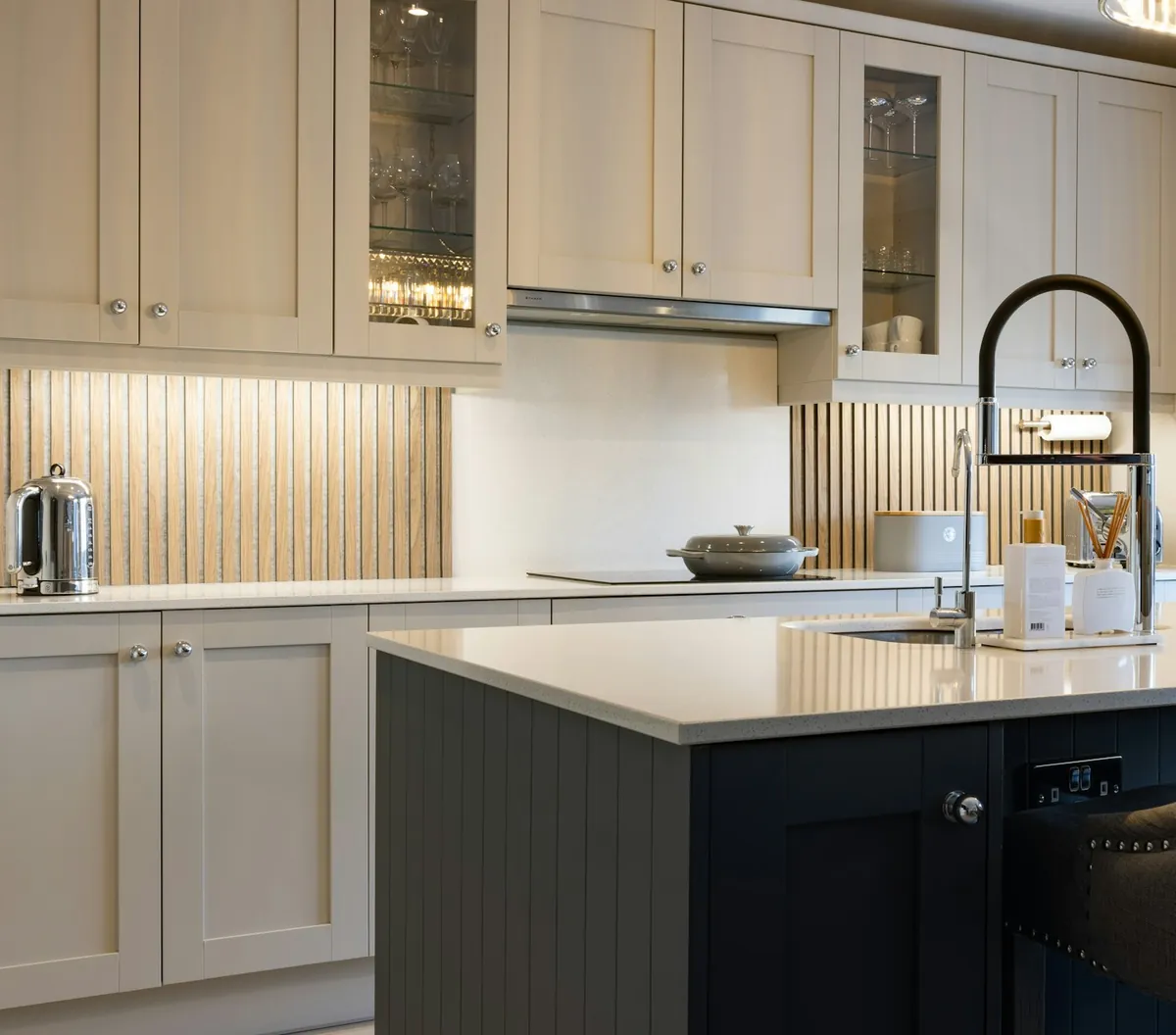
Paint when the boxes and doors are sound but the wood is not something you want to look at. That covers more kitchens than people expect: a run where a previous owner replaced three doors with a near-miss match, a kitchen with visible repairs, an orange-toned oak that has gone out of fashion, or simply a set of perfectly good doors in a colour that fights everything else in the house.
It is also the right answer when you want a dramatic change cheaply. Published Huntington Beach estimates put cabinet painting at $1,060 to $5,899, and at the lower end of that range nothing else in this trade transforms a room so completely for so little.
It is the wrong answer in exactly two situations. If the boxes are failing, paint puts a new surface on a dying cabinet. And if the actual problem is storage, reach or layout, paint leaves that problem entirely intact, which is an expensive way to remain frustrated.
Published Cabinet Painting Costs for Huntington Beach
Expect $1,060 to $5,899 for a kitchen, based on published estimates specific to this city. The same source gives labour at $70 to $120 an hour, depending on design, size and material, and puts materials, meaning primers, brushes, paints and sanding equipment, at up to $200 if bought independently. It also records 181 Huntington Beach cabinet painting projects quoted this year.
| Service | Result | Published local range |
|---|---|---|
| Painting | Opaque colour, grain hidden | $1,060 to $5,899, labour $70 to $120 per hour |
| Refinishing | New clear or tinted finish, grain visible | $1,079 to $6,002, about $4 to $10 per sq ft |
| Refacing, laminate | New doors and a new face skin | $1,576 to $2,482 for 12 cabinets |
| New doors and fronts | New doors on the existing face frame | Quoted per door and front |
All local figures from published Huntington Beach cost pages, read at source 30 September 2026.
What moves a painting quote inside that range is preparation, not paint. A set of flat slab doors in sound condition is at the bottom. A deeply profiled raised panel kitchen with heavy cooking residue, several repairs and a thermofoil section that needs a bonding primer is at the top, and the difference is almost entirely hours.
Identify the Substrate Before Anything Else
The primer is chosen by what is underneath, and choosing wrong is the single most common reason painted cabinets fail. Thermofoil, rigid foil and melamine are non-porous films, and ordinary primer has nothing to key into. Within months the finish lifts at an edge and then peels off in sheets, which is not a paint quality problem, it is a bonding problem.
| What the door is | How to spot it | Primer requirement |
|---|---|---|
| Solid timber | Continuous grain over the edge, corner joints visible | Standard cabinet primer; grain filling if a smooth result is wanted |
| Wood veneer on composite | Grain on the face, core visible at a chip | Standard primer, with care not to sand through the veneer |
| Thermofoil or rigid foil | A wrapped film with a seam on the back edge | A bonding primer made for slick surfaces, without exception |
| Melamine or printed laminate | A repeating pattern, white or brown core at a chip | A bonding primer, and realistic expectations about edges |
| MDF | No grain, dense uniform edge | Ideal for paint; seal the cut edges properly |
Grain filling, if you want a factory-smooth result
Paint does not fill open grain, it follows it. An oak kitchen painted without grain filling will be a white oak kitchen: the colour changes and the grain texture stays. Some people want that. Those who want the smooth, sprayed look of a modern painted kitchen need the grain filled first, which is extra hours and should appear in the quote as a line rather than as an assumption either way.
Preparation Is Most of the Job
Degrease before sanding, always. Kitchen cabinets carry cooking residue, especially around the range and above the hob, and sanding a greasy surface drives the grease into it rather than removing it. Every subsequent coat then sits on contamination, and the finish fails at exactly the places that get touched most.
- Doors, fronts and hardware removed and labelled by position before anything starts
- Thorough degreasing, particularly on the cabinets flanking the range and above the hob
- The existing finish keyed so the primer has a mechanical grip as well as a chemical one
- Holes, dents and old hardware positions filled and sanded flush where hardware is changing
- A primer matched to the substrate, and a bonding primer on anything foil or melamine faced
- Doors sprayed flat, both faces, rather than hung and sprayed vertically
- Full cure time before rehanging, not just dry-to-touch time
The cure question deserves its own line because it is where good work gets ruined at the last step. Cabinet coatings reach dry-to-touch quickly and full hardness slowly. Rehanging and loading the kitchen before the film has hardened is what causes fingerprints in the finish, dents from crockery, and the memorable failure where a door sticks to its frame and takes a patch of paint with it when opened.
The 275 Gram Limit That Applies in Huntington Beach
Huntington Beach sits inside the South Coast Air Quality Management District, and that caps what can legally be sprayed on your cabinets. For work done in your house, Rule 1113, Architectural Coatings, sets the limits, and the categories that apply to cabinet work are notable for carrying no small container exemption.
| Coating category | Grams of VOC per litre | Small container exemption |
|---|---|---|
| Wood coatings | 275 | None listed |
| Varnish | 275 | None listed |
| Sanding sealers | 275 | None listed |
| Lacquer | 275 | None listed |
| Stains, interior | 250 | Yes |
| Wood conditioners | 100 | None listed |
| Primers, sealers and undercoaters | 100 | Yes |
| Nonflat coatings | 50 | Yes |
| Flats | 50 | Yes |
Source: South Coast AQMD Rule 1113, Architectural Coatings, amended 5 February 2016, Table of Standards 1, grams of VOC per litre of coating less water and less exempt compounds.
Where the doors are taken away and sprayed in a shop, Rule 1136, Wood Products Coatings, applies instead. It caps clear and pigmented topcoats, primers, sealers and undercoats at 275 grams per litre, high-solids stains at 350 and low-solids stains, toners and washcoats at 120. Its definition of wood products names cabinets for the kitchen, bath and vanity explicitly, and it states that it does not apply to residential non-commercial operations, which is the honest reason a homeowner's own weekend spray job is not held to the same standard as a professional's.
The practical result is that professional cabinet painting here runs on waterborne systems: waterborne alkyd-urethane hybrids and two-component waterborne polyurethanes. Those are harder and more washable than the solvent products they replaced, so this is a constraint that improved the trade rather than limiting it. The finishing rules guide sets out both rules with their limit tables.
Choosing a Colour That Survives a Coastal Kitchen
Two practical constraints worth knowing before you fall in love with a swatch. The first is sunlight: west-facing kitchens in coastal Huntington Beach take serious afternoon sun, and strong colours fade unevenly where a run turns a corner and one face gets the light. The second is contrast: a very dark exterior against a pale melamine cabinet interior is visible every time a door opens, so interiors either get addressed too or get chosen to suit.
The third, which is not a constraint but is worth saying, is that a painted island in a different colour from the perimeter run is the most requested combination in this market and it works for a good reason: an island is a freestanding object seen from all sides, so a deliberate difference reads as design rather than as mismatch. The islands page covers the rest of that decision.