What Refinishing Actually Is
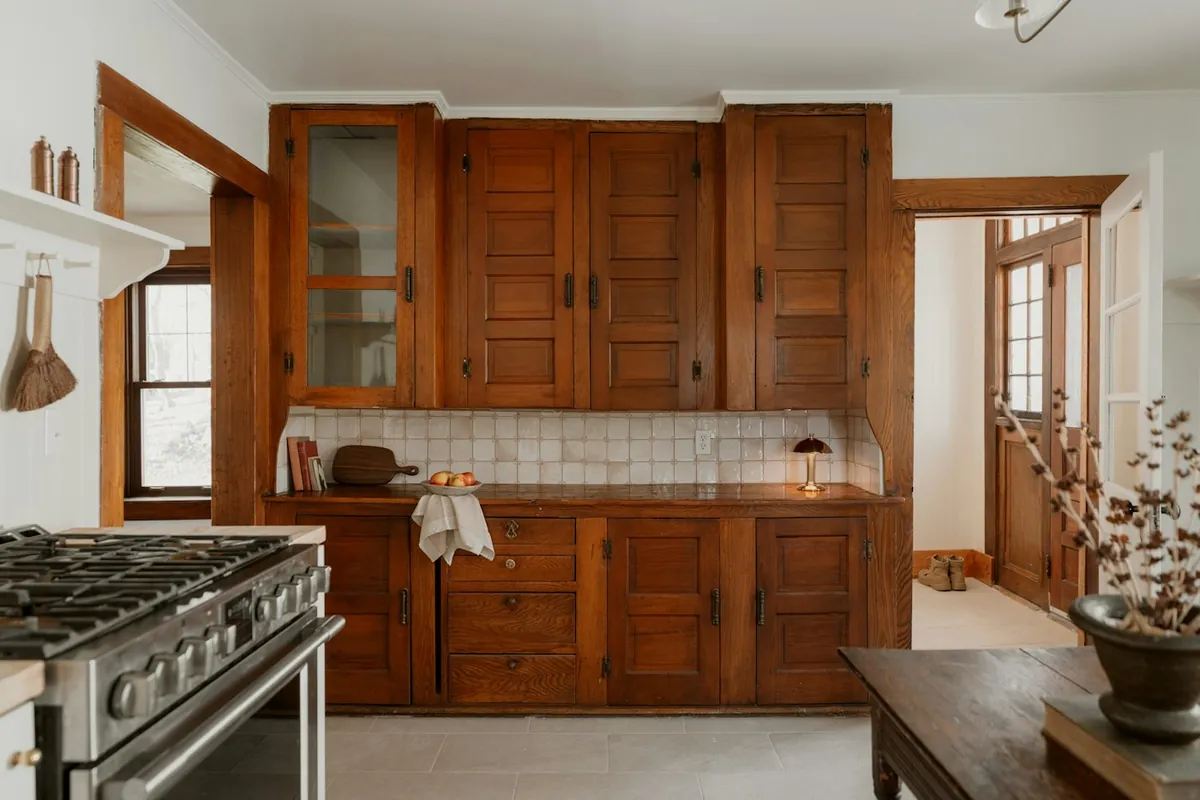
Refinishing replaces the coating and keeps the wood. That is the entire definition, and it is what separates refinishing from the three services people compare it to. Painting replaces the coating with an opaque one that hides the wood. Refacing replaces the doors and skins the frame. Replacement replaces the cabinets. Refinishing alone leaves the grain visible and looking better than it did.
That makes it the right answer for a specific and common situation: good wood under a tired finish. In Huntington Beach that describes a great many kitchens from the stained-oak and stained-maple eras, where the carcasses are sound, the doors are solid timber, and the only real problem is that the clear coat has worn through at every handle position and yellowed on the sun-facing wall.
Published Refinishing Costs for Huntington Beach
Expect $1,079 to $6,002 for a kitchen, or about $4 to $10 a square foot, based on published estimates for this city. The wide range reflects two things that genuinely vary by a factor of several: the total surface area being coated, and how much work the existing finish demands before anything new goes on.
| Service | Grain visible after? | Published local range |
|---|---|---|
| Refinishing | Yes | $1,079 to $6,002, about $4 to $10 per sq ft |
| Painting | No | $1,060 to $5,899, labour $70 to $120 per hour |
| Refacing, laminate | No, new surface entirely | $1,576 to $2,482 for 12 cabinets |
| Refacing, wood veneer | Yes, new veneer | $2,000 to $6,000 standard, $7,000 to $10,000 larger |
All figures from published Huntington Beach cost pages, read at source 30 September 2026.
What pushes a job towards the top of the range is profile depth and film thickness. A flat slab door with a thin worn coat can be scuffed and recoated. A deeply moulded raised panel door with a thick, cracking, decades-old film has to be chemically stripped, and every quirk of the profile has to be worked by hand. Those are the same service and very different amounts of labour.
The One Thing to Check Before Anything Else
Refinishing needs wood, and a lot of cabinet doors are not wood. Thermofoil, rigid foil, melamine and printed laminate are all films over a composite core, and stripping them does not reveal timber, it reveals particleboard. There is no version of refinishing that works on those.
| Door construction | Refinishable? | How to spot it |
|---|---|---|
| Solid timber | Yes, straightforwardly | Continuous grain across the edge, joints visible at the corners |
| Real wood veneer | Yes, carefully | Grain continues onto the edge only if edge banded in wood; core visible at a chip |
| Thermofoil or rigid foil | No | A wrapped film, usually with a seam on the back edge; softens near heat |
| Melamine or printed laminate | No | A repeating printed pattern; a chip shows white or brown core |
| Mixed kitchen | Partly | Common where a previous owner replaced some doors. Refinish the wood, replace or paint the rest |
Veneer is where jobs go wrong
Cabinet veneer is thin, and sanding through it cannot be reversed: once the core shows, the only fixes are a new door, a patch that will always be visible, or paint. That is why refinishing veneer is a chemical-stripping job with hand work rather than a machine-sanding job, and why the edges and corners get the lightest touch of all. A quote that does not distinguish between solid and veneered doors has not looked closely enough.
Preparation Is the Job
Almost all refinishing failures are adhesion failures, which means they were decided before the first coat went on. A finish that lifts at the handle positions within a year did not fail because the coating was cheap; it failed because the surface it went onto was contaminated, glossy, or carrying residue from a stripper that was not neutralised.
- Every door, front and piece of hardware removed and labelled by position
- Degreasing before sanding, not after, because sanding a greasy door drives the grease in
- Chemical stripping where the film is thick or the profile is deep, and full neutralisation afterwards
- Sanding to one consistent grit across the whole job, so the colour takes evenly
- Dust removal before sealing, which on a profiled door means more than a wipe
- A sealer coat appropriate to the substrate before any colour goes on
- Cure time respected, which is longer than dry time and is what stops early wear
The kitchen nearest the sink and the stove takes the worst of it, and those doors carry cooking residue that ordinary cleaning does not remove. Degreasing them properly is unglamorous, time-consuming and the difference between a finish that lasts and one that peels.
What You Can and Cannot Change
You can go darker, and you generally cannot go lighter. Stripping removes the film on top of the wood; it does not remove the stain that penetrated into it. A dark stained oak kitchen can be refinished to a different dark tone, or warmed, or cooled, but it cannot become pale natural maple.
Where a real lightening is wanted, there are two honest routes. Bleaching can lift colour out of some species, though results vary and it is not predictable on every timber. Or the kitchen gets painted, which covers the colour entirely and puts you in the painting service instead at a comparable published range.
There is a third option worth mentioning for mixed kitchens, which are common where a previous owner replaced part of a run: refinish the solid wood, and replace or paint the doors that are not wood. The doors and fronts page covers that half of the work.
The Coating Rules That Apply in Huntington Beach
Refinishing is usually done at least partly on site, which puts it under South Coast AQMD Rule 1113, Architectural Coatings. That rule caps wood coatings, varnish, sanding sealers and lacquer at 275 grams of volatile organic compounds per litre each, interior stains at 250, wood conditioners at 100, and primers, sealers and undercoaters at 100.
| Coating category | Grams per litre | Small container exemption |
|---|---|---|
| Wood coatings | 275 | None listed |
| Varnish | 275 | None listed |
| Sanding sealers | 275 | None listed |
| Lacquer | 275 | None listed |
| Wood conditioners | 100 | None listed |
| Stains, interior | 250 | Yes |
| Primers, sealers and undercoaters | 100 | Yes |
Source: South Coast AQMD Rule 1113, Architectural Coatings, amended 5 February 2016, Table of Standards 1. Note that the four wood-specific categories carry no small container exemption, unlike most categories in the same table.
The practical effect is that professional refinishing here runs on waterborne systems, particularly waterborne conversion varnishes and two-component waterborne polyurethanes, rather than on traditional solvent lacquer. That is a better kitchen finish in durability terms anyway, but it is worth knowing that it is the rule book rather than fashion driving it. Where doors are taken away and finished in a shop, Rule 1136 applies instead, with the same 275 gram ceiling on clear and pigmented topcoats.
The finishing rules guide sets out both rules and the categories that apply to cabinets, and the three-way comparison works through which surface service suits which kitchen.
Why Refinished Cabinets Do Well on This Coast
A finish on wood has to tolerate the wood moving underneath it, and on the Orange County coast the wood barely moves. The USDA Forest Products Laboratory Wood Handbook puts the nearest listed station to Huntington Beach, Los Angeles, between 9.4 and 11.7 percent equilibrium moisture content across a full year, a band of 2.3 points. Fresno swings across 8.4 points, Chicago across 2.8 from a much higher base, and Las Vegas across 4.6 from a much lower one.
Small movement means less stress at the panel shoulders, which is where a clear finish on a framed door cracks first. It is one of the quiet advantages of doing this work here, and it is a genuine, measurable one rather than a marketing claim. The coastal moisture guide runs the numbers.