The Axis Nobody Compares Species On
Wood moves across its grain when its moisture content changes, and how far it moves per percentage point is a published property of the species. That number, rather than colour or figure, is what decides whether a framed door stays tight, whether a mitre opens, and whether a wide panel shows a bare line at its shoulder in a dry month.
The USDA Forest Products Laboratory publishes these figures as dimensional change coefficients in Table 13-5 of the Wood Handbook, separately for the radial direction, which is roughly quarter-sawn, and the tangential direction, which is roughly flat-sawn. They are valid between 6 and 14 percent moisture content, which covers every condition a cabinet in a house will ever see.
| Species | Radial (quarter-sawn) | Tangential (flat-sawn) |
|---|---|---|
| Cherry, black | 0.00126 | 0.00248 |
| Alder, red | 0.00151 | 0.00256 |
| Walnut, black | 0.00190 | 0.00274 |
| Ash, white | 0.00169 | 0.00274 |
| Maple, red (soft) | 0.00137 | 0.00289 |
| Poplar, yellow | 0.00158 | 0.00289 |
| Red oak, northern red | 0.00137 | 0.00304 |
| Maple, sugar (hard) | 0.00165 | 0.00353 |
| White oak, white | 0.00194 | 0.00376 |
| Hickory, true | 0.00259 | 0.00411 |
| Beech, American | 0.00190 | 0.00431 |
| Douglas-fir, Coast-type | 0.00165 | 0.00267 |
| Redwood, old-growth | 0.00120 | 0.00205 |
| Cedar, incense | 0.00112 | 0.00180 |
Source: USDA Forest Service, Wood Handbook FPL-GTR-282, Chapter 13, Table 13-5, dimensional change coefficients for shrinking or swelling within moisture content limits of 6 to 14 percent, based on the dimension at 10 percent moisture content.
What Those Numbers Mean Here
Coefficients on their own are abstract. They become useful when multiplied by the moisture swing a cabinet will actually experience, and on this coast that swing is unusually small.
The Wood Handbook publishes month-by-month equilibrium moisture content for US locations in Table 13-1. The nearest listed station to Huntington Beach is Los Angeles, in the same coastal marine layer regime, and its twelve readings are 9.4, 10.2, 10.5, 10.4, 11.0, 11.7, 11.6, 11.2, 10.8, 10.6, 9.8 and 9.9 percent. The whole year fits inside 2.3 points.
The Handbook's Equation 13-3 gives the arithmetic: change in dimension equals the starting dimension multiplied by the coefficient multiplied by the change in moisture content. Applying it to a 24 inch flat-sawn panel across a 2.3 point band gives the following. This multiplication is ours; the coefficients and the moisture data are published.
| Species | Tangential coefficient | Movement over 2.3 points |
|---|---|---|
| Cherry, black | 0.00248 | 0.137 in |
| Alder, red | 0.00256 | 0.141 in |
| Walnut, black | 0.00274 | 0.151 in |
| Maple, red (soft) | 0.00289 | 0.160 in |
| Red oak, northern red | 0.00304 | 0.168 in |
| Maple, sugar (hard) | 0.00353 | 0.195 in |
| White oak, white | 0.00376 | 0.208 in |
| Hickory, true | 0.00411 | 0.227 in |
| Beech, American | 0.00431 | 0.238 in |
Our arithmetic from Equation 13-3 and the Table 13-5 coefficients, applied across the 9.4 to 11.7 percent band recorded for Los Angeles in Table 13-1. A real panel in a conditioned house will see less than the full outdoor swing.
The headline is the spread: from 0.137 inches for cherry to 0.238 inches for beech, a difference of a tenth of an inch across a 24 inch panel. That is real but it is not large, and it is the reason species selection on this coast can be driven by appearance and budget rather than by anxiety.
For contrast, the same panel two hundred miles inland
Fresno's recorded band runs from 7.4 percent in July to 15.8 in January, a swing of 8.4 points. A 24 inch flat-sawn sugar maple panel over that band moves 24 x 0.00353 x 8.4, which is 0.712 inches. That is more than three and a half times the coastal figure, and it is why inland Californian kitchens open mitres and gap panel shoulders in a way that coastal ones largely do not.
The Species, One by One
Hard maple
Dense, pale and close-grained, with a tangential coefficient of 0.00353. It takes a clear finish beautifully and a stain unevenly, which is why blotch control matters on maple more than on most timbers. It is hard enough to resist knocks well and is one of the most popular cabinet timbers in the country for good reason.
Soft maple
Slightly more stable than hard maple at 0.00289 tangentially, considerably easier to machine, and frequently used as paint-grade stock. Structurally adequate for cabinet work in every normal position, and a sensible economy where the surface is going to be painted.
Red oak
Open-grained, strongly figured, and at 0.00304 tangentially more stable than hard maple. The open grain is the defining characteristic: it takes stain readily and unevenly in a way people either like or do not, and it telegraphs through paint unless the grain is filled first. Enormous quantities of Orange County housing stock have red oak kitchens from the 1980s and 1990s.
White oak
Denser and more closed than red oak, with a tangential coefficient of 0.00376 that is higher than red oak's. Quarter-sawn white oak, at 0.00194 radially, is one of the classic stable cabinet materials and shows the characteristic ray fleck that makes it instantly recognisable.
Red alder
Stable at 0.00256 tangentially, even-toned, moderately soft and very well behaved under a stain. Its softness is the trade-off: alder dents more easily than maple or oak, which matters on a drawer front at knee height and matters much less on an upper door.
Black cherry
The most stable of the popular cabinet hardwoods at 0.00248 tangentially, and the one with the most distinctive ageing behaviour: cherry darkens substantially with light exposure over the first year or two. In a west-facing coastal Huntington Beach kitchen that darkens unevenly if part of a run is shaded, which is worth knowing before specifying it.
Black walnut
Stable at 0.00274 tangentially, dark, and expensive. It is the species most often used for a contrasting island against painted perimeter cabinets, which is the most requested combination in this market. Unlike cherry, walnut tends to lighten slightly rather than darken.
Hickory
The least stable common cabinet timber on this list at 0.00411 tangentially, and the hardest. Its dramatic colour variation between heartwood and sapwood is either the point or the problem depending on taste, and its movement means wide flat-sawn hickory panels need more design allowance than most.
Yellow poplar
Paint grade, and good at it. At 0.00289 tangentially it is comparable to soft maple, it machines cleanly, and it holds a crisp profile. Its greenish and purplish streaks make it unsuitable for a clear finish, which is precisely why it is inexpensive.
The Shop Target, and Why It Matters More Than Species
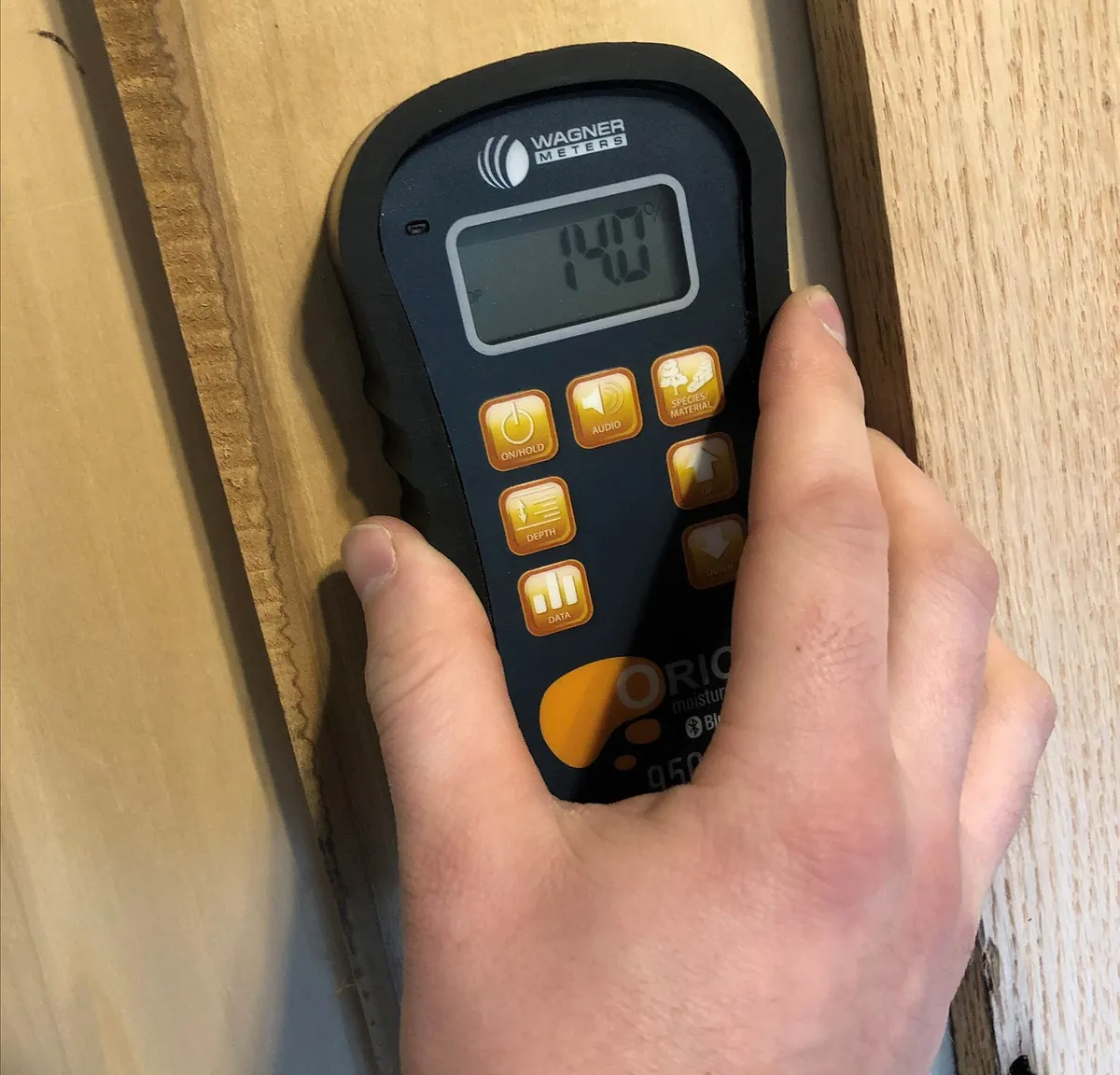
The Wood Handbook is explicit about the working figure: "Hardwood and softwood lumber for furniture, cabinetry, and millwork usually has a final moisture content of 6% to 8% and can be specified to be free of drying stresses." Elsewhere it states that hardwood lumber for furniture, flooring, cabinets and millwork "is usually dried to 6% to 8% moisture content" and that softwood for the same uses is dried to 7 to 9 percent.
It also gives the underlying principle in one line: "Match the moisture content of lumber as closely as is practical to the equilibrium moisture content (EMC) conditions in service." A door built from wood at 12 percent and installed into a house that holds it at 8 will shrink after installation regardless of species, and that shrinkage will be larger than the difference between any two species on this page.
| Use | Most areas of the US | Dry south-western area | Damp, warm coastal area |
|---|---|---|---|
| Interior: woodwork, flooring, furniture, wood trim | 8% average, 6 to 10% individual | 6% average, 4 to 9% | 11% average, 8 to 13% |
| Exterior: siding, trim, sheathing, laminated timbers | 12% average, 9 to 14% | 9% average, 7 to 12% | 12% average, 9 to 14% |
Source: USDA Forest Service, Wood Handbook FPL-GTR-282, Chapter 13, Table 13-2. The three zones are mapped on the chapter's Figure 13-1, which is an image we have not read, so this site does not claim which zone Huntington Beach falls in. The measured Los Angeles Table 13-1 row above is the local fact we rely on instead.
How to Actually Choose
- Decide painted or stained first, because that eliminates most of the list immediately
- If painted, consider MDF for the doors and poplar or soft maple for any solid components
- If stained, choose on grain character and colour, since movement differences are small on this coast
- Check the widest single panel in the design, because that is where movement actually shows
- Ask for quarter-sawn material on any wide panel if you want the stability, and expect to pay for it
- Confirm the shop's moisture target, which should be 6 to 8 percent
- On a west-facing kitchen, ask how the species you have chosen behaves under sustained sun
The sun question is not incidental in this city. Coastal Huntington Beach living space takes real afternoon sun, and cherry in particular darkens visibly over the first year. That is a characteristic rather than a defect, and it is easier to accept when it was expected.
The door styles guide covers how the door profile interacts with species choice, and the coastal moisture guide goes further into the local climate data. The Wood Handbook chapter itself is at the USDA Forest Service research library.
What Species Choice Does to the Price
Species is a smaller lever on a cabinet quote than most people expect, because the timber in a kitchen is mostly doors, face frames and drawer boxes rather than whole carcasses. Paint-grade poplar and figured walnut are worlds apart per board foot, and the difference they make to a finished kitchen total is real but rarely dominant.
The bigger levers sit elsewhere. Run length sets the scale of everything. The split between drawer bases and door bases moves the per-foot rate considerably, because every drawer carries a box, two runners and a front. Door style changes machining time and finishing area. Species comes after all three, which is why choosing on appearance is usually the right approach rather than an indulgence.
One genuine exception is a wide solid panel in an expensive timber. A run of tall doors in figured walnut is a large area of a costly material, and that is the specification where species does start to dominate the number. If that is the look you want, it is worth pricing a veneered version of the same panel alongside it: veneer gives the same face with far less material cost, and on a wide panel it is also more stable than solid wood.
Three Species Mistakes Worth Avoiding
1. Painting an open-grained species without filling the grain
Paint follows grain rather than filling it. A red oak kitchen painted without grain filling becomes a white oak kitchen: the colour changes and the texture stays exactly where it was. Some people want that, and plenty do not, so it should appear in the quote as a decision rather than as an assumption either way.
2. Expecting maple to take a stain evenly
Hard maple is dense and close-grained, which is why it finishes beautifully under a clear coat and blotches under a stain unless the finisher controls for it. A conditioner or a dye-based approach handles it, but it is work, and a quote that assumes maple will stain like oak is a quote that has not been thought through.
3. Forgetting that cherry darkens
Black cherry changes colour substantially with light exposure over the first year or two, and in a west-facing coastal Huntington Beach kitchen it will do so unevenly if part of the run sits in shade. That is a characteristic of the timber rather than a defect, and it is far easier to live with when it was expected rather than discovered.