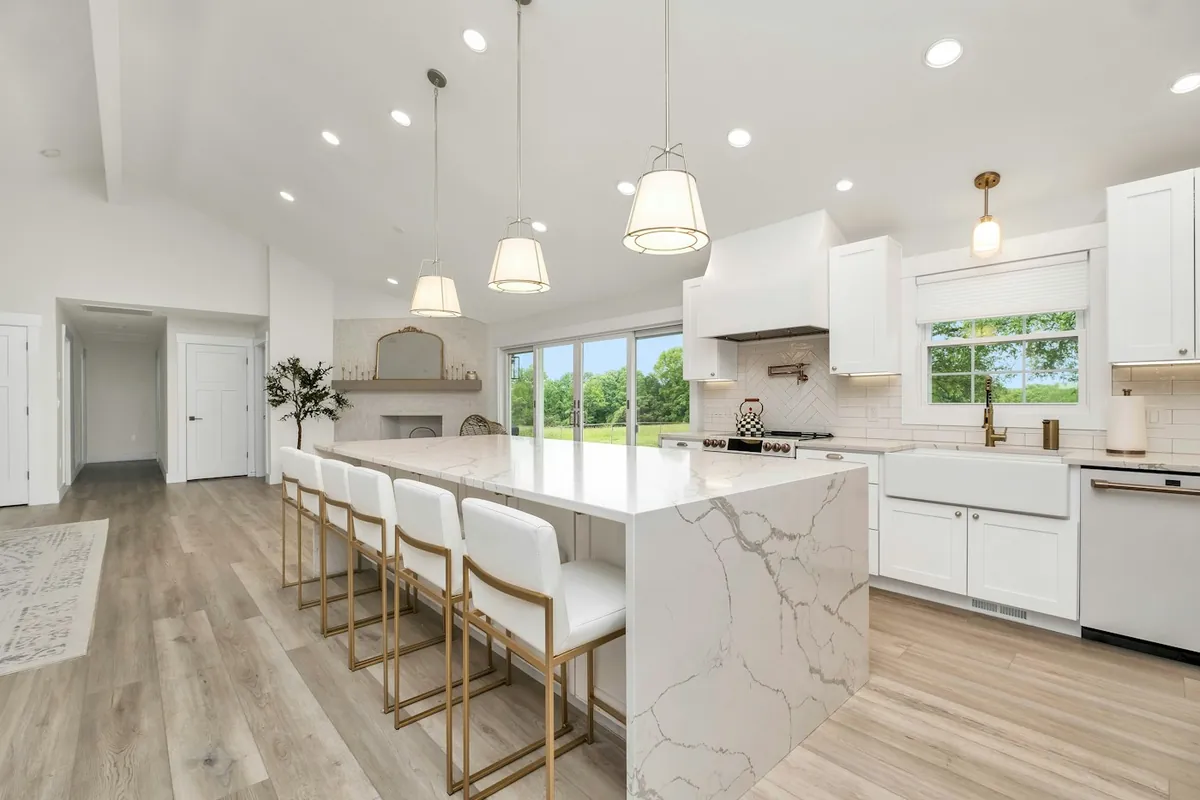
What the 10 by 10 Kitchen Actually Is
The 10 by 10 is a comparison device, not a kitchen. It describes an L-shaped layout in a notional 10 foot by 10 foot room containing roughly 20 linear feet of cabinet run, and it exists so that quotes from different suppliers can be compared on a common basis.
That makes it genuinely useful and quietly misleading at the same time. Useful, because 20 linear feet is a defensible middle figure and multiplying it by a published rate produces a number you can reason about. Misleading, because people assume it describes their own kitchen when very often it does not, and because different suppliers fill their 10 by 10 with different cabinets.
The Arithmetic, at 20 Linear Feet
The published national bands are installed cost per linear foot. Multiplying each by 20 gives the following. This multiplication is ours; the per-foot inputs are published.
| Tier | Published rate per linear foot | x 20 linear feet |
|---|---|---|
| Stock | $75 to $400 and up | $1,500 to $8,000 |
| Semi-custom | $150 to $900 and up | $3,000 to $18,000 |
| Custom | $500 to $1,400 and up | $10,000 to $28,000 |
Per linear foot inputs: Thumbtack, Cost to install kitchen cabinets, last updated 8 July 2026, read at source on 30 September 2026. The multiplication is our own arithmetic. The page states explicitly that the three tiers are quoted per linear foot, not per cabinet.
| Basis | Rate per linear foot | x 20 linear feet |
|---|---|---|
| Los Angeles area custom | $500 to $1,500 | $10,000 to $30,000 |
| Los Angeles area semi-custom tier | $150 to $650 | $3,000 to $13,000 |
| Los Angeles area premium tier | $300 to $800 | $6,000 to $16,000 |
| Los Angeles area budget tier | $75 to $150 | $1,500 to $3,000 |
Per linear foot inputs from a Los Angeles cabinet maker's published 2026 cost guide, read at source 30 September 2026. The multiplication is ours. Labelled as a Los Angeles area range, not an Orange County measurement.
The two tables agree more than they disagree, which is reassuring: the national custom band of $10,000 to $28,000 and the Los Angeles custom band of $10,000 to $30,000 land in almost the same place. That overlap is the strongest evidence on this page that the numbers are roughly right.
Use your own number instead
The whole point of a per-foot rate is that it scales. Measure your run, pick a tier, and multiply.
| Run length | At $500 per foot | At $1,000 per foot | At $1,500 per foot |
|---|---|---|---|
| 12 linear feet | $6,000 | $12,000 | $18,000 |
| 16 linear feet | $8,000 | $16,000 | $24,000 |
| 20 linear feet | $10,000 | $20,000 | $30,000 |
| 25 linear feet | $12,500 | $25,000 | $37,500 |
| 30 linear feet | $15,000 | $30,000 | $45,000 |
| 35 linear feet | $17,500 | $35,000 | $52,500 |
Our arithmetic from the published Los Angeles per linear foot band. The 15, 25 and 35 foot rows match the project totals the same source publishes directly, which is a useful check that the method is the one the source intends.
How to Measure Your Own Run Length
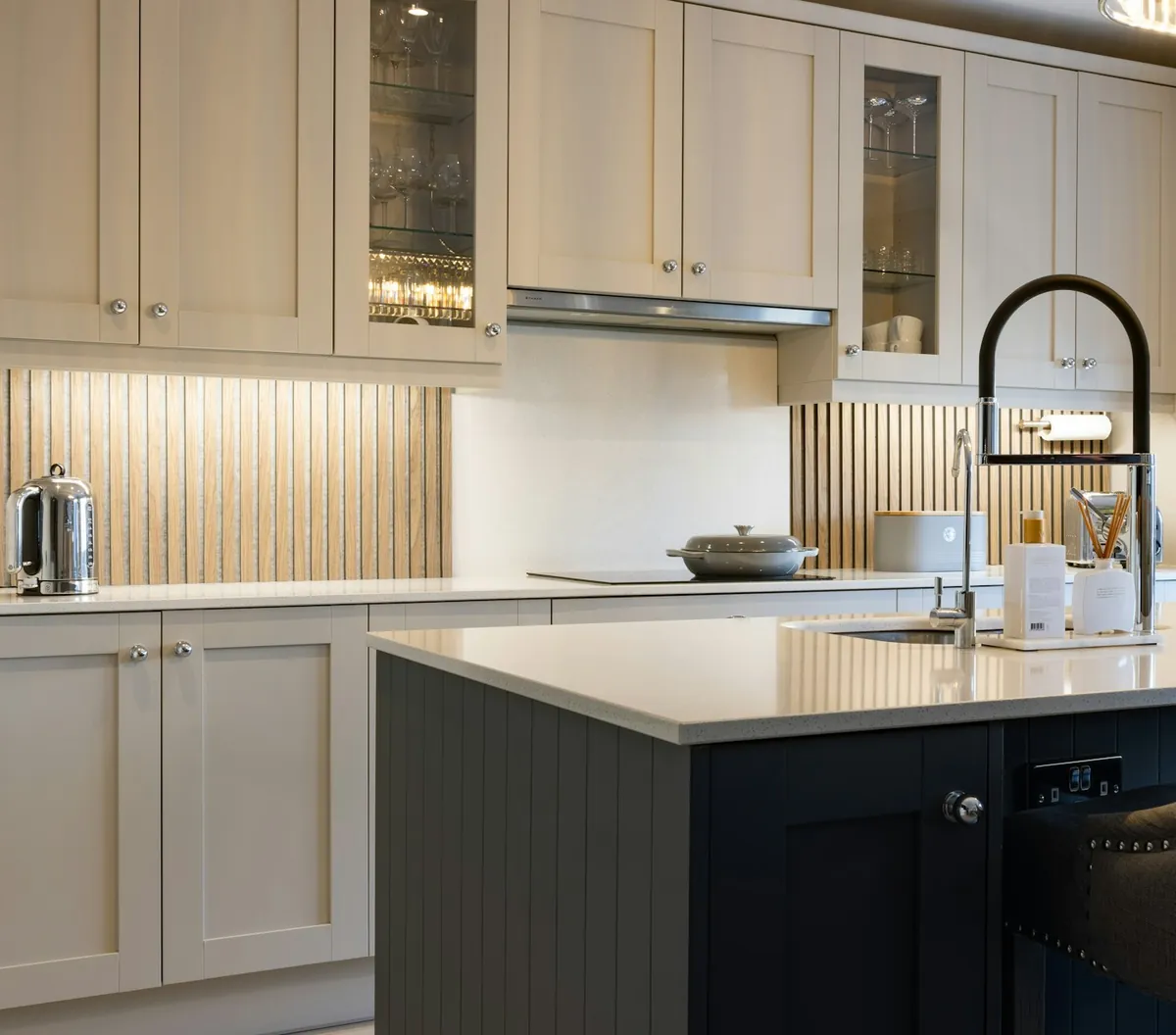
Ten minutes with a tape will tell you more about your likely cabinet cost than any amount of reading averages. The convention is straightforward once stated.
- Measure along the base cabinets at counter height, wall by wall
- Add the wall totals together to get the total run
- Count appliance gaps under 30 inches, because those positions still need cabinetry either side and a counter over them
- Skip a refrigerator opening wider than 30 inches, since no cabinet occupies it
- Add the perimeter of any island or peninsula, which is cabinet run like any other
- Do not measure wall cabinets separately; the convention counts the run once
- Write the number down, because you will want it for every quote you compare
A useful sanity check: if your total comes out under 12 feet, you have a small galley and published averages will overstate your cost significantly. If it comes out over 30, you have a large kitchen and published averages will understate it. Either way the per-foot method still works, which is why it is the one worth using.
Why 20 Feet Overstates a Lot of Huntington Beach Kitchens
Most of Huntington Beach's housing is single-storey tract construction from the era when the city grew from an oil and agriculture town into the fourth most populous city in Orange County. The city has 78,003 housing units at an average density of 2,446.5 per square mile, and density at that level means compact footprints.
The original kitchens in that stock are frequently 12 to 16 linear feet, and several factors have shortened them further since. Kitchens drawn around a 1960s appliance list assumed a 30 inch range, a shallow refrigerator and often no dishwasher. Every modern substitution, a counter-depth refrigerator, a 36 inch range, an integrated dishwasher, eats into the cabinet run on both sides.
The practical consequence for a homeowner here is encouraging: published averages assuming 20 linear feet will usually overstate what a straightforward Huntington Beach kitchen costs, and the difference between tiers at 14 feet is much smaller in absolute dollars than it is at 20. The kitchen cabinets page goes into the layout problems specific to this stock.
Why Two 10 by 10 Quotes Can Differ by Thousands
Because each supplier's 10 by 10 contains a different set of cabinets, and because different quotes include different add-ons. Both effects are large.
The cabinet schedule
A 10 by 10 built mostly from door bases costs considerably less than one built mostly from drawer bases, because every drawer carries a box, two runners and a front. A supplier quoting a cheap 10 by 10 is often quoting the door-heavy version, which is a perfectly honest thing to do and a completely different product from the drawer-heavy one.
The add-ons
| Item | Published figure |
|---|---|
| Installation, per cabinet box | About $100 |
| Installer labour, per linear foot | $50 to $70 |
| Crown moulding | About $70 per 8 ft section |
| Finished end panel | $100 to $200 each |
| Removal of existing cabinets | About $300 |
Source: Thumbtack, Custom cabinet cost and Cost to install kitchen cabinets, both last updated 8 July 2026.
Add crown along 20 feet, two finished end panels and removal of the existing kitchen, and a quote gains several hundred dollars without a single cabinet changing. That is most of the reason apparently identical quotes are not identical.
What Is Never in a Cabinet Price
Countertops, appliances, sinks, taps, flooring, lighting, plumbing and electrical work. Those are separate trades with separate pricing, and on a full kitchen they frequently add up to more than the cabinetry does.
Published national figures for a standard kitchen's cabinets by material give some sense of the cabinet-only share: $5,000 to $25,000 for solid wood, $1,900 to $13,000 for wood veneer and $4,000 to $15,000 for laminate. Those whole-kitchen figures sit alongside the per-foot ones rather than replacing them, and the wide internal spread is another reminder of how differently sized a standard kitchen can be.
What to Do With This Number
Use it as a filter rather than as a budget. If your run length times the custom band lands somewhere you are comfortable with, get quotes at that tier. If it lands well outside, the productive move is not to squeeze the rate but to look at the tier and the schedule: the tier comparison guide sets out where each one stops being able to help.
And if the kitchen's boxes are sound and only the face is wrong, the cheapest path is not a cheaper tier at all. Published Huntington Beach figures put laminate refacing at $1,576 to $2,482 for a 12 cabinet kitchen, which is a fraction of any figure in the tables above. The refacing cost guide works through whether your kitchen qualifies.
Two Things the 10 by 10 Deliberately Ignores
1. Ceiling height
The reference layout says nothing about how tall the wall cabinets are, and that changes the price meaningfully. A run of wall cabinets taken to an eight foot ceiling contains more panel, more door area and more finishing surface than a standard-height run with a gap above it. In Huntington Beach, where most of the single-storey stock has eight foot ceilings, taking cabinets to the ceiling is usually the right call and it is not free.
2. The tall run
Pantry cabinets and oven housings are tall cabinets, and a linear foot of tall cabinet contains far more material than a linear foot of base plus wall. A 10 by 10 with a tall pantry run in it is a more expensive kitchen than one without, at the same measured linear footage. When comparing quotes, check whether both include the same tall units.
A Sanity Check You Can Run on Any Quote
Divide the quoted cabinet total by your measured run length. That gives you a per linear foot figure you can compare directly against the published bands, and it is the fastest way to tell whether a quote is in the right universe.
| Result per linear foot | What it suggests |
|---|---|
| Under $150 | Stock, or a quote that excludes installation |
| $150 to $400 | Stock installed, or semi-custom excluding installation |
| $400 to $900 | Semi-custom installed, or entry custom |
| $900 to $1,500 | Custom installed, consistent with the published Los Angeles band |
| Over $1,500 | Luxury specification, an unusual species, or a scope that includes more than cabinets |
Our interpretation of the published national and Los Angeles area bands. A figure outside these is not automatically wrong, but it is worth asking what the quote includes before assuming it is.
The most common reason a divided-out figure looks too low is that installation is not in the quote, and installer labour is published nationally at $50 to $70 per linear foot. The most common reason it looks too high is that the quote includes countertops, appliances or a whole remodel rather than cabinets alone. Both are answered by asking what is in the scope rather than by arguing about the rate.